

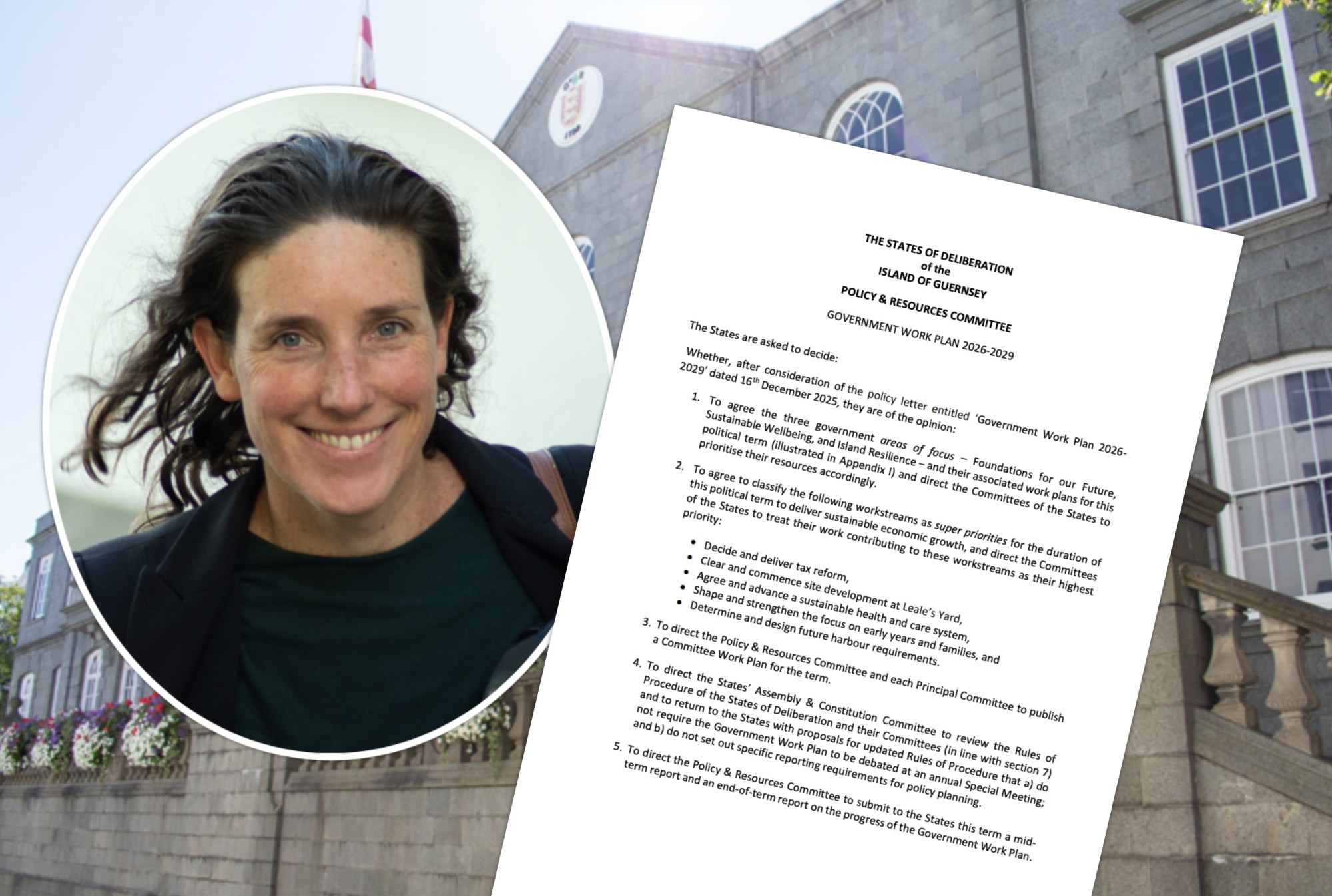
Guernsey’s Government Work Plan is the States’ blueprint for what it intends to prioritise and deliver over the next political term… from finally delivering tax reforms to working out how to sustainably fund healthcare, Express breaks down the key elements.
Covering the period 2026 to 2029, the 36-page plan sets out where resources, time and political focus should be concentrated in response to what it describes as growing pressures on housing, infrastructure, public finances, health and care, and other long-term island challenges.
According to the policy letter, the GWP “outlines the States of Guernsey’s priority workstreams for this political term” and is designed to “focus resources on the Island’s greatest challenges, both now and those in the future”.
The plan is structured around three overarching areas of focus:
- Foundations for Our Future
- Island Resilience
- Sustainable Wellbeing
However, the Policy & Resources Committee said that while these areas provide breadth, they do not on their own create enough focus. To address this, five specific areas have been designated as “super priorities”. These are described as the States’ “highest priority” commitments for the term.
Video: Chief Minister and P&R President Deputy Lindsay de Sausmarez provides an overview of the GWP.
These super priorities are “not abstract goals but concrete commitments against which progress can be measured”, the GWP says, and are intended to help the public “hold government accountable for progress on the issues that matter most”.
So… what are the five ‘super priorities’?
1. Decide and deliver (long-awaited) tax reform
Tax reform has been identified as a super priority because the States have been operating with what the policy letter describes as a “structural imbalance”, with spending exceeding income for several years.
The document states that this approach – relying on reserves to cover the gap – is “not sustainable”, particularly with “increasing demands on pensions, health, children and long-term care, alongside the need to invest in critical infrastructure and housing”.
This super priority commits the States to “making a definitive decision on tax reform and implementing agreed changes to taxation and social security during this term” to provide “fiscal stability and the funding required to progress other important workstreams and protect essential services”.
2. Make significant progress on Leale’s Yard
The GWP names clearing and commence site development at Leale’s Yard as another “super priority”.
Purchased by the States in August 2025, the area is described as “a key development site in St Sampson’s with significant wider regeneration potential”.
Under this super priority, the States aim to demolish and clear the site, develop a detailed plan, establish enabling infrastructure and begin housing construction during this political term.
A VIEW FROM THE P&R PRESIDENT
“We’ve talked with and listened to our colleagues across the different committees and finalised our proposals for the Government Work Plan, which we believe are an accurate summary of the States’ priorities overall,” Deputy Lindsay de Sausmarez, President of the Policy & Resources Committee, said.
“One of the criticisms of the GWP last term was that it listed so many workstreams that left us without clarity on what the priorities actually were. With this iteration of the GWP, we’ve identified some “super priorities” that are the essential building blocks for our economy and the most pressing work that we as a government need to progress. These are among a number of workstreams in the three core “areas of focus” that set out the most important contributions each committee will make to the foundations for our future, island resilience and sustainable wellbeing.
“We hope this will help bring the States’ priorities to life in a way that makes sense to the community, with clarity on the progress that needs to be made on the big issues facing our island. High level strategies can be very dry, but we’re keen to set out what we think is realistically deliverable, so people can judge this States on the progress made on the super priorities by 2029 when our term of office ends.”
While the policy letter acknowledges that “full development will take time”, it states that “significant visible progress will be achieved this term”.
3. Work out how to fund a “sustainable” health and care system
The policy letter warns that Guernsey’s health and care system risks becoming “overburdened and financially unsustainable” as the population ages.
This super priority commits the States to “defining and beginning implementation of a new model for health and care provision, and exploring funding options”.
The document says this work is essential to ensure islanders can “continue to access the care they need as demand grows”, while also helping to ensure that funding remains available for other essential services.
4. More focus on early years and families
Supporting children and families is described as underpinning “Guernsey’s future social and economic wellbeing”.
By 2029, the States aim to deliver “a coordinated, cross-committee Early Years and Families Framework”, setting out both long-term goals and immediate actions to improve outcomes for children and support parents.
The policy letter states that this work will benefit children directly while also “strengthening economic resilience by enabling greater workforce participation, cultivating a skilled next generation, and ensuring Guernsey can retain and attract young families”.
5. A plan for modernising the harbour
Guernsey’s harbours are described as “vital infrastructure for commerce, essential supplies, travel, and leisure”, but the policy letter warns they face “ageing facilities, capacity constraints, tidal limitations, and vulnerabilities to climate change and rising sea levels”.
This super priority commits the States to “settling a long-term solution for harbour infrastructure during this term”, including completing detailed designs and feasibility work for the chosen option.
The document describes this as a “complex, once-in-a-generation decision” that requires sustained momentum and strategic focus.
What happens next?
If approved by the States, the Government Work Plan will apply for the remainder of the political term, with progress reported at mid-term and at the end of the term rather than through annual debates.
The policy letter concludes that endorsing the GWP would confirm a collective intent “to ensure that Guernsey’s resources are directed toward the most critical workstreams” and “to invest in the long-term wellbeing of residents”.
Follow Express for further updates and analysis…
