


The number of abortions carried out in Guernsey has reached a a ten-year high, and Public Health has committed to finding out why.
The most recently available data is for 2024 – when 127 abortions were recorded. Data for 2025 is due out later this year – and Public Health said it is auditing that information to track other patterns too.
This includes the increase in women aged 25-29 having abortions, with that age group also the most likely to have repeat terminations.
The number of women and girls under 20-years-old having an abortion continues to decline, while the majority of all abortions are carried out before the 10th week of pregnancy.
There’s also been an increase in the number of abortions being carried out at home, instead of at the hospital, after the law was changed in 2021.

Public Health is looking at all of this data, and more, to ensure all women have access to prompt and safe treatment, and what barriers might be contributing to any delays in procedures being carried out.
The most recently available data on abortions was published by the States in July.
The 2025 Guernsey and Alderney Sexual and Reproductive Health Strategy Annual Report includes statistics on reproductive health, including terminations.
The most recently available data is for 2024 – but Public Health cautioned that the numbers may shift once the States confirms population data for the year.
The data
The number of abortions carried out in Guernsey has been broadly stable since 2010, but the latest three-year average has been higher than all previous results.
Between 2022 and 2024 there were 350 abortions in Guernsey (excluding some that were carried out in England and Wales for Guernsey) with 127 of those carried out in 2024. That is the highest number recorded locally in one year for more than 10 years, said Public Health.
Dr Nicola Brink said no one can explain this peak at the moment, but it is clear that the number of terminations rising is not down to any health conditions detected in the baby.
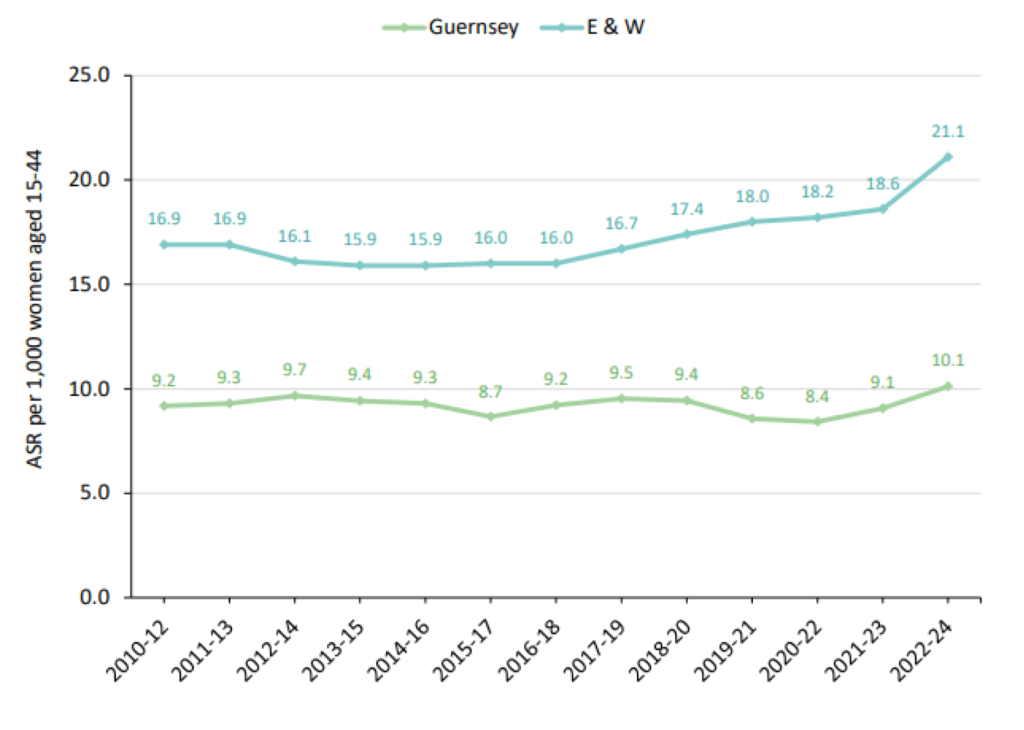
“The choice to have an abortion is a personal one and women are not required to explain their motivations for discontinuing a pregnancy,” Dr Brink explained. “Therefore, it is not possible to fully explain increases or decreases in the numbers of procedures year-to-year.
“However, we do know that this is not due to an increase in abortions due to fetal anomaly. In the Bailiwick where the number of procedures is relatively low, it is always recommended to look at rolling-average rates to better understand change over time, as this helps to minimise the effect of random, short-term variation in numbers.
“That said, Guernsey may be mirroring a trend seen much more widely than just here, which is for increasing numbers of abortion procedures over time. Several factors may be influencing women’s reproductive choices including household finances, the economic outlook for raising a child, and healthcare availability including cost of contraception.”
Dr Brink cautioned that the data for 2024 may vary once population data is confirmed.
She also reiterated that Guernsey’s abortion rate remains below that seen in England and Wales, even with the recent increases.
Young women
The majority of abortions carried out in Guernsey are performed on women in their mid-late 20s.
Fewer than 1% of all abortions are in girls under 16.

Taking a broader look at age related data, a reduction in abortions for the under 20
age group and an increase in the 25-29 age group are the most notable trends over the past 15 years.
Public Health suggested the former is possibly related to the introduction of
free contraception for Under-21s from December 2017 while the latter accounts for 50% of procedures over the latest three years.
The fact that women over 21 often have to pay for their contraception of choice may contribute to the rise in abortions in higher age groups, explained Dr Brink.
She said that other factors are also at play though.
“Free contraception was introduced for islanders under 21 in 2017 and is thought to have contributed to reductions in abortion rates among younger women,” Dr Brink said.
“Possible contributing factors for women in their mid-20s and older could include health inequalities and issues around access to reliable and affordable contraception. Alternatively, it could be that the number of conceptions in women aged 25 to 29 has been stable, but that more women than in the past are choosing abortion rather than continuation of pregnancy (e.g. to delay starting a family). Economic and social factors are known to influence decisions on family size and birth timing/spacing.”
As well as being most likely to have an abortion, women in their 20s are more likely to have a repeat abortion too.
Public Health’s data shows that between 2022 and 2024, a third of all abortions were repeat procedures and 23% of all abortions carried out on women under the age of 25 abortions were repeat procedures.
21% of all abortions on women under 25 were after a birth.
Gestation
Public Health’s data shows that most abortions performed in Guernsey are carried out before the tenth week of pregnancy with very few occurring beyond the thirteenth gestational week.
Over the three years leading up to 2024, 79% of all terminations (80% for 2024) were carried out under 10 weeks of pregnancy. This is a lower proportion than in England and Wales (88%) and Jersey (93% in 2024).
Guernsey carries out a higher proportion of abortions between 10 and 12 weeks gestation compared to England and Wales (16% compared to 5%), and a similar proportion of abortions at 13+ weeks (5% in Guernsey, compared to 7% for England and Wales).
Public Health said it is auditing this data to find out the reason behind the lower percentage of abortions occurring under 10 weeks of gestational age in Guernsey, along with the higher proportions in the 10-12 week category.
“The audit is to try to understand why, for the last four years, a lower proportion of abortions in Guernsey have been carried out before 10 weeks gestation and a higher proportion between 10 and 12 weeks, compared to nearby jurisdictions,” said Dr Brink.
“Earlier abortions generally carry a lower risk of complications and are regarded as an indicator of prompt access and high service quality. We are examining all steps in a typical pathway for a woman seeking abortion care to identify if and where any delays or barriers to access could be causing procedures to occur at a later gestation, on average, than in other places.
“The audit is also to help us understand why a higher-than-expected proportion of abortions are done surgically in Guernsey relative to medically. This is likely to be linked, at least in part, to gestation at time of procedure, as detailed above.”

Despite a law change in 2021, allowing abortions up to the 24th week of pregnancy where the mother’s physical or mental health is at risk from February 2022 the data published by Public Health shows no meaningful change in the number of abortions carried out after the 12th week of pregnancy.
In answering questions from Express around the published abortion data, Dr Brink reiterated that “we cannot fully understand the motivations of women seeking abortion care as these decisions are, rightly, personal”.
The data audit may help health professionals understand the reasoning better and help ensure women are able to access prompt and safe treatment.
Abortions at home
The 2022 law change also allowed women to have abortions at home rather than in hospital for the first time.
In the following few years, there was a significant shift from abortions being carried out at the PEH to being completed at home.

The number of women choosing to complete their abortion at home increased from 8% in 2023 to 43% in 2024.
Public Health said this shows that the law change enhanced choice for women.
“There is now more choice for women, than in the past,” said Dr Brink.
“The development of a pathway for women to complete early medical abortion has facilitated this process.”
“We expect and welcome home-based abortions to increase as women make use of this option,” she added. “Home abortions are carried out medically, rather than surgically, which is generally safer for the patient and has favourable cost implications.”
Dr Brink also said that there are an increasing number of medical abortions being carried out in Guernsey – 77% between 2022 and 2024 compared to 72% in 2019-21.
“This supports women completing their abortion at home if that is the pathway they choose,” said Dr Brink.
Guernsey’s law
Guernsey’s Abortion Law was amended in 2021, with those changes coming into force in February 2022.
From then on, abortion has been allowed for women up to 24 weeks pregnant “if continuing the pregnancy poses a risk to the woman’s physical or mental health”.

The amended Abortion Law replaced existing legislation from 1997.
Among the approved changes, the 2021 amendments also permitted abortions to take place at home for the first time in Guernsey.
Prior to the law changes being enacted in February 2022, all abortions had to be carried out at the Princess Elizabeth Hospital. Now they can be performed “in other suitable locations” if the woman is at an “early gestation”.
In addition to the increased threshold and the approval of abortions at home, abortions can now be signed off by one doctor, rather than two, and self-abortions were decriminalised.
