


Will Guernsey’s credit rating drop if the States rejects the GST tax package?
That’s become one of the latest battlegrounds in the increasingly bitter debate over Guernsey’s tax reforms.
Last week, Express exclusively revealed that S&P had rejected the idea that its assessment of Guernsey hinges on GST.
Now, S&P Global has gone further, stressing that it is “prohibited” from advising governments on policy and “cannot” require politicians to take any particular action.
S&P’s latest response comes after Deputy Rob Curgenven asked it to clarify several claims that had emerged during the GST debate, including reports that the credit agency had expressed concerns about delays to Guernsey agreeing a new tax strategy.
However, S&P declined to discuss confidential conversations with the States, leaving uncertainty over how the agency’s position has been interpreted and communicated to deputies.
Deputy Curgenven said the response raised “uncomfortable questions” about whether deputies and the public had been given an accurate understanding of S&P’s position during the GST debate.
P&R strongly refuted any suggestion it had “misrepresented” S&P’s position, arguing instead it was “concerned that its position is being misrepresented by some States members and recent media coverage”. (Read the States full response below along with S&P’s statement)
‘Have we been misled?’
Deputy Curgenven told Express: “S&P’s response leaves me with a very uncomfortable question: have deputies and the public been misled about what S&P actually said?”
He said S&P’s response clarified that it can’t advise the States to “adopt a particular tax measure”, and that its assessment was based on “Guernsey’s overall fiscal position”.
Deputy Curgenven said: “That is very different from the impression that has been created during this debate – that rejecting GST somehow puts our credit rating at risk.
“I’m not prepared to accuse anyone of deliberately misleading the States without seeing the evidence.
“But these are serious discrepancies, and the public deserves to know exactly what was said to the States, by whom, and how that was subsequently communicated to deputies.”

Deputy Curgenven said P&R “now says it has never suggested that Guernsey needed to pass this GST package to avoid a credit rating downgrade”.
“The difficulty with that position is that the public record is there for everyone to see,” he added.
“The public are perfectly capable of reading what S&P actually said, comparing it with what was said by deputies and deciding for themselves.”
He said the issue was “no longer about whether GST is the right policy or the wrong policy”.
“It is about something far more important: can the public trust what their government tells them?”
‘Cannot require any particular action’
Deputy Curgenven had asked S&P whether it had expressed concerns about delays to Guernsey agreeing a new tax strategy, whether any such concerns related specifically to GST, and whether the ratings agency had ever indicated that approving GST was necessary to maintain the island’s A+ credit rating.
S&P’s response was emphatic on one point.
The ratings agency said it is “expressly prohibited from providing any sort of advice or recommendations” and added that it has not, and cannot, require governments “to take or not take any particular action”.
“We have not, and cannot, opine on the appropriateness of any individual fiscal policy measures that a sovereign issuer may choose to take, and have not, and cannot, require an issuer to take or not take any particular action,” it said.
S&P added that its role is to assess creditworthiness, rather than recommend particular tax policies.
The unanswered questions
However, while S&P was clear about what it cannot do, it was less forthcoming about what was said during private discussions with States representatives.
Among the questions left unanswered was whether the agency had ever expressed concerns about delays to tax reform.
An S&P spokesperson explained that the agency was prohibited from disclosing confidential information “regarding our discussions with the government which led to our rating”, adding: “I would defer you to the government representatives who engaged us.”

What S&P said to civil servants and the deputies involved, and how that message was presented to the rest of the Assembly, remains unclear, leaving the questions:
- Did S&P ever say privately to civil servants or individual deputies we could be downgraded if the tax package didn’t go through – or that it was concerned about the delays to the tax reform package?
- Did deputies have an accurate understanding of S&P’s position on those issues?
While S&P did not state whether any of its team had raised concerns of any kind to deputies or civil servants in private, but was clear that it would be against its own rules to offer “advice” to any government.
What did S&P say matters?
The agency was willing to discuss was its broader assessment of Guernsey’s finances.
S&P said its A+ rating continues to be supported by the island’s low debt levels and substantial accumulated assets, while noting longer-term challenges including an ageing population, rising healthcare costs, housing pressures and infrastructure requirements.

It stressed that its focus is on whether Guernsey can maintain its strong fiscal and debt position over the long term, rather than on any individual tax measure.
The agency also repeated a warning contained in its most recent ratings report.
“We could take a negative rating action if, contrary to our expectations, fiscal pressures eroded Guernsey’s general government liquid assets,” it said.
It added that one possible scenario would be a substantial increase in capital spending without adequate offsetting revenue measures.
Questions for P&R
The latest exchange is unlikely to end the political row.
During and after the tax debate, members of P&R repeatedly linked the proposed tax package to Guernsey’s credit rating and future borrowing costs.
Deputy Yvonne Burford wrote on social media that if the latest GST package was “not approved, credit ratings are likely to fall and borrowing rates go up”.
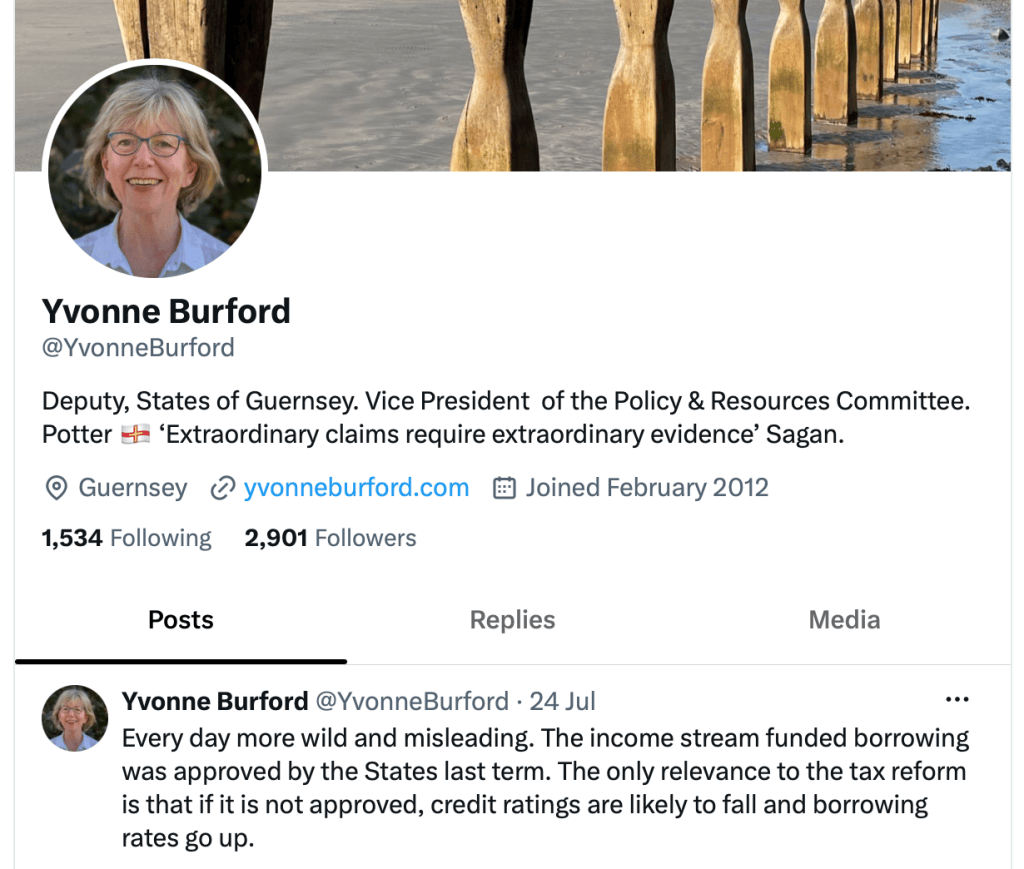
Similar warnings were echoed in the States by Deputy Andrew Niles and by P&R President Deputy Lindsay de Sausmarez in last month’s debate.
Deputy Niles linked the tax package to Guernsey’s credit rating during the debate, warning that a downgrade would have long-term consequences for the island’s finances.
According to Hansard, the official record of States’ meetings, he told the Assembly on 16 July: “If we do not have that rating, if we have an alternative rating that is lower, it costs us money.
“It not only costs us money tomorrow, it costs us money forever.”
Several deputies also revealed in the chamber there had been WhatsApp messages circulating among deputies about the S&P rating.
Deputy Andy Sloan said: “Deputy Niles has admitted on the WhatsApp group that actually part of the reason for GST is so we can borrow more money.”
While Deputy Niles didn’t dispute the existence of WhatsApp messages in the chamber, he later publicly dismissed the idea that a GST package was being introduced to increase borrowing.
Deputy Gavin St Pier argued that there had been no mention of S&P in the tax policy letter, arguing that adding “additional information at this stage is not particularly helpful to the wider debate”.
Some are now querying whether the statements from members of P&R represented a fair interpretation of S&P’s position.

While S&P’s response does not contradict any private discussions that may have taken place, it is likely to intensify scrutiny of how the ratings agency’s position was characterised during the debate.
P&R has rejected suggestions that it had misrepresented S&P’s position, saying it was instead concerned that the ratings agency’s views were being misrepresented by some States members and in recent media coverage.
“There has been no misrepresentation of S&P’s position by our Committee,” P&R said in a joint statement.
P&R pointed to S&P’s public warning that Guernsey could face a downgrade if the States’ liquid assets were eroded, arguing that this is consistent with its longstanding position that failure to address the island’s structural deficit will eventually put reserves under pressure.
P&R also stressed that it had never claimed S&P supports any specific tax measure, noting that the ratings agency “does not comment on the specific measures jurisdictions should implement”.
The committee argued that the proposed tax package remains the only “viable” solution currently on the table capable of addressing Guernsey’s long-term financial challenges.
Deputy Curgenven, meanwhile, says the ratings agency’s latest response raises “uncomfortable questions” about whether deputies and the public were given an accurate understanding of what S&P had actually said.
Rather than centring on what the ratings agency’s position, whether GST is a good idea, or the importance of Guernsey’s rating, part of the political battle now appears to be about trust, accountability and whether the public can rely on their government to present the evidence fairly.
Who said what?
S&P’s full letter
Dear Deputy Curgenven,
Thank you for reaching out to us via email on 28th July, and for your questions. We attach for your convenience our most recent published report on our rating on Guernsey and the sovereign ratings methodology on which this rating is based.
Please note that as a regulated rating agency, we are expressly prohibited from providing any sort of advice or recommendations to an issuer. We assess creditworthiness and express that opinion in our published report, based on information received from an issuer as well as public information, in accordance with our published methodology. Accordingly, we have not, and cannot, opine on the appropriateness of any individual fiscal policy measures that a sovereign issuer may choose to take, and have not, and cannot, require an issuer to take or not take any particular action.
When we assess creditworthiness, we take into consideration the current and likely future government policy and analyze what impact this policy could have on the sovereign’s financial standing. Our ratings on Guernsey are currently “A+” with a stable outlook, indicating that we see risks to the ratings as balanced over the next two years. We note Guernsey’s low debt levels in an international comparison and sizable accumulated liquid assets available to the government for budgetary and debt service needs.
Nevertheless, we recognize that, like many other developed jurisdictions, Guernsey faces a number of long-term challenges, including an ageing population and therefore rising healthcare and other public services bills, infrastructure requirements, housing and others. Therefore, we follow how the fiscal position will evolve over the medium-term, taking into account the likely existing constraints characterizing the Bailiwick’s economy (likely more constraints in being able to raise additional revenues compared to other countries globally, given the desire to remain a competitive jurisdiction from a doing business perspective). So, in essence, we are following how these longer-term spending pressures could evolve and what the government will do about them. This is not about any one particular measure in isolation but rather about the overall impact and whether the authorities will succeed in maintaining Guernsey’s currently strong fiscal and debt position over the long-term. As we have publicly said in the attached rating report, in our most recent outlook statement (February 2026):
“We could take a negative rating action if, contrary to our expectations, fiscal pressures eroded Guernsey’s general government liquid assets. This could happen, for instance, if the government increased its capital spending (capex) plans substantially without adequate offsetting revenue-raising measures.”
In addition to express prohibitions on providing advice or recommendations to an issuer, we are also expressly prohibited from selectively disclosing any confidential information received from an issuer in the context of our rating, and any information on our rating that is not public.
As such, to the extent you seek specific information regarding our discussions with the government which led to our rating, I would defer you to the government representatives who engaged us – and with whom we interacted in the process of issuing that rating.
We hope this helps address the questions you raised.
S&P Global
P&R’s full response
There has been no misrepresentation of S&P’s position by our Committee; however, we are increasingly concerned that its position is being misrepresented by some States members and recent media coverage.
S&P’s position is clear and in the public domain, available at https://www.spglobal.com/ratings/en/regulatory/article/-/view/type/HTML/id/3514278, in which it says: “We could take a negative rating action if, contrary to our expectations, fiscal pressures eroded Guernsey’s general government liquid assets.
“This could happen, for instance, if the government increased its capital spending (capex) plans substantially without adequate offsetting revenue-raising measures.”
This is completely in line with what our Committee has been advising members and the public, namely that:
- S&P has advised it could lower our credit rating if our liquid assets erode. (These are our general revenue reserves, or savings, and we have explained they could be exhausted by 2031 if the States does not take action to improve our financial position).
- S&P has inferred that our reserves will erode if we increase our capital expenditure; our Committee’s (and indeed successive States Assemblies’) position is that we need to invest in the island’s infrastructure more than we have done.
- S&P does not comment on the specific measures jurisdictions should implement, and our Committee has never suggested it does or has.
- Our Committee has warned that failure to agree a tax reform package that addresses our structural deficit will result in our reserves being eroded, which is likely in turn to result in a credit rating downgrade.
None of this is new information to anyone who has followed our credit rating reports or tax reform debates in recent years. Indeed, Bailiwick Express ran a story in February stating “Guernsey’s Standard and Poor’s credit rating has remained steady for another year. However, the rating is partly based on assuming the island introduces “a suite of tax reforms, including a Goods and Services Tax”.”
It is disappointing that our consistent commentary on this topic is now being misrepresented. For the avoidance of doubt:
- we have a known financial challenge,
- it has been known for a long time,
- S&P has publicly stated its position that we need to address that challenge, otherwise it may consider downgrading us, and
- the 2026 Tax Reform Package addresses it. In our view is it is currently the only viable option on the table that does so effectively.
