


With new pathways and buildings planned for the Little Chapel site, the Foundation that runs the religious tourist attraction has confirmed there are no plans to introduce an entry fee.
Giving Express a tour of the site as it is now and an insight into how it could look in the future, Joe Mooney said the main focus of the plans is improving accessibility, not making money.
The Little Chapel Foundation recently submitted a planning application seeking permission to redevelop the pathways around the small building, to create an interpretation centre, and to put in toilets.
The Chairman of the ‘TLC Foundation’ said this work will be reliant on donations and will take years to complete.

Mr Mooney reiterated that this planning application is distinct from previous plans which sought permission to build a wall across the front of the Little Chapel raising fears of an entrance fee.
He said instead the Foundation wants to ensure as many people as possible can get to the Little Chapel to reflect its ongoing position as one of Guernsey’s most popular sites.
“As a tourist attraction for Guernsey, there’s the Victor Hugo House and the Little Chapel and they are the two most talked about,” he suggested.
“Our main focus initially is accessibility and getting from the lower car park, staying within the confines of the Little Chapel grounds, and accessing both doors, the lower and upper doors of the Little Chapel itself,” he explained.
Acknowledging that the Little Chapel itself will remain inaccessible to some people because of how small it is inside, Mr Mooney said the work planned to the pathways will allow many more people to see it up close for themselves.

“It will be a much more enhanced visitor experience, because you’ll have time to meander along through the pathway. Lots of times you come in, you come up the side steps, and then you go up the steps, and then you come back down the same steps, so we’re saying you’ll be able to go around the corner and come out the other side or go back the other way.”
The pathways that currently join the car park that lies at the entrance to the Little Chapel from Route de St André (Le Bouillon Road) are accessible by foot but are muddy, uneven, and overgrown. The pathways around the Little Chapel itself are similarly uneven at best.
Smoothing these out, to allow wheelchair access from the car park to and around the Little Chapel are the priority if planning permission is given, said Mr Mooney.
He is also keen for work to start on the proposed Interpretation Centre that is intended to go at ‘Deodat’s Castle’.

‘Deodat’s Castle’ – named after Brother Deodat who built the Little Chapel – is the outside space to the north of the Chapel itself, overlooking the valley.
The Foundation hopes to remove some of the existing stone archway to create a Gazebo offering shelter with information boards. The land immediately around this area will be landscaped, while shells will be added to some of the retained columns to ensure the area is in keeping with the Little Chapel.
“There’ll be an area for you to sit down, catch your breath, or whatever, because it is a bit of a trek from the car park to here,” said Mr Mooney.
“And you can just take in the valley as well,” he added.

Built by Brother Deodat – a member of the De La Salle Brothers who taught at Les Vauxbelets – in stages between 1913 and 1939, with further decorative pieces of crockery added by Brother Cephas until his retirement in 1965, the Little Chapel has been one of Guernsey’s leading tourist attractions for decades.
Acknowledging that doing further work to the site – more than 100 years on from when the first iteration of the Little Chapel was built, demolished, and replaced by Brother Deodat – will cost a lot of money, Mr Mooney said the Foundation is looking at what has previously been achieved for their inspiration.
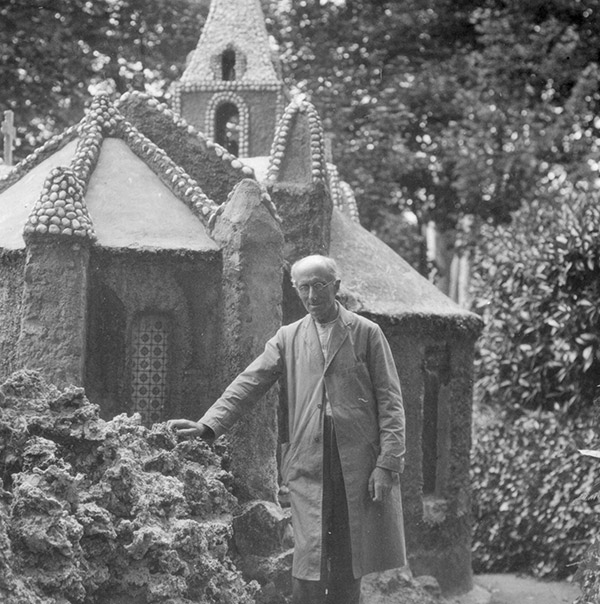
“There’ll be no entrance charges, we can say that, and the wall that was proposed on the side that’s not going to be built,” he confirmed.
“People, when they ask me about funding, I say Brother Deodat built the Chapel previously, and he had no money, and he actually built it three times.”
Pictured: Brother Deodat (The Little Chapel website).
A message on its website says that it needs ‘approximately £500,000 to fully restore the Little Chapel’.
It says this money will pay for ongoing work at the site ‘together with proposed plans for the woodland gardens, the Stations of the Cross, information area, car park, and wheelchair friendly access pathways’.
“Most times when things fail, they don’t necessarily fail because of a lack of finances, but most of the time, it’s the will to do it, and that is there with the Foundation members at the moment,” reiterated Mr Mooney.

Mr Mooney hopes that work will start on either the pathways or the Interpretation Centre this year.
When work starts on the pathways it will take into account the site’s religious significance, he added.
This will include retaining and re-installing the Stations of the Cross in numerical order along the newly accessible pathways.
Mr Mooney said ensuring the site’s religious significance is maintained is important to the Little Chapel Foundation.
“We will get the Stations of the Cross onto the pathway and get them into numerical order as well, so you can focus, so if you wish to say a decade of Rosary on the way, you can do so.”
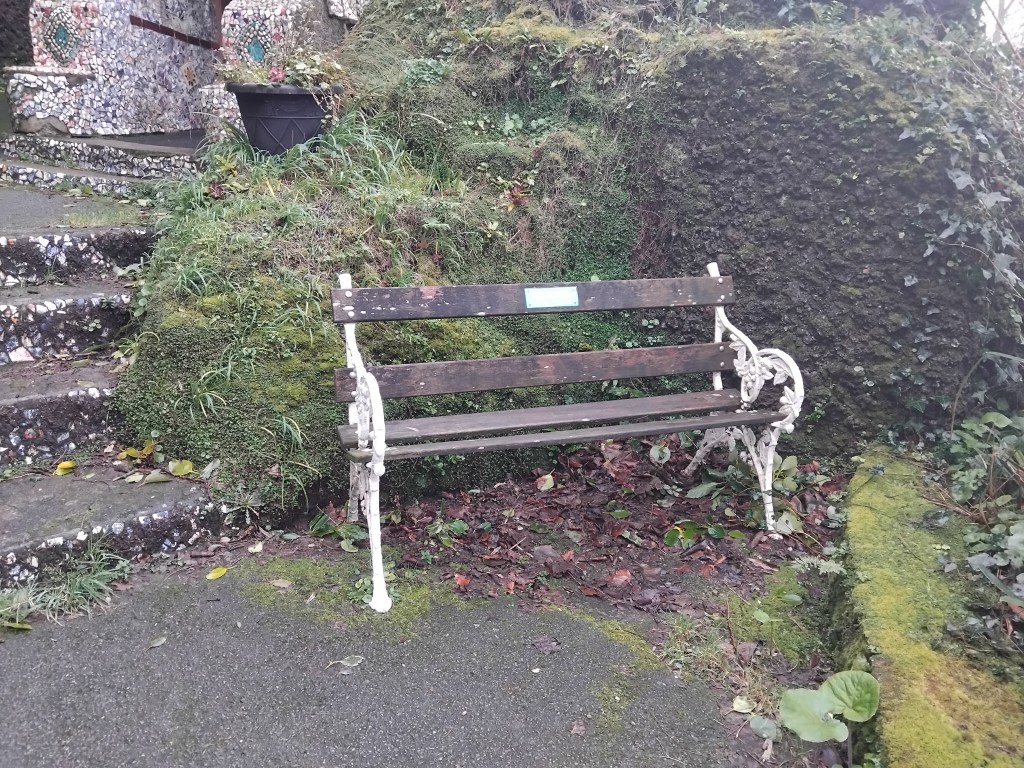
Seating would be provided “throughout” the new pathways under these plans, as well as within the Interpretation Centre.
Plans to create toilets have also been included in the current designs to coincide with an ‘entrance shelter’ at the car park end of the site, but Mr Mooney said the pathways and Interpretation Centre will be the priority once planning permission is secured.
He also said that a shop/café that is included in this planning application could follow in the future, but that is also not a priority for the initial building work.
“That’s going to take a little bit longer (to build toilets and/or a shop/café) but that’s our aim. It’s important to have facilities for visitors to enhance the visitor experience,” he said.
“We’re at the planning stage, so we have to wait and see (what’s approved). It has been approved previously so hopefully it’s successful and we look forward to the challenge.”
Designed by Lovell Ozanne Chartered Architects, the current plans – that can be viewed in full at gov.gg – propose putting in new plants and hedges, a dry valley to divert rain water down stream, resin bound gravel paths, and “simplified step access” with handrails.
Additional changes to Deodat’s Castle – where the new Interpretation Centre is planned – include iron railings, an ‘anti-skid finish’ to the flooring, and new retaining walls.
Toilets could be built alongside a new ‘entrance shelter’ at the car park end of the site.
Changes to the car park along Route de St André (Le Bouillon Road) include plans to repair damaged tarmac, repairs to the granite boundary wall, and the addition of blue badge parking spaces along with designated bicycle parking.

A pedestrian link between the Little Chapel and neighbouring Blanchelande College (pictured at the top of the picture above) will be retained under the plans, but the school has no involvement in the upkeep of The Little Chapel or its future plans.
For more information on the Little Chapel and to donate visit HERE.
For more information on the planning application visit HERE.
