


Connect took the opportunity to see how Ms Harford-Fox has settled into the island, as well as her plans – including whether successful public debates hosted at the school are a feature for the future.
A year into your island life, what’s been the biggest surprise so far?
So the first thing to say is that I accepted the job at The Ladies’ College without having ever been to Guernsey! Because of the timing during lockdown, we had initially thought that I would be able to visit as the second part of the interview process and meet the Governors face to face, enjoy the College community and look around the island, but that was not to be!
In Improv Comedy (which I have been involved with and where you work with people to create stories ands scenes on the spot) there is a saying that you are rewarded with safety by saying ‘no’ and by adventure when you say ‘yes’. And so my husband and I decided on adventure and I think probably the biggest surprise is how easy the move has been. I’ve lived and worked in a number of different places in my life, but I’m not sure I’ve ever felt so supported or welcomed as I have been in Guernsey and at The Ladies’ College in particular. The strength of the warm welcome was not something I’d fully expected and has been a true delight.

Pictured: Daniele Harford-Fox moved to Guernsey to take up the leadership role at The Ladies College.
How do Guernsey and the College’s students compare to other places you’ve worked?
When I was about to leave my first school in Nairobi, I shared some concerns with a friend that, having loved teaching my students in Kenya, I wouldn’t meet such wonderful young people again. But within weeks of starting at my new school in Birmingham, it became clear that, regardless of the school or country, students are students are students. Every young person I’ve taught has brought something unique and interesting to the table and that is equally true here.
What is different for me is working in an all-girls community and the impact of that is quite apparent. Students at Ladies’ College feel much more relaxed, playful and willing to be authentically themselves than I’ve found in girls in other contexts. From Lower Sixth (Year 12) students being willing to stand up in front of the College as part of the Head Girl Hustings, vulnerably and authentically explaining why they want to lead, to Inter-House Gym and Dance where public brilliance and the challenge of joyfully embracing failure were both evident, the girls here feel brave and confident enough to take risks. It is an unusual and powerful thing to witness.
Have you always had a knack for organising topical events for students and the community?
I do love a good conversation! I think one of the reasons I love teaching teenagers is because they are so curious about the world, and so willing to challenge accepted orthodoxy. Students make my days interesting and what is exciting in this role is that I can share more widely the conversations we’re having.
For example, in the past week students have spoken to me about how they’ve learnt more from failure than success, about the problems around diagnosing mental illnesses, about the balance between religious freedom and social cohesion, and around whether the narrative that ‘women can have it all’ has actually been helpful or detrimental to society. That’s the great joy of working with young people, they’re full of ideas. And the great joy of being a Principal is that I can help shine a spotlight on the girls and challenge them to look for opportunities to find and share their voice.
Pictured: The Ladies College is 150 years old this year.
How well have these types of events been received by staff, students and parents?
I was speaking with Michael Buerk after he chaired The Ladies’ College Big Debate (a celebratory event to mark 150 years of the College) and we both agreed that it was one of the best debates we’ve been involved in (having debated with Michael many times at my previous school). The College students were astounding, and the debate (This house believes that sexism today is worse than it was 30 years ago) was interesting and nuanced. However, what really struck me was how much the audience embraced the conversation. There was an energy in the room and a willingness to ask questions and push deeper into ideas that made the whole event a tremendous success.
Similarly, a panel discussion last week for International Women’s Day was thrumming with energy. The panel of fantastically accomplished and pioneering women were extraordinary, bringing diverse and penetrative analysis to the issues around women and technology. However, again, it was the questions from the floor and that sense of collective curiosity that really made the event a success.
Events like this are everything I want for The Ladies’ College. They bring our community together, they show girls what they can do and be, and they allow us to consider nuanced and complex ideas in a thoughtful and reflective way.
What have you got in the pipeline in terms of events, and why do you feel they are important?
Well, I certainly think we’ll continue to do events like those most recently held, as well as looking at discussion and dinner events where we can have a speaker and then discuss issues with students, alumni and our community. Next term, I’m hoping to arrange a fireside chat between myself and Eve Jardine-Young, the Principal of Cheltenham Ladies’ College and one of our College Governors and, after the success of the first one, I think we will certainly be looking to have an annual Big Debate.
After a great conversation with some local business leaders, I think one of our next explorations will be arranging an improvisation workshop where the girls will work together with business people to learn improv comedy skills, which I have found to be powerfully helpful in risk taking, collaboration and creativity.

Pictured: The Ladies College is at Les Gravees in St Peter Port.
What other plans do you have for the school now you’ve got your bearings?
One of the great privileges I have is that I’ve inherited a school which is already a thriving success. My predecessor did some amazing work on wellbeing and we’ve won awards in that area. We’ve also shared our work and resources with teachers, parents and students, both within and outside of our immediate College community. For example, we gifted our Wellbeing Hub access to St Anne’s school in Alderney at the end of last year. Our ISI inspection report from last March could not have been more positive about the academic, intellectual and wider skills of our students and there is a committed staff who love the girls and love the College. So that’s my starting point!
However, I do think we are in a period of immense change. From the climate and biodiversity challenges to the rise of artificial intelligence and technology, our social and economic fabric is going to change faster for this generation than perhaps any in recent history.
I was reading Tom Fletcher’s book on survival skills for the 21st century recently, and one point that stood out to me was that doctors of the 1900s would look on medicine today and be baffled by its practices. However, educators and teachers from the 1900s would probably see much of the same practices in place.
The truth is that we’ve been teaching the same way for the last 150 years – teachers hold knowledge, they pass that knowledge on to children, and then we separate and rank children on their ability to regurgitate that information in examination conditions. Even before we look at how AI is going to dramatically change the future context for these children, the current exam system does not build the skills they’re going to need even today.
I think as educators we have a responsibility to be ahead of that curve rather than behind it. The children who enter our Remove (Year 7) today will finish university and enter the world of work after 2030. We need to prepare them for what they will face.
So, this is a challenging but exciting moment for education and, at College, we have already taken our first steps on this journey – we’re a Microsoft Showcase School and have allocated significant curriculum time to teach ‘future-ready’ skills. We are also currently in the process of appointing a Director of Innovation to lead our work in this area and ensure that we are genuinely equipping our students with the skills to not only navigate these upcoming challenges, but also to thrive.
Do you feel welcomed and appreciated by the community?
From meeting people across the local education, charity and business landscape, to starting to get to know our wonderful alumni and parent body, it has been such a delight.

Pictured: The Ladies College held a swimming gala at La Vallette as part of its 150th anniversary celebrations.
What’s one thing you feel is lacking locally?
I’m not sure I really think about cultures or communities as ‘lacking’ – that would suggest there is a perfect model of a community, like a perfect model of a student, and that we just need to add bits to it to make it ideal. The truth is that, as with children, it is in the uniqueness that we find the strength. Every community and culture is a complex, evolving and intricate web of relationships and traditions and Guernsey is a prime example of that.
I do think, however, that I’m joining the community at an interesting moment in time. In the same way that education must face the challenges of biodiversity, climate and tech changes, so too must Guernsey. It’s exciting to witness and be part of a lot of fascinating conversations about how Guernsey will position itself in this period of change.
And what stands out in Guernsey for me is how much the island punches above its weight. It’s true in its landscape and culture, its restaurants and provision. But it’s also true in its people. There are such interesting and insightful voices in Guernsey and so we have the opportunity to take advantage of some of the brilliant minds we have in our community in order to ensure that we continue to evolve and position ourselves so that we also not only navigate but thrive!
What’s been the biggest learning curve in your new role?
Managing myself.
I think I was aware, before I became a Principal, that this job would provide a ‘360-degree’ challenge and that I would have to develop and grow faster than I could imagine. And, of course, it is easy to say that in theory. In truth, growth is hard and managing yourself becomes the heart of being able to lead.
It reminds me of the start of my career when I was training to be a theatre director by working for a range of other directors across the UK and USA. I learnt the most from those directors who struggled with the role, who found it frustrating or difficult to enact their vision. Some would shout to get actors to emotionally achieve the connection they wanted. Others would try to model every action they wanted their actors to perform so that, at best, the actor would only be an imitation of the director. Others would only cast actors that they really liked and who never challenged them.
What it taught me was that their vision for their productions was being held back by their own demons. Their own inability to communicate in a way that people could hear, their inability to allow others to bring ideas or perspectives they had not considered, and their fear of being challenged, prevented their often-powerful vision from being fully realised.
So, I think my duty as a leader is to try to manage myself. To continue to reflect and grow and learn so that I can come to the table as centered, open and grounded as possible.
It is so easy to say and hard to do. But I think that that, more than anything, is the responsibility I have.
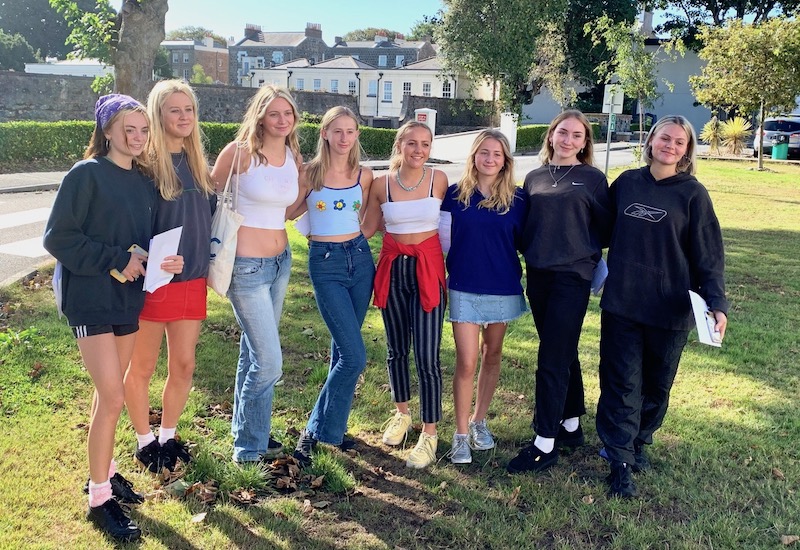
Pictured: Students collecting their GCSE results in August 2020.
Do you feel validated that the schooling model you preside over is sustainable?
There are many ways to interpret that question.
Do I think the independent school model is sustainable? Yes, because it offers choice.
At the heart of the strength of independent education is, well, independence! It’s the ability to set our own agenda, and to move quickly to nuance our delivery to what we see as the needs of the students. Independence allowed the independent sector to move incredibly fast during Covid and offer online provision and innovation. It is also what allows me to genuinely ask questions about what our students need, given the impact of AI and technology advances, and to move rapidly to adapt our curriculum and provision to meet that need. Essentially, being independent gives choice to parents but it also allows for innovation, new ideas and rapid change which, in my opinion, benefits the entire education sector.
Do I think single-sex education is sustainable? Yes, because it also offers choice.
The evidence shows that girls do better in single-sex schools. They do better academically, and they do better in terms of self-esteem and confidence. And I have witnessed that. I have witnessed it in our Young People Survey results which showed that the girls at Ladies’ College were less likely to be bullied, had higher confidence and a sense of belonging and felt prouder of being part of their community. But the impact doesn’t stop there. Coming from a co-educational environment, I have not previously seen girls take the social, intellectual or personal risks that they take here at College. I have not seen girls own their own voices and, as our ISI inspection report noted, ‘speak without inhibition or self-consciousness’. I have not seen girls lead in such a varied and authentic way in other spaces. So I feel, both from the research and from my own experience, that single-sex schools provide girls with the space they need to find out who they are before the world tells them who they should be. And I want that opportunity for girls in Guernsey.
This year The Ladies’ College is 150 years old, making us one of the oldest girls’ schools in the British Isles. The College has woven its way through history and through Guernsey, often challenging the status quo, carving out space for young women. Its history is a history of the island: of allowing girls and women to have the same voice and space as boys and men.
And through that history the College has faced challenges and had to adapt, and it has done so. It entirely relocated during WWII and it moved online during Covid. The challenges of technological and social change are in front of us, and I think the College has something interesting and unique to offer in that space. But at our heart, we are driven to empower young women to have the skills, confidence and passion to have an impact on their world.
