


Guernsey based artist, Frances Lemmon is currently displaying at Saumarez Park with her latest exhibition, George Sand: The Feminist Troubadour.
Literary icon, Sand’s real name was Amantine Lucile Aurore Dupin de Francueil. She wrote under her male pen name George Sand so she could get her political texts and novels published.
Sands was considered scandalous because of her turbulent love life, her adoption of masculine clothing, and her masculine pseudonym.
“Troubadours were performers and singers in medieval times,” explained Ms Lemmon.
“They were traditionally male singers who sang without any musical accompaniment, and they toured courts and palaces for entertainment,” said landscape artist Ms Lemmon.
She goes on to explain that Sands named herself a ‘feminist troubadour’, and that definition was the beginning of her imaginings on how she was going reflect Sands’ work in her latest exhibition.
“Everyone has faults and issues with their personality and traditionally, the Troubadours would be singing about this perfect woman, so she’d be on this pedestal, raised above everyone else. And that’s fine, until that woman decides to talk or to act, and then she displays her thoughts. So until that time, she is this perfect woman.”

Currently the paintings are a range of oil and acrylic paintings. Some still life figues and two richly detailed floral works, as well as Ms Lemmon’s signature landscape art. All paintings have Ms Lemmons distinctive bold yet harmonious color palettes, and ‘The Dance’ in particular, for me as a critic personifies Sand’s thoughts on equality in relationships.
Central to the exhibition is the portrait of the iconic Sands, set in a frame that Ms Lemmon actually bought first, and fit or painted to, where Sands emerges from a garden of vibrant blossoms, overlaid with birds in flight. Ms Lemmon explained that she was captivated by the gold frame and that the portrait that is now sold, is brought to life in it.
“I think it’s something to do with freedom, isn’t it? You sort of feel that if you’ve got wings, you can sort of scan the landscape and get away from things. And birds have always been in my subconscious.”
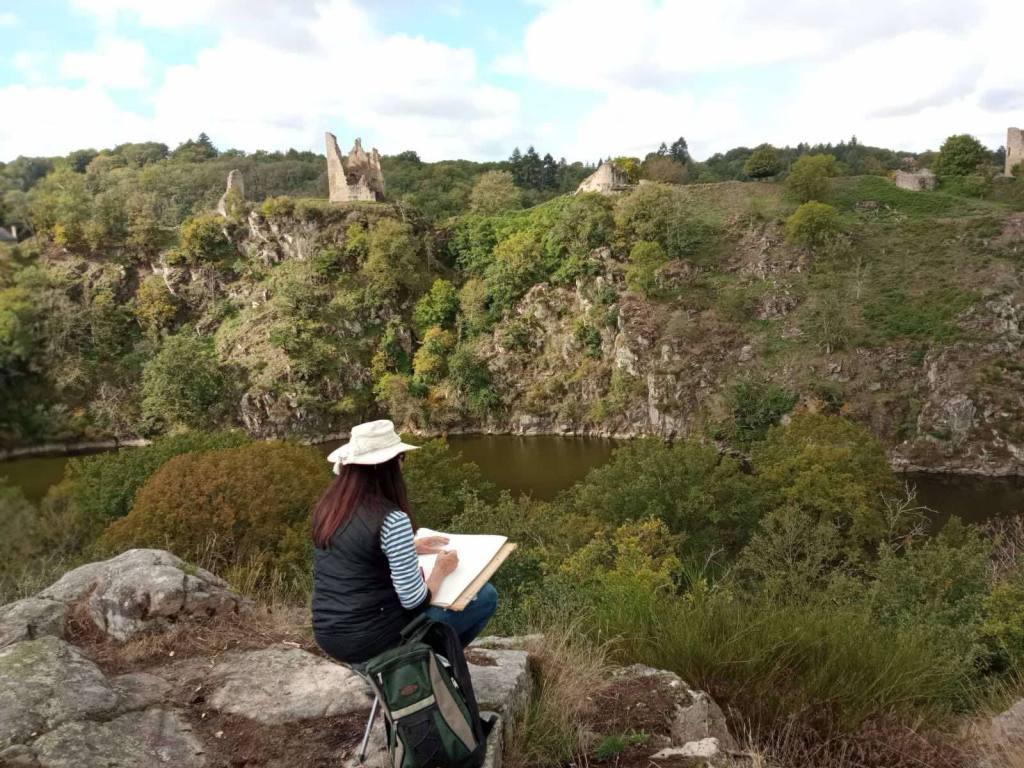
She explains that she did most of her research on Sands in a place called Gargilesse, in France, an area, now known as ‘The Valley of the Artists’. Sands had lived there in her later life and also used it a country retreat when not “moving freely in the bourgeois society of Paris”.
“There is a specific golden oriole bird native to Gargilesse, that inspired me too, so that is what you see in the portrait.”
Born Amantine Lucile Aurore Dupin, known as Aurore, Sands was brought up by her grandmother, who gave her great freedoms in dressing in boys clothes and being able to ride horses in the French countryside.
Along the way, there was an early marriage, two children, a legal separation – and numerous love affairs, most famously with the actress Marie Dorval and the composer Frédéric Chopin.
Like her great-grandmother, Louise Dupin, whom she admired, George Sand advocated for womens right’s and criticised the institution of marriage and fought against the prejudices of a conservative society.
Ms Lemmon goes back to the Troubadour reference and the title of her exhibition, when talking about the central portrait again.
“That is a direct quotation of George Sand. She’s saying she’s a feminist troubadour. So she’s singing, or indeed writing, about feminist issues, but she’s not necessarily being heard.
“You’re singing to the to the audience, much like a Golden Oriole, but you’re not necessarily entirely visible. You’re shifting anchor all the time. So I thought, well, I shall incorporate the Golden Oriole as part of her portrait. And then I’ll put flowers in too, because that’s a very much a feminine icon. White flowers for virginity and pink flowers for femininity. So I put the bird sitting on the flower, and then the bird across the face to distort the face. As flowers are overtly feminine.”

Ms Lemmon shares that Sands was famous for dressing in mens clothes, explaining that Sand’s cross-dressing is depicted in many sketches of her, and in her understanding was a mode she slipped into mostly as a means of securing anonymity, a passport to other realms; a way of ensuring she was listened to.
“I think that’s another stereotypical portrait of her, and I didn’t want to replicate that. There are lots of portraits or caricatures of her, smoking a cigar, wearing a suit, wearing a bowler hat, wearing men’s clothes, big nose, big ears, whatever.
“And to me, the power is in being true to yourself. So she was true to herself. I believe at the end of her life, she was in a successful relationship. She was living a good life, you know, drawing, painting, writing, part of that was at Gargilesse, that little tiny village in the middle of France where she didn’t have that bourgeois society around her.”
Ms Lemmon explains that in her eyes Sands was striving for equality in relationships, explaining that the wearing men’s clothes was a freedom she had pre marriage growing up as a child, in other words, a physical manifestation of her pseudonym.
“She was a very popular, successful writer, and she achieved that partly through wearing men’s clothes. Yes, because she, well, she joined a writer’s group that was only for men, and she could only go to that group a club. It was called to network basically as a man. So, I mean, the opportunities weren’t there for.
“There was a lot of criticism thrown at her when she was discovered to be female, and they focused, I believe, almost entirely on her sexuality and the fact that she’d had relationships with men and women, and the fact that she was exploring all this sexual fluidity, I suppose, in her writing as well.
“I’m not illustrating her life. I’m interested in the countryside, because I’m always interested in people that have trodden the same fields that I tread on… and how they lived on that landscape. I’m interested in the bigger themes of lifting people up in socialism and equality, because I think they are interesting themes.”
The exhibitions next stop is Gargilesse, France, and Ms Lemmon has already admitted that there are more works of art to come.
Exhibition Location: George Sand: The Feminist Troubadour is on at Art at The Park Gallery, Folk Museum, Saumarez Park
Exhibition dates: 7 – 30 May 10:00 – 17:00. (Please note that on the final day the exhibition will close at 14:00.) The Gallery is free entry, is accessible friendly and runs alongside the Museum gift shop.
