

GET supports around 230 people who want to work but need additional support in various ways.
Chief Executive Nikki said there is a potential multi-million pound bonus for the economy through increasing the number of people with disabilities working. She said GET isn’t about making money – it’s about supporting people to benefit their lives.
“If we look at it from an employer’s point of view, there’s a really strong business case for having a diverse and inclusive workforce. research says, and we see it ourselves that generally it can be increased profitability, having a workforce that are more creative, better at problem solving, but also just having a workforce that represents the community in which you live in which you serve.
“Andan inclusive workforce values that everybody’s different and everybody does things in different ways, and then that’s where we come in.
“So, Guernsey Employment Trust is changing the way that employers define and view disability by connecting disabled people to jobs that match their talent.”
Formed in 2015, GET currently works with around 230 clients, with a waiting list. It also works with around 160 employers.
Kate is an Employment Support Officer who carries out the vocational profiling that is at the heart of GET’s work.
She said it helps them “really get to know someone and to test their abilities”.
“We’re looking at we’re looking at their skills from what they’ve done in the past, employment wise or voluntary wise,” she said.“We’re looking at their education.We’re looking at their health, their disability.We’rebasically building up this big picture of them to then be able to work out what work could be suitable.”
When GET places a client into employment, the support doesn’t stop there. Ongoing support is offered to both the client and employer, which is also tailored to each individual.
When Rosa was assigned a placement with Guernsey Post she went to visit her new colleagues before starting. She is partially sighted and has other needs which Guernsey Post set out to meet by making what GET calls ‘reasonable adjustments’. This can include things like larger monitors and keyboards, a standing desk or computer apps.
“They had a training phone so that I would use it. They’d plug it into the phone so I could listen in because of my eyesight, I couldn’t use the actual buttons,” said Rosa.
She also used an app to scan documents with her phone dictating the text back to her and was able to do simple things like expanding her computer screen to be able to better read the text which was something she taught a colleague how to do.
“It was really good. It felt good. It was like they were teaching me and I was teaching them. So it was not just one sided, so it was really good.”
Niamh from Guernsey Post said these adjustments benefited the workplace as well as Rosa.
“We’ve got quite a big admin floor, different departments, Rosa works in customer services, and we’ve got IT. We’ve got loads of different areas that people can come and experience, and it’s important to us that we are an inclusive employer.
“That’s why we got involved with GET, to make sure that we were doing everything we could to make sure that we were being inclusive and thinking about all of the reasonable adjustments that we could make things that we could bring in.
“Before Rosa came in, we had a meeting so she could come and have a look around the office, look at our IT set up, look at our phone set up and just see what adjustments we would need to make in order for her to have a good experience with us, and so that she could do as much as possible when she was working with us.”
Rosa said she would encourage anyone else looking for work to see what support GET can offer them – and she’d also recommend Guernsey Post, and Waitrose (where she has a permanent part time job) as employers.
“They’ve got to really know me well and also know what my disability issues are, so they know them in depth. It’s not just surface level,” she said.
“Guernsey Post was amazing and literally anything they were like ‘let’s try this’…they let me try anything.”
Sign up to the GET Disability Charter
The Guernsey Employment Trust is encouraging more businesses to sign up to its nine-commitment Disability Charter ahead of anti–discrimination laws coming into force from October.
The charter asks businesses to work towards the nine commitments which include encouraging applications from people with disabilities, guaranteeing interviews for all applicants who meet the minimum criteria, offering work experience placements to people with disabilities, and encouraging Disability Awareness Training for staff and managers.
Each business signed up to the Charter is also asked to develop their own commitment to enhance employment opportunities for people with disabilities.
GET’s Chief Executive said the charter is something she is very proud of.
“We developed this in 2017, and that was when the talks of legislation, the discrimination legislation, seemed like years away. What we wanted to do is create something tangible for employers who were committed to providing equity of opportunity but wanted to know ways of going about it.
“We wanted to give them something practical to work towards.”
Nikki said the nine commitments within the charter are targets and don’t all need to be met in one go or before a business can sign up to it.
“At the point of signing up, you’re not saying that you are a platinum standard employer with regards to equity. It’s more of an acknowledgement that you’re starting out on a journey and here are nine steps that you could be taking, and you’re acknowledging that you’re working towards them.”
Nikki is keen that the charter is not just a ‘tick box’ exercise to meet the requirements of the new law and believes it has a positive impact on employment.
“Guernsey is facing a recruitment crisis so it makes good business sense for employers to really review and diversify how they attract new talent. We are one solution to that and more.
“Every day we receive emails from organisations with them sharing their vacancies because they want our help to fill their vacancies. It’s wonderful that we’ve got that wealth of knowledge to then share amongst amongst our client group. Also, many businesses as well.
“By signing up, it can act as a bit of a badge of honour. We physically give organisations a certificate, a trophy and our logo that they can include in their adverts or their signatures if they want or on their websites. Many businesses…there is this push to work towards, CSR objectives or ESG initiatives. It’s a way of them being able to do that, but also helping them to work towards the legislation and meeting the requirements of that because it’s getting employers into good practise.”
GET also offers tailored training tuition for businesses.
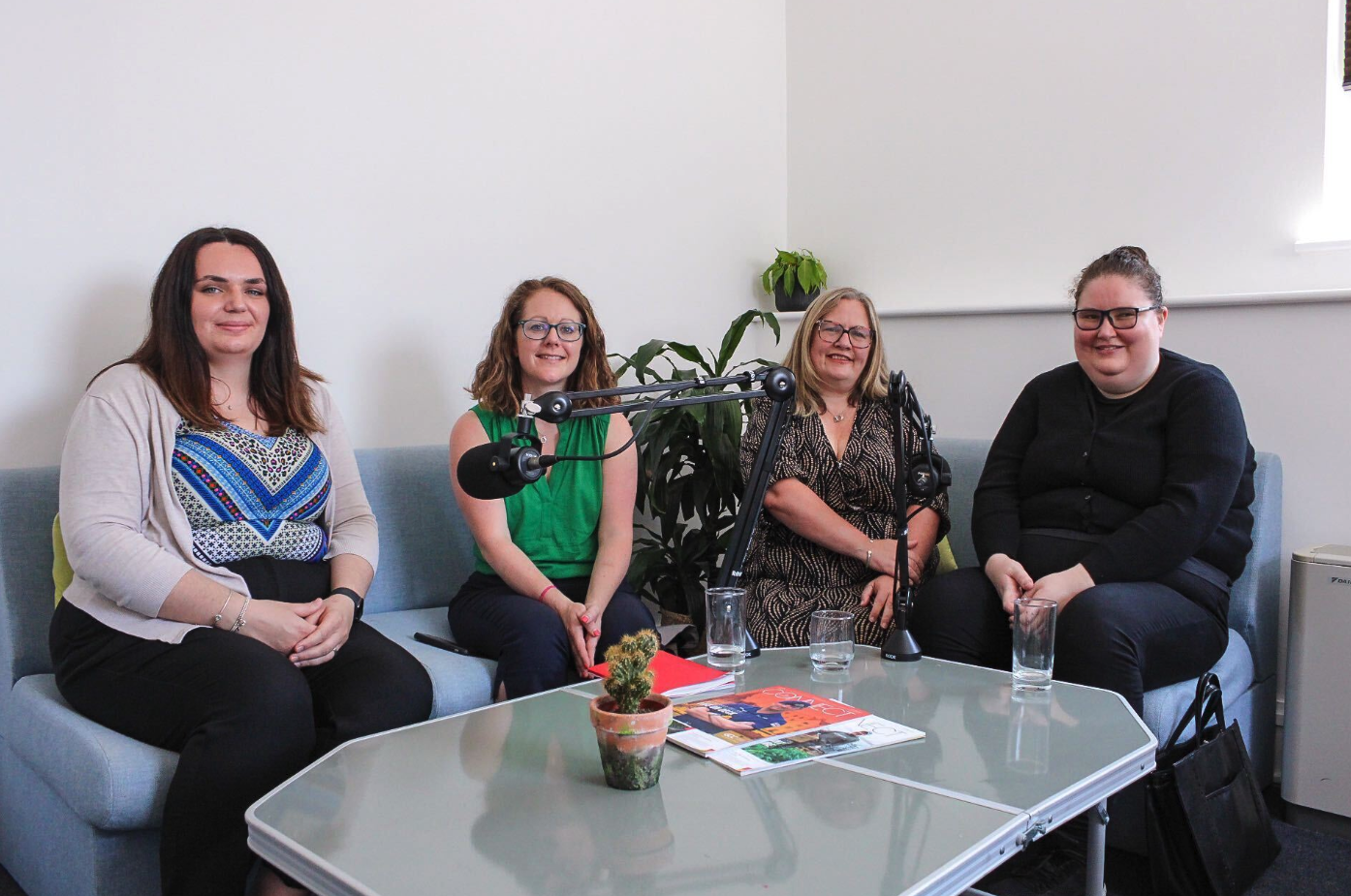
Pictured: (L-R) Niamh (Guernsey Post) Nikki and Kate (GET) and Rosa (GET client).
