

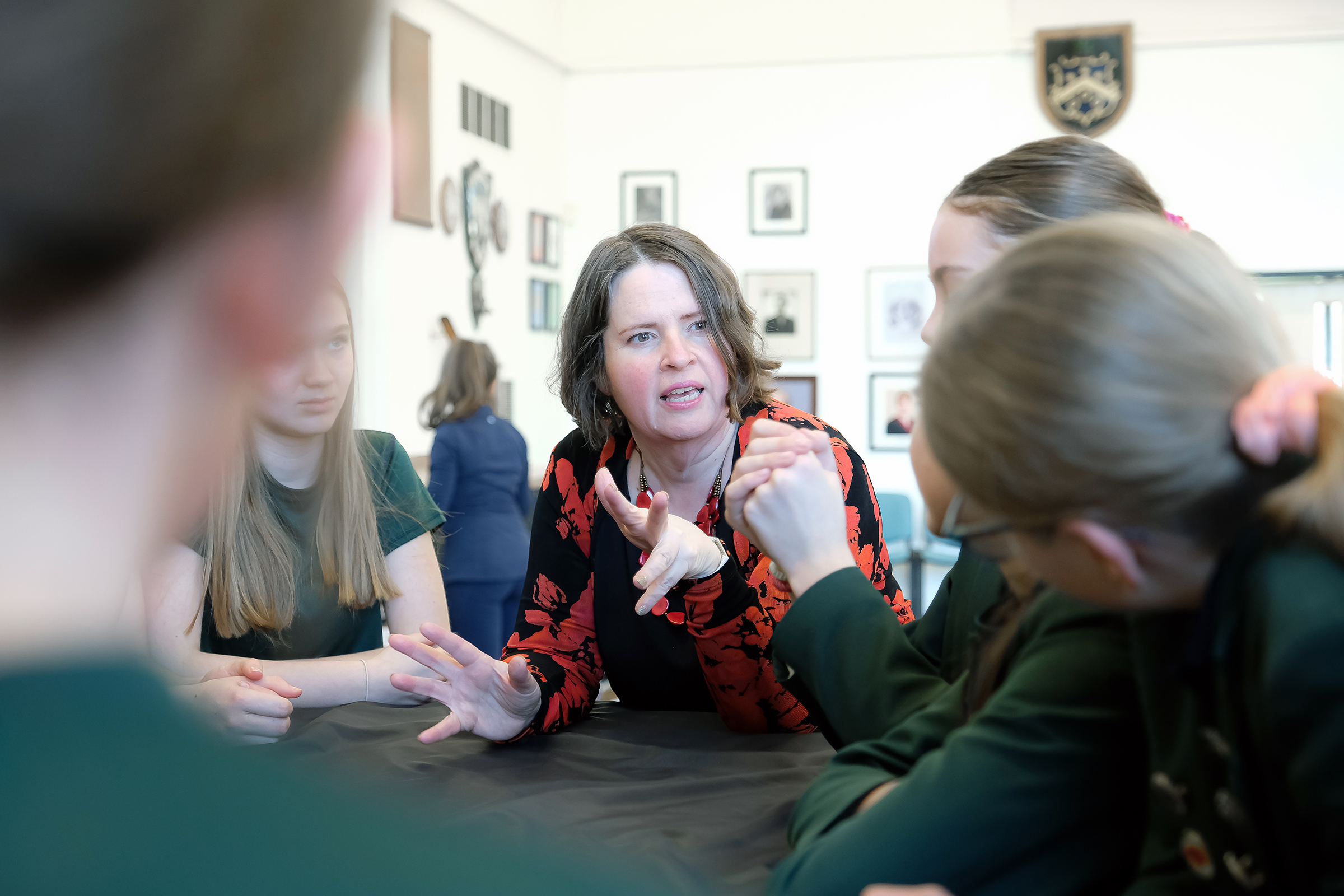
From Afghanistan to the US, women’s freedoms have been eroded. Closer to home, there has been a growth in online misogyny appearing in social media feeds.
But is this a temporary backlash against women’s rights or a genuine backslide?
That is the question The Ladies’ College Principal Daniele Harford-Fox poses and one which will take a few years to unravel.
This year’s International Women’s Day theme is Accelerate Action because at the current rate of progress, it will take until 2158 to reach full gender parity, according to data from the World Economic Forum.
It is, of course, not a simple picture as you cast your eye internationally to see progress in some countries and a huge rolling back in others.

“You look at what’s happening to women in Afghanistan, women are enslaved, right? They can’t even leave the house. They aren’t even allowed to read out loud, which is to prevent them learning to read, so they can be kept intellectually, entirely tied to the family. They can’t travel without a man,” said Ms Harford-Fox.
We’ve not allowed slavery in any country in the world for over 100 years, but we’re allowing it in Afghanistan. So yes, International Women’s Day is needed.”
But is it needed now, in the Western world? Has there been progress?
“We actually had a debate on this a couple of years ago at the College of whether sexism is worse today than it was 30 years ago. So in some ways it’s better, laws have improved. So on the surface, things have got better for women.
“But then you look at the number of female deputies there are in States, and also how those female deputies are treated, and you question whether we’re all the way there.
“You look at the online growth in misogyny and the experience of my teenage students, who are now seeing a rise in, essentially, sexism and racism being endorsed by young men. You look at the response to Trump’s election, where Nick Fuentes statement, ‘your body, my choice’, was in Guernsey, 24 hours later, the girls had heard that. So I don’t think we’re all the way there.”
150 years ago, when Ladies’ College started, a woman was not allowed to be the principal or speak at open days or at events.
“We have come a long way, and it’s a powerful journey, and we have been supported by men and women together, but this story about the importance of whether you’re male or female, the story that traps our young people, both male and female, into certain behaviors and certain limits on their lives, it’s just not an acceptable story, and we’re not at the end of getting rid of it.”
With Donald Trump’s election in the US, women’s legal rights have been reduced.
The Vice President JD Vance has suggested that women were better off when they stayed at home as wives and mothers and did not have other choices.
“Obviously, it’s great to be a wife and mother, but wife and mother shouldn’t mean that you’re doing all the domestic labour. I think we’ve moved to a place where generally Western liberal cultures have accepted that there’s value for men and women to be treated as individuals with their own strengths and weaknesses, rather than to be compartmentalised by their gender.
“I do think there’s a strong backlash that’s happening online to try and argue that the unhappiness, particularly in young men, is due to the opportunities for young women.
“I don’t think that’s the case. I think the unhappiness in young men is due to huge amounts of factors from social isolation and the fragmentation of our societies, not feeling a sense of being valued for who they are as individuals.”

She is holding judgment for the next couple of years to see whether this is a backlash or a backside.
“Because then we know how we respond to that.”
She deliberately chose to lead an all girls school, because she wanted to give a space to young women, where they are not defined by their gender.
“Which is why you get girls doing a lot more science and maths, and probably have more girls doing DT here than across the island, and you get them being loud and messy and not thinking twice about leading and not thinking twice about being physically awkward. And I want that for both boys and girls. I just want them to have space where they can be seen as uniquely, fully, complexly and beautifully themselves and there still are forces that try and stop that.”
