


‘Lancelot Edwin Sloggett was born on Christmas Day 1903.’
That might sound like the start of a children’s book, but Lancelot Sloggett didn’t come from the fertile imagination of Roald Dahl or JK Rowling.
Instead, he came from the very real, if rather ordinary, town of Swindon, in Wiltshire, before moving to Guernsey to become a teacher – and eventually headteacher – at St Martin’s Boys School.
Now, Mr Sloggett’s granddaughter, Sue Child, has returned to the modern-day primary school to present a kindness cup named in his honour.
Mrs Child, who was also a headteacher, never met her grandfather as he died in 1942, but she told Express he “absolutely loved learning about the world around him”.
The Lancelot Sloggett Values Cup will be awarded each year to a departing Year Six pupil who best embodies the school’s values, including kindness, respect and aiming high.

Mrs Child said it was remarkable how similar the school values were to her grandfather’s own morals, which he laid down in a handwritten journal.
“He really believed in being kind, respecting others, helping people, but most of all, he really wanted to make the most of his life,” she said.

Mr Sloggett and his wife Daisy had two children, Brian and Jean, both born on the island.
Brian attended St Martin’s Boys School in the 1930s when his father was teaching there.
Keeping values alive
Sloggett Sr took over as Acting Headteacher at the start of World War Two from the exotically-named Captain Boon, when the latter was called back to the Army.
However, with the Germans planning an imminent invasion of the Channel Islands, Mr Sloggett had no choice but to help evacuate the schoolchildren at short notice in 1940, following them to Cheshire in the north of England with his family.
Mrs Child said: “He stayed with them, made sure they continued their education, and tried to keep the school’s values alive – even during wartime.”
Legacy
Like Mrs Child, Mr Sloggett’s son Brian also went into education, becoming a Deputy Headteacher.
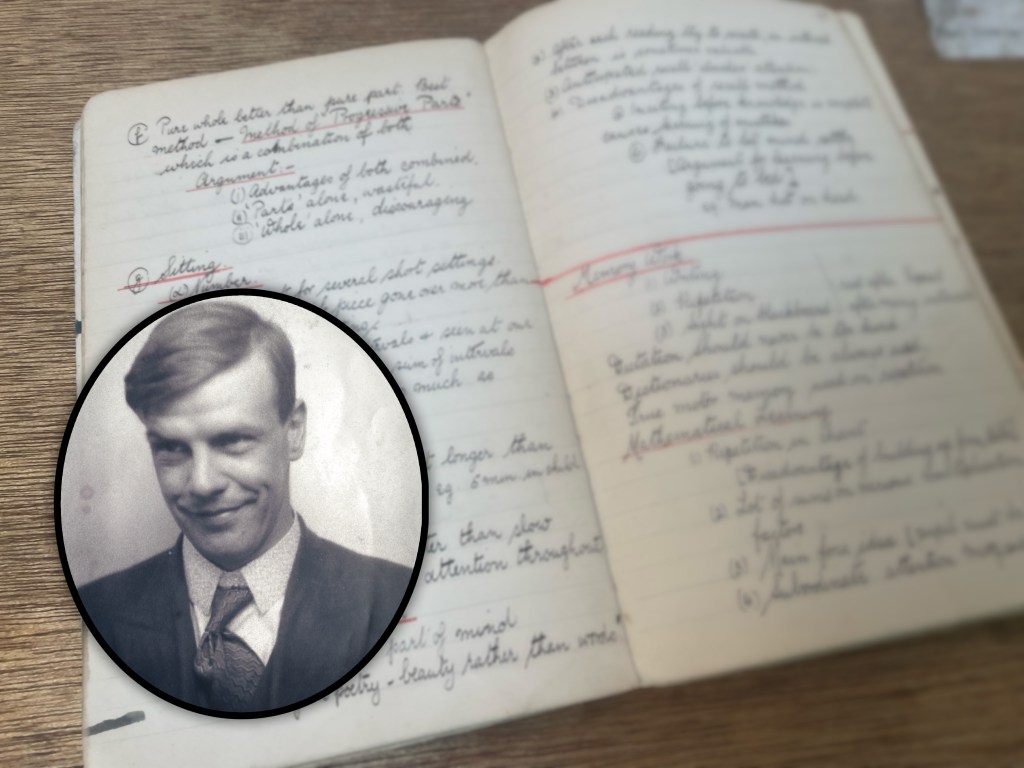
As well as the values cup, Mrs Child has donated several of her grandfather’s belongings to Guernsey’s Island Archives.
These include photos, journals and even a list of evacuated children.
‘Does anyone remember him?’
She said she was keen to hear from anyone who remembered her father, aunt or grandparents from their time in Guernsey.
“I’d be interested to know if there was anybody on the island who remembered him from the school in the 1930s.”
Anyone with any information can contact her through St Martin’s current headteacher, Clare Giles, she added.
Ordinary life
Mrs Child said she was also looking for a publisher for her father’s memoirs, which showed what an “ordinary life” looked like growing up in England and then building a life in pre-war Guernsey.
“Life back then was very different from today [when Lancelot was growing up],” she said.
Queen Victoria had only died two years earlier.
Most people travelled by horse and cart, as cars were rare, Mrs Child explained to the school’s modern-day pupils.
In fact, the first aeroplane flew just one week before Mr Sloggett was born, and it would be years before Guernsey saw one.
Likewise there was no electricity or TV and homes were heated by wood or coal fires.

Children’s lives were different too, she added, with slate and chalk instead of iPads.
But the lack of modern technology was no issue for Mr Sloggett, who loved being out in nature.
“In summer, the family would picnic at Fermain Bay, eating cucumber and tomato sandwiches on the beach,” Mrs Child added.
Different century, same values
Regardless of the changes in the last 120 years, one thing has remained constant, Mrs Child said – the values of St Martin’s Primary School.
She concluded: “Those were his values, all that long time ago, and that’s how he wanted everybody in this school to behave and hold most dear.”
“So I thought, ‘What would Lancelot like?’
“And I thought he’d like to honour [the children of St Martin’s].”
