


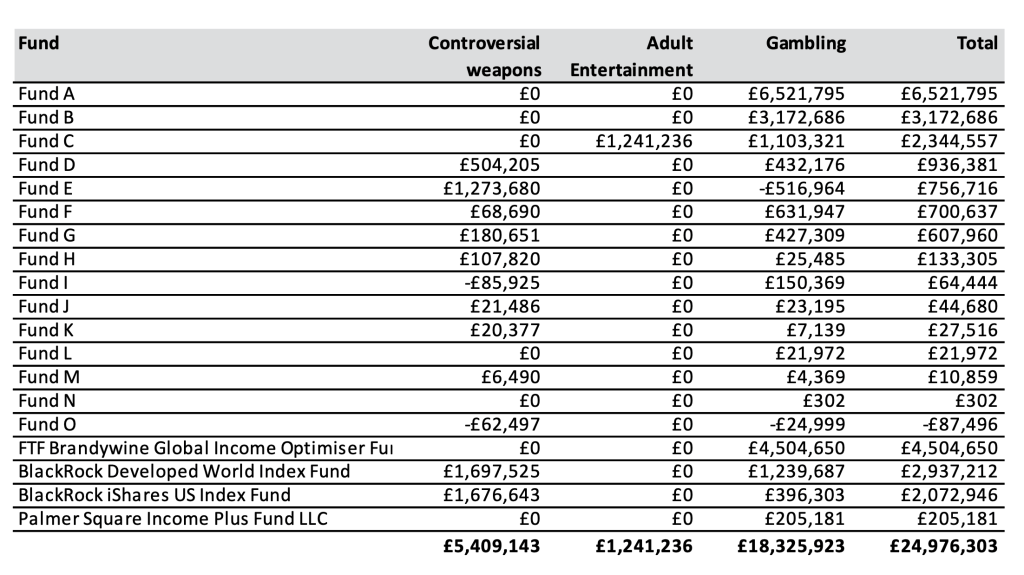
£25million of Guernsey’s money is tied up in investments linked with gambling, weapons, and adult entertainment.
The bulk of that amount – more than £18m – is held in investment portfolios linked with gambling, while more than £5m is in portfolios linked with “controversial weapons”, and a further £1.5m in accounts linked with adult entertainment.
Despite being Chief Minister since early July, Deputy Lindsay de Sausmarez wasn’t privy to this information, so she lodged official questions with Policy and Resources – the committee which she is President of – to find out the answers.
She asked for “details on the total exposure of the States of Guernsey’s investment portfolios to controversial businesses by total GBP investment amount”.
The answer came back this week – but the data relates to figures accurate at the end of 2024, which is the most recent data available.

While there is a lot of money invested in portfolios linked to the controversial activities, P&R’s response tried to clarify that it is a very small amount of the money the island has invested in total.
The combined £25m invested in portfolios linked to gambling, weapons, and adult entertainment represents just 0.73% of Guernsey’s total investments, explained P&R.
“It must again be noted that much of this exposure is to companies that are not narrowly focused on controversial industries but are included on the basis that certain parts of their operations fall within the MSCI definitions we utilise in reporting,” P&R added.
Some of the companies that Guernsey has money invested in, through portfolios, are linked with BlackRock which is the world’s largest asset manager.
Some of the companies that Guernsey is linked with through its investments are well-known names such as Wynn Resorts, Galaxy Entertainment Group Ltd, Konami Group Corporation, and MGM Resorts International.
P&R says Guernsey’s exposure to “controversial sectors” is minimal because the money invested is “below global index averages”.
“These exposures are monitored and managed on a continuous basis,” added P&R.
P&R has also said it won’t be withdrawing any money from these controversial funds, nor will it be looking to restrict making investments in such funds in the future.
That would be unworkable it said, in response to Deputy de Sausmarez’s questions.
“While the aspiration to eliminate exposure to controversial sectors entirely is understandable, there are several practical considerations that have a bearing on its compatibility with the SIB’s broader objectives.
“Imposing a strict 0% threshold would significantly reduce the pool of eligible managers or funds.
“This may mean the States of Guernsey’s investment portfolios are not able to access the best strategies available to them. Within passive exposure, this may mean we rely on niche or custom-built solutions that lack scale or track record. Within other asset classes this may mean we are not able to invest in certain strategies altogether.
“The consequences of this are potentially higher costs, lower performance, and greater risk, which run contrary to the SIB’s primary objective of achieving superior risk-adjusted returns.
“The Board believes that our current ESG policy strikes a balanced and effective approach — minimising exposure to controversial sectors while maintaining flexibility to achieve strong risk- adjusted returns and support broader sustainability goals.
“We remain open to enhancing our ESG framework and will continue to monitor exposure levels, engage with managers, and report transparently. However, we recommend not adopting a blanket 0% exposure policy at this time, given the potential trade-offs in cost, performance, and strategic flexibility.”

Deputy de Sausmarez is not the only politician concerned about exactly where our money is invested through the States of Guernsey’s portfolio.
Deputy Andy Cameron recently asked questions about BlackRock in particular – as he tried to find out how much public money is tied up in accounts linked with the asset managers funds.
He was told that four BlackRock index funds are held directly within the States of Guernsey’s Investment Portfolios.
“The Investment Portfolios are highly diversified, with positions in a large number of underlying managers,” P&R said in June.
“These underlying managers may make limited use of BlackRock funds as part of their own strategies, giving rise to indirect positions in BlackRock funds. These indirect positions may be held for the short or long term and are not entered into at the States of Guernsey’s discretion.
“Any individual indirect position is likely to be extremely small in relation to the size of the overall portfolio.”
Deputy Cameron was also told that “none of the largest 10 holdings within each respective fund are securities issued by weapons manufacturers or defence contractors”.
He was also told that none of these States investments are assessed against Environmental, Social, and Governance concerns.
“These four funds are broad, passive, index funds that give exposure to an underlying equity or fixed income index and, as such, there are no ESG screens applied at the level of the fund,” said P&R.
