

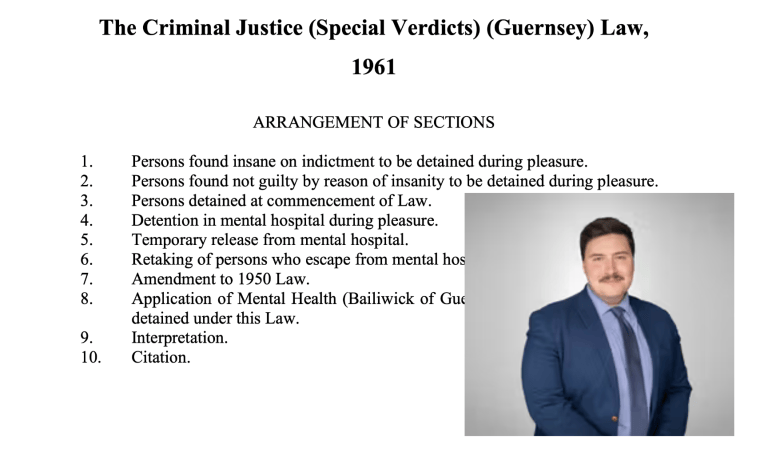
A deputy plans to ask questions in the States about the impact on modern court cases of a 1961 law governing defendants who are unfit for trial, after an Express article highlighted a senior judge’s concerns.
Deputy Tom Rylatt will question the Home Affairs President in the States tomorrow morning, after he was left with “serious concerns” about the “adequacy” of the ‘Criminal Justice (Special Verdicts) (Guernsey) Law, 1961‘.
The law governs how the island’s courts deal with people who are found unfit to enter a plea or be sentenced on criminal charges.
Judge Catherine Fooks has twice highlighted the urgent need to reform this law – first in 2024 when dealing with a case involving a ‘young person’ found to have committed sexual offences, and this year, when dealing with a high-profile case involving an adult sex offender.
Deputy Rylatt wants to know what has been done to update the law since Judge Fooks first raised her concerns two years ago.
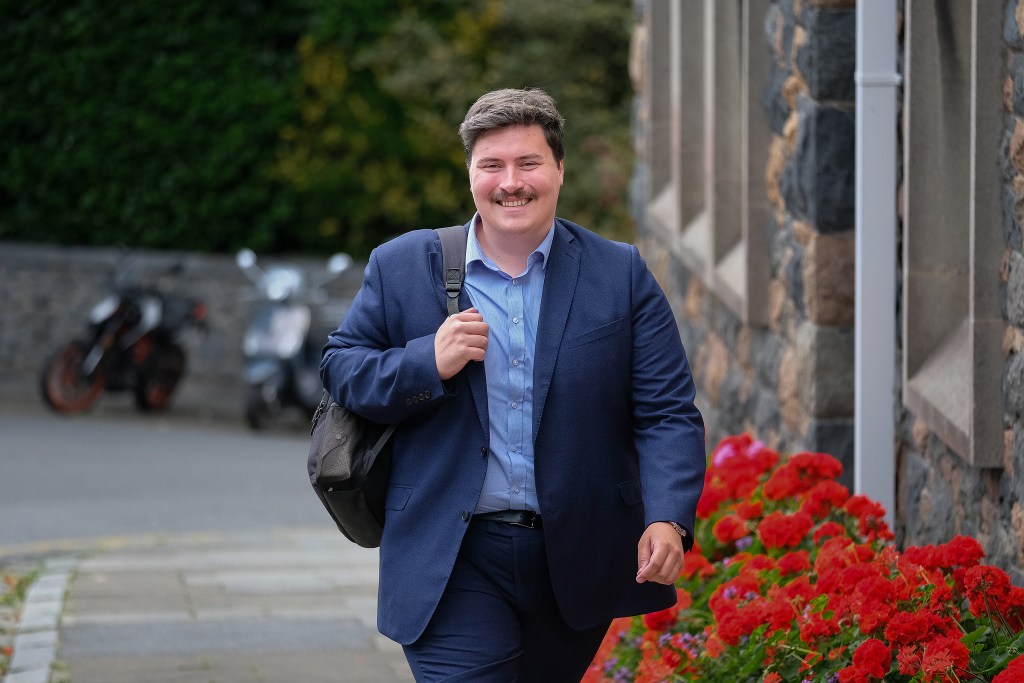
“I’ve lodged the question because we have now had two judgments, almost two years apart, in which serious concerns have been expressed about the adequacy of the existing legislation,” he told Express.
“In cases involving someone who is unfit to plead, it is clearly in the community’s interests that the courts have a sufficient range of powers to protect public safety and ensure such cases can be dealt with fairly and appropriately.”
Deputy Rylatt confirmed that Express‘ article published earlier this month prompted his question.
Our research found that Judge Fooks had raised concerns about the 1961 Law twice, with her written judgment on the 2024 case saying that “the Law Officers are fully aware that urgent reform of the Law is needed” and that she was “assured that work is under way to achieve that reform”.
Our article highlighting the judge’s call to urgently reform the law prompted some members of the public to agree – commenting on Facebook that it was long overdue.
Deputy Rylatt is now asking what progress has been made.

“Importantly, the October 2024 judgment indicated that work was already underway to reform the legislation,” he said.
“Given that almost two years have passed and the need for reform has once again been highlighted, I think it is reasonable to ask what progress has been made and when deputies can expect to see proposals.”
1961 Law
The ‘Criminal Justice (Special Verdicts) (Guernsey) Law, 1961‘ governs how the island’s courts deal with people who are found unfit to enter a plea on criminal charges.
Where an individual is found to be unfit to enter a plea, the courts can order that the individual is detained at His Majesty’s Pleasure in an approved establishment.
In Guernsey this could be the Oberlands or another part of the Princess Elizabeth Hospital as an alternative to prison.
The detention can be for a fixed or indefinite length of time.
William King case
Sex offender William King was released from custody over the summer after his advocate Peter Ferbrache successfully argued that he could no longer be detained at the Oberlands facility at the Princess Elizabeth Hospital under that law.

Described as having learning difficulties and autism, 45-year-old King had been held at Guernsey’s mental health facility since January 2025 where he was undergoing a sex offender treatment programme.
Despite being described as posing a “high risk” of reoffending, Advocate Ferbrache and mental health professionals, including Consultant Psychiatrist Dominic Bishop, said that King’s rehabilitation could be managed in the community going forward.
The Ordinary Court – with three Jurats and Judge Catherine Fooks presiding – agreed that King could not stay on Crevichon ward indefinitely.
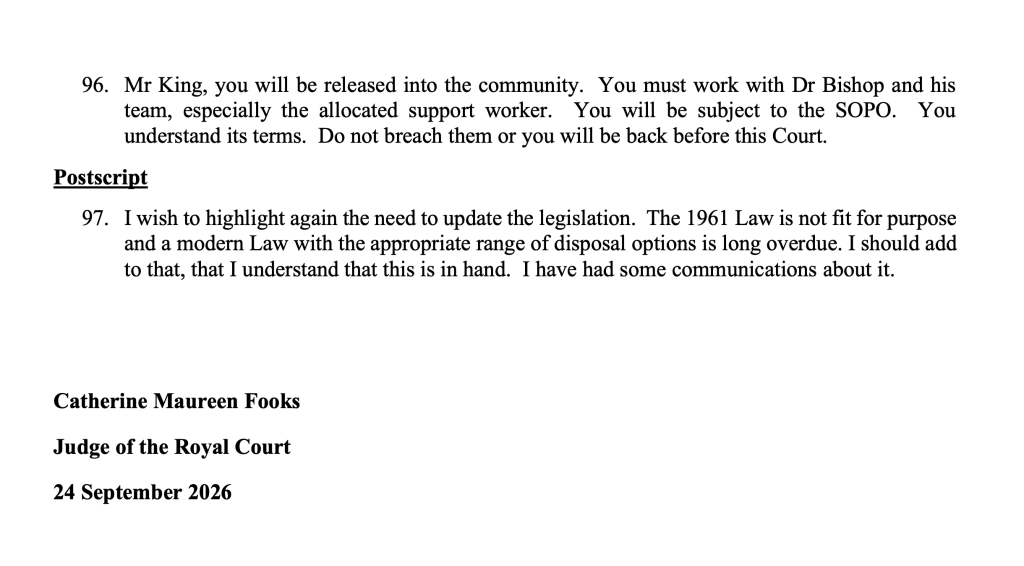
After tweaks to his community rehabilitation plan, King was released to his mother’s home in August.
He was detained after being found to have committed sexual offences – including sexually assaulting a woman in his car – despite being found unfit to plead.
2024 case
In presiding over a case involving a young person – who can’t be identified – Judge Fooks said “urgent reform of the law is needed”.
In that case, the court decided that the young person who was unfit to stand trial had downloaded 234 indecent images of children, taken four, and distributed two of them.
The young person was made subject to a Supervision Order with Notification and MAPPA processes in place to assist them and to protect the public.
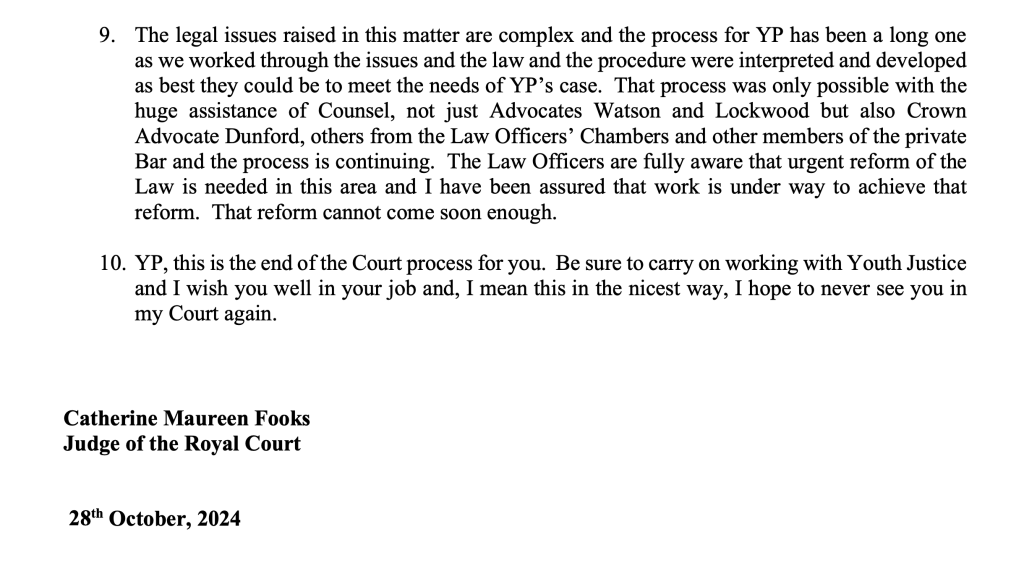
In 2024, the orders were discharged after it was determined that holding the young person at the Oberlands “would not be an appropriate order” under human rights laws.
Express asked Judge Fooks to comment on her calls for the 1961 Law to be updated – she declined to comment, saying it would be “inappropriate” to do so.
