


Guernsey is in the process of getting ready to celebrate the 80th anniversary of the end of the German Occupation, and as we get further and further from that occasion, it becomes more and more important to turn those oral histories into recorded and written ones.
If they are documented, they will never be able to fade from memory.
Those who lived through the horrors of the Second World War will agree that it is crucial to avoiding the mistakes of the past, and honouring those who went through so much. That includes Pamela Masterman.
Five years ago, during the Covid-19 Pandemic, I was working at BBC Radio Guernsey. I decided that as part of the 75th celebrations of Liberation Day I would ask my Nan if she was interested in sharing her story.
As an evacuee, I always knew she’d been through more than I could imagine at a young age, but we’d never really had a proper talk about it.
I also have a younger brother, Sam. He was a teenager at the time, so I felt it was poignant for him to lead that conversation.
Against a backdrop of separation due to lockdown restrictions and covid bubbles, with masks and enough anti-bacterial gel to crack the skin, we managed to make the chat happen between Pamela Masterman, then 82 years old, and Sammy, just 13.
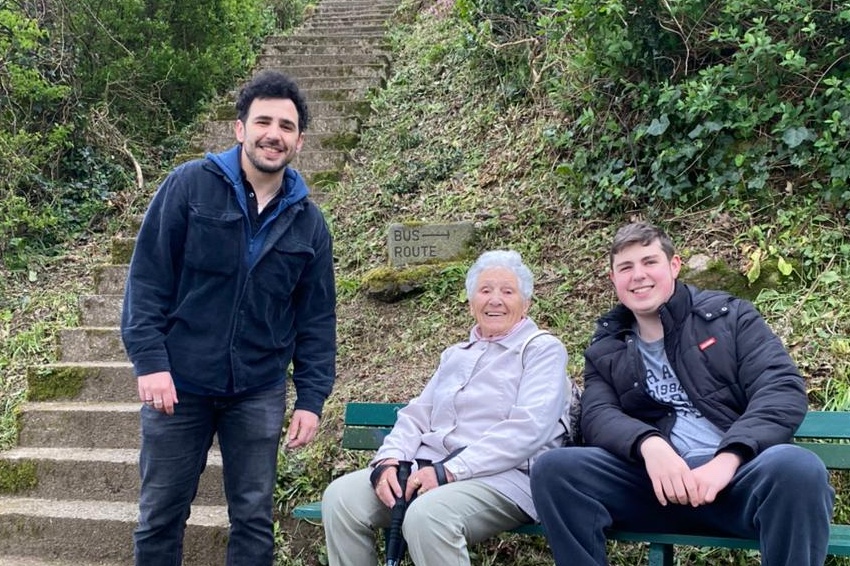
Sam: “Did you go with anyone when you were evacuated? Or did you go on your own?”
Pamela: “As far as I know, it was my mother, my brother and I, and as far as my mother told us, we were taken to a church somewhere, and then we were billeted out with somebody for a few weeks. Then we were moved around from pillar to post for the next few years. We finally landed up in Birmingham.”
Sam: “Do you remember who stayed with the most at the time?”
Pamela: “Oh, I know they were a Mr. And Mrs. Baker, but who they were, I couldn’t tell you. We stayed with them for quite a while. They let us have one room.”
Sam: “So you weren’t in the same house the whole period the war? You kind of moved around?”
Pamela: “We were moved around, yes, we spent a couple of months in one place, six months somewhere else. We moved around from Nottingham, Birmingham, Manchester, Fulham, oh, just all over the place. We were moved around!”
Sam: “Were you glad you were young during the war?…
Pamela: (At the same time) “Yes!”
Sam: “Because you didn’t remember part of it?”
Pamela: “I do remember the barrage balloons, and I do remember the planes going over. Having to rush down to shelters. I do remember running to a railway station, and we had to all go down there, and sit down there and wait till the planes had gone over. I do remember the buzz bombs going over and we wait for them to whistle and little things like that. One doesn’t ever forget things like that, especially the sirens. I don’t like to hear them, even today, when they did them one year down at the harbor over here. I don’t like it.”
Sam: “How long did you not see your dad for?”
Pamela: “Five years. I was seven years old before I saw my father again. My father left before we were evacuated, and I didn’t see him again till I was seven years of age.”
Sam: “Do you know where he was posted during the war?”
Pamela: “He spent five years out in Egypt. In Palestine. But he sent us some lovely cards and things from there, when he could, when he came back. He was invalided out, and when he came back, he brought us some lovely things from the east. We were very lucky.”
Luke (Rudely interjecting): “How did that affect you? Having your father so far away at such an unbelievable time for a young child?”
Pamela: “Well, as far back as I can remember. When I left here for two I didn’t realise my father was gone. I didn’t realise that until I was about six, and my mother said my father was coming back from the war in another year’s time, hoping to come back for my seventh birthday! He didn’t manage until after I was seven. So not having a dad didn’t really affect us, because we hadn’t had one.
“We went over there, over to the mainland, and we never had one until he came home so…Mum used to talk about a gentleman being my father, but I couldn’t visualise it. We didn’t have any photographs, so I don’t suppose it meant anything to me at the time. Probably it meant more to my brother than to me because he was older.”
Sam: “How did you feel when you saw your dad again after the war, after he came back?”
Pamela: “I cried my eyes out. I think I hid behind my mother, because even though I was coming up to seven, my father was a big chap. I think it frightened me more than anything, although after, after the initial introductions and that, it was lovely. I don’t think I left my father alone. After that, I remember sitting on his knee.”
Pamela returned to Guernsey in 1948, where she has resided ever since.
Sam: “How did that feel when you returned?”
Pamela: “Oh, I thought it was marvellous, because we went to see the sea. We went to stay with my grandmother for a while, and the first beach we ever went to was Moulin Huet. We just spent all the summer there, and it was lovely.
“We were free. There were no bombed buildings or anything like that, like we used to run over when we were in England. It was really lovely coming over. I can always remember it. Driving up from the boat to my grandmother’s, and then the following day, my cousins came around, and they all took us down to Moulin Huet, and we had a beautiful day down there. I’ve never forgotten it, and I do love Moulin Huet, even today.”
Sam: “What were the years after the war like?”
Pamela: “It’s totally a totally different place to the mainland it was! Because over there, where we were stationed in Fulham and different places, we had to go through a lot of over bombed building sites. I always remembered running over them and being told off for doing it. And we came back here and everything was so quiet. It was totally different. There was no trains to go on. Everybody was pleased that the war was finished, but everybody was so busy, and doing what? I’m not sure, because when we came back, being a young child, all we wanted to do was go swimming.”

I’m so glad I recorded this conversation.
Both Nan and Sammy are both fine, my Nan is going strong at 87 years old, almost 88 now! Meanwhile Sammy is proving that he got all the brains of the family at university.
I’m glad we recorded this conversation because we all know the impact of first hand accounts such as my Nan’s.
It gives an appreciation of all they went through, what that kind of war does to entire countries, but having that personal connection to it gives it that extra level of poignancy.
If you have a relative who was an evacuee, deportee, or was occupied. If you have someone with a story to tell in your life; ask questions, learn their history, learn what they went through.
In a world where it’s easy to get wrapped up in the complexities of our modern life, it’s incredibly humbling to hear what was happening during those dark years in world, and local history.
Thanks to BBC Radio Guernsey for allowing Express to use a transcription of the audio, and if you would like more Liberation, and occupation content, you can read all about the Guernsey-born Podcast Producer, Ollie Guillou, who recently released a new series with his gran, Guernsey deportee Jill Chubb HERE.
You can also learn of Roland Duquemin’s story, who was 7 when the Germans occupied Guernsey, and the 5 years he spent under German rule HERE.

Leading provider of trust, corporate and fund administration solutions VG is proud to support Bailiwick Express's Liberation 80 coverage.
