
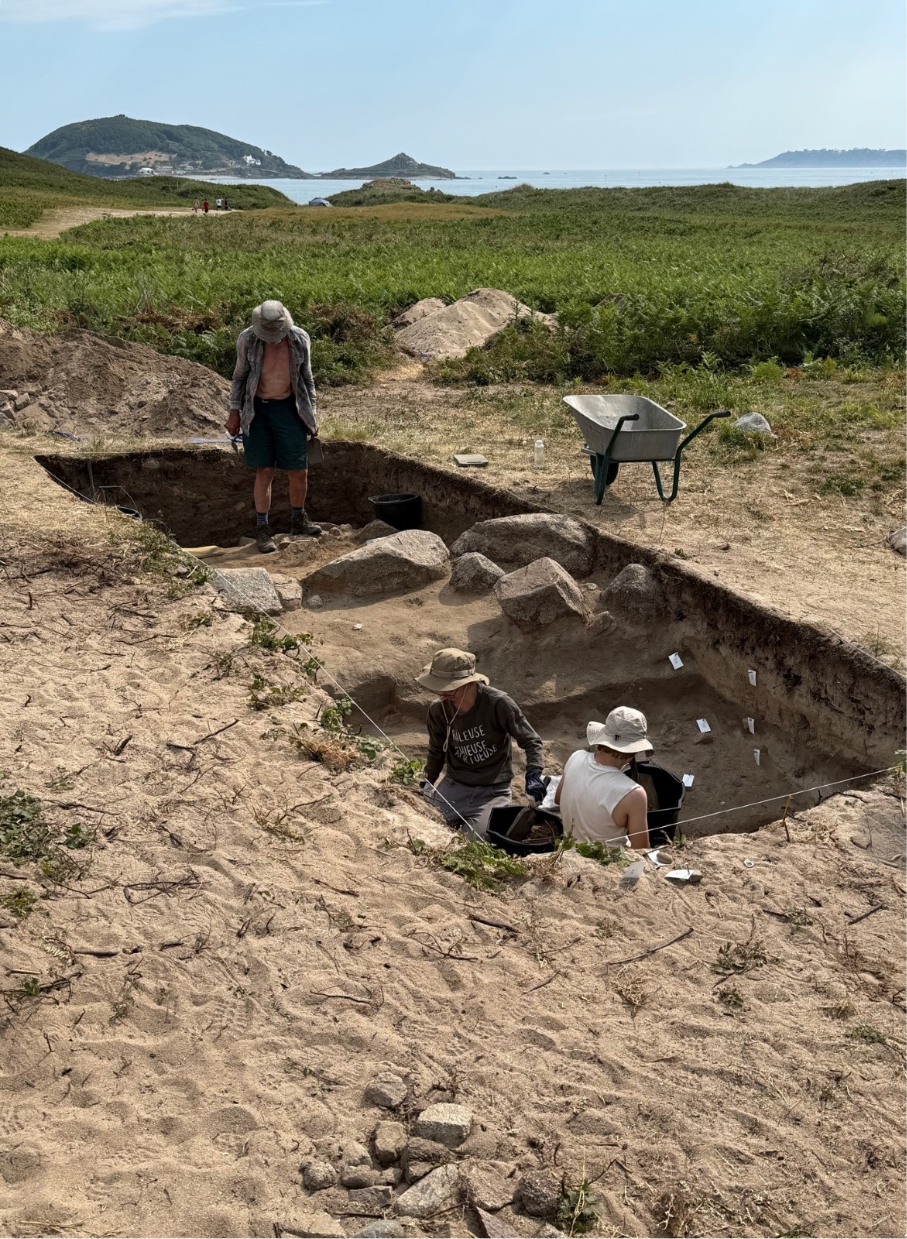

Archaeologists returned to Herm this summer to continue their work to unearth the island’s neolithic past.
The NEOSET (NEOlithic SETtlement) project has excavated Herm to discover settlement and burial sites on the island that date back to between 6,500 and 4,500 years ago.
After successful excavations in 2024 and 2025, the team resumed their work this year, focusing on the path leading to Bear’s Beach and at Robert’s Cross.

Led by French professor Hélène Pioffet-Barracand and Chris Scarre, Emeritus Professor at Durham University, they dug through Herm’s windswept landscape to reach the neolithic remains.
Dr Scarre said: “We’re not only uncovering new evidence about the megalithic tombs on Herm, but we’re also finding traces of the settlements of some of the earliest farmers on the island, all buried today beneath the wind-blown sand that has accumulated in recent millennia.
“It is always exciting to strip back the sand and expose these surfaces that have not been seen for thousands of years, that give insights into the world of the people living on the island in the past.”
At the Bear’s Beach site, archaeologists reopened a trench dug last year where they found two postholes, pottery and lithics – stone tools.
Digging deeper this year, the team found another posthole and they intend to conduct more research on it next year.

At Robert’s Cross, a new trench was dug to confirm whether a line of blocks found in 2024 form a circle.
The circle was not found, but, surprising the archaeologists, a bank was found running between two tombs.
The bank was capped by large granite blocks and seemed to use the tombs as anchors on a line between Petit Monceau towards Grand Monceau.
Archaeologists thought it might have been a medieval structure, but further excavation revealed that it dates to 2500 BC – 4,500 years ago. The tombs, though, are much older, having been built around 6,000 years ago.
Roman plough marks from 2,000 years ago, a sequence of tombs and a megalithic wall suggest Robert’s Cross has been important to civilisation for some 6,000 years.
