

Policy & Resources (P&R) has repeatedly argued there are “no credible alternatives” to its own tax reform proposals, which includes a 3% GST.
So Express decided to test that claim, by looking at a series of proposals from other deputies.
Next up: Deputy David Goy and his Productivity Incentivisation Tax (PIT) framework, which targets higher-value assets, under-contributing households, vacant housing and high-net-worth arrivals rather than applying a broad-based consumption tax.
The big idea
Instead of imposing a broad-based GST, Deputy Goy proposes a series of targeted taxes aimed at higher-value properties, underutilised housing, high-powered vehicles, high-value property transactions and high-net-worth new arrivals.
His plan consists of eight amendments: five proposing alternative tax frameworks for P&R to investigate, and three introducing measures aimed at preventing government waste.
“Broad-based taxes belong at the very top of the escalation ladder,” Deputy Goy argues, saying targeted taxes, measures to reduce government waste and economic growth should be investigated and pursued before broad-based taxes are considered.
In his own words: What Deputy Goy says
Deputy Goy told Express: “It is very obvious that P&R’s claim of ‘no credible alternatives’ is not true. To make that claim, you would first have to investigate the alternatives. And I use the word ‘investigate’ in its literal sense.”
“Broad-based taxes (with GST being just one example) belong at the very top of the escalation ladder. This is because their impact is indiscriminate: they raise the cost of living for everyone, with ordinary people impacted the hardest.”
“If an HNWI were instead to leave the island because of such a modest contribution, that would suggest that they did not have meaningful economic, business, employment or family ties to Guernsey in the first place, and that their primary reason for being here was the favourable tax environment.”
“A sufficiently punitive TRP rate for vacant properties and holiday homes would, hopefully, deter property speculation and the use of scarce island housing as a passive store of wealth. If owners choose to sell, that would increase housing stock. If they choose to rent, that increases supply. And if they hold on, they contribute more. It is a win-win either way.”
The diagnosis: What is actually broken?
Deputy Goy strongly rejects P&R’s claim that alternative tax options do not exist, arguing that P&R has not properly investigated or modelled the alternatives.
His framework highlights five areas where he believes there is scope for additional taxation:
- Under-contributing high earners: States data shows 560 households living in the top 10% largest properties on the island pay less in combined income tax and social security than the median household.
- Property speculation: Houses left vacant for over 12 months or used as passive stores of wealth could face higher TRP under his proposed Underutilised Property Levy.
- High-powered vehicles: Deputy Goy’s Premium Road Levy would replace P&R’s proposed Transport Tax with an annual registration fee targeting the top 10% most powerful vehicles.
- Multi-million-pound property transactions: High-value property purchases would face additional document duty surcharges under his proposed High-Value Document Duty.
- High-net-worth arrivals: A Jersey-style minimum income tax contribution would apply to new high-net-worth arrivals through the Open Market Property route.
How the numbers stack up
Deputy Goy explicitly declines to publish speculative revenue totals, pointing out that deputies lack access to all the internal Revenue Service data needed to populate the variables.
Instead, his five tax amendments ask P&R to investigate the measures using existing States data and mechanisms, and report back to the States by June 2027.
- Fair Contribution Levy (FCL): Targets households in the top 10% largest properties whose combined income tax and social security contribution is below the median household contribution, subject to exemptions.
- Underutilised Property Levy (UPL): Applies higher TRP rates to properties vacant for over 12 months or occupied for fewer than 183 days a year, subject to exemptions.
- Premium Road Levy (PRL): Replaces P&R’s Transport Tax by targeting the top 10% most powerful vehicles and new cars over £65,000.
- High-Value Document Duty (HVDD): Adds 25%, 50% and 75% surcharges on property purchases over £2.5m, £5m and £10m respectively.
- High-Net-Worth Residency Scheme (HNWRS): Introduces a Jersey-style minimum income tax contribution for new Open Market arrivals.
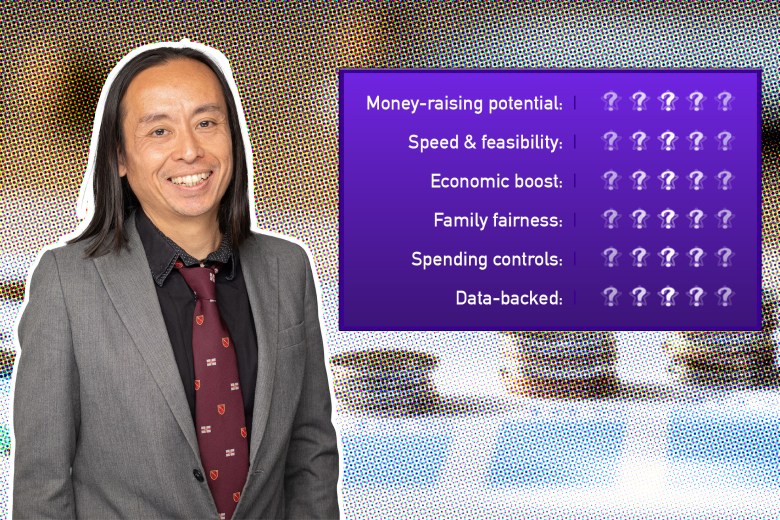
Express scorecard: The wealth & luxury surcharge plan
The key questions raised by Deputy Goy’s proposal are how much the measures could raise, how quickly they could be implemented, what behavioural effects they might have, and whether the States can establish their feasibility from the available data.
| Question | Score | What the proposal currently shows |
|---|---|---|
| 1. How much could it raise? | ★★★☆☆ (3/5) | Targets specific high-value revenue streams using explicit mathematical rules, but Deputy Goy is asking P&R to model the potential yield using States data. |
| 2. How fast can it be done? | ★★☆☆☆ (2/5) | The five tax amendments call for investigation and reports back to the Assembly by June 2027, followed by any necessary legislative work. |
| 3. Will it help the economy? | ★★★☆☆ (3/5) | Deputy Goy argues targeted taxes could avoid some of the economy-wide effects of a broad-based consumption tax, while some measures are intended to change behaviour around property and vehicle ownership. |
| 4. What would it mean for working families? | ★★★★★ (5/5) | The proposals are designed to avoid applying the proposed charges broadly to ordinary households, with the PRL specifically intended as an alternative to P&R’s wider Transport Tax. |
| 5. Does it address government waste? | ★★★★☆ (4/5) | Yes. Three of the eight amendments separately seek measures to prevent government waste. |
| 6. Is it backed by hard data? | ★★★☆☆ (3/5) | Built on detailed, transparent blueprints using existing States mechanisms (TRP, vehicle kW, utilities). Fully worked out formulas, but requires internal civil service data to calculate the final yield. |
Note: We are testing the proposals at a high level, looking at what they propose, the evidence and assumptions behind them, and how they compare with the P&R’s stated position. We are not independently modelling each proposal or assessing its full economic impact, as we don’t have access to P&R’s underlying tax models or data, so our analysis should not be read as an independent economic assessment of the potential revenue or wider effects of any proposal.
The catch
Because Deputy Goy refuses to guess revenue figures without the necessary civil service data, his plan does not offer a pounds-and-pence revenue total today.
Its next step depends on P&R carrying out the investigations requested in the amendments and establishing whether the measures are practical, what they would cost to administer and how much revenue they could generate.
Deputy Goy also makes clear that revenue is not the only objective of some of the measures.
The UPL, for example, is intended partly to change behaviour around vacant and underused property.
The proposals are therefore not presented as a complete replacement for P&R’s tax package on their own.
Deputy Goy says they are intended to contribute alongside measures to support economic growth and reduce government waste.
The bottom line
Deputy Goy’s plan challenges P&R’s claim that there are no credible alternatives by setting out five specific tax frameworks for the States to investigate, rather than providing a completed alternative revenue model.
Its central weakness is also its central feature: the potential yield remains unknown until the States carries out the modelling Deputy Goy is asking for.
As he puts it: “At the very least, you would need to model an alternative and publish the results. For some alternatives, you might even need to run a pilot programme and test it over a period of time to see what the results are.”
And his wider argument is that broad-based taxation should only come after more targeted measures, government waste reductions and economic growth options have been properly investigated and exhausted.
Deputy Goy’s proposals in full
You can find the full details of Deputy Goy’s proposals on his website, including a 160-page PDF (nearly as long as P&R’s 172-page tax policy letter).
We’ve published his full response to our questions HERE.
