


A political campaign group has welcomed recommendations from the independent election observers who visited the island when we went to the polls in June.
They’ve made nine in total, ranging from establishing a permanent Electoral Roll to creating various ‘Code of Conduct’ systems for candidates and the media, and rules for parties.
They also included a recommendation that Guernsey extends conventions covering discrimination, and the report noted an improving rate of equal representation in the States, although it’s not quite balanced yet.
Specifically, the Commonwealth Parliamentary Association’s election observers said the States should: “Extend the Convention on the Elimination of All Forms of Discrimination against Women (CEDAW) and the Convention on the Rights of Persons with Disabilities (CRPD) to Guernsey to reinforce its commitment to equality, non-discrimination, and inclusive democratic participation.”
CEDAW is a UN human rights treaty adopted first in 1979. Known as the international bill of rights for women, it serves as a guarantee for women’s enjoyment of human rights and freedoms, particularly in areas like law, education, employment, health, and marriage.
Shelaine Green, Chair of Women in Public Life, would be pleased to see the island recognise CEDAW, but she believes there is also work to be done locally too.
“We welcome the elections observers’ recommendation that CEDAW is extended to the island, Guernsey is far behind other jurisdictions in this respect.
“But it’s important to stress that the States could be doing a lot more to encourage women and other under-represented groups to stand for election. It doesn’t need to wait for CEDAW and shouldn’t be relying on groups of volunteers like us.”
She looked to our nearest neighbour, for what other jurisdictions are doing.
“For example, the States Greffe in Jersey hosted a special event on International Women’s Day this year to celebrate the island’s female political pioneers and inspire more women to stand for election to their States Assembly”.
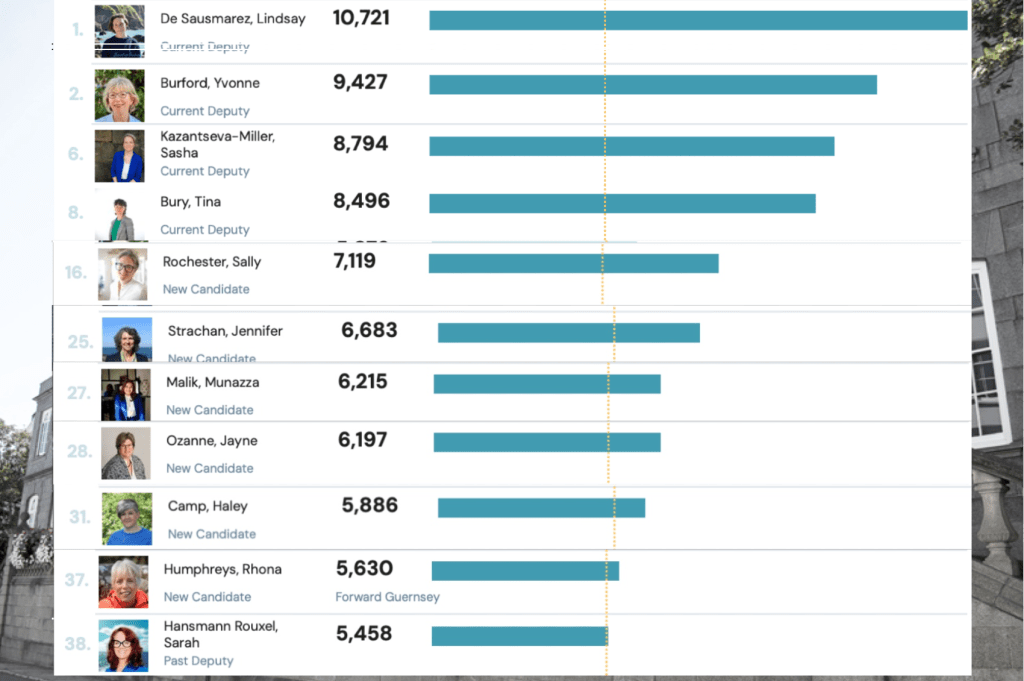
In the report from CPA BIMR, the oberservers also noted the imbalance when it comes to the number of women in political positions, compared to what the figures should say.
“Women, although still underrepresented in public office, made up a record-high 33% of the candidate pool. Eleven women were elected to the States of Deliberation, representing 28.9% of the 38 seats. This was a significant improvement compared to previous elections, though still just below the 30% threshold identified in the Beijing Declaration and Platform for Action, adopted at the United Nations Fourth World Conference on Women in 1995. This benchmark was originally set as the minimum needed for meaningful participation.” – CPA BIMR, Guernsey EOM 2025 – Final Report.
So despite a record number of women wanting to be involved in the political sphere that governs Guernsey, the Bailiwick still feels short of the international “minimum standard” needed for “meaningful participation”.
Ms Green said WIPL is pleased with record breaking statistics but it still wants more too.
“There were times in the last States term when we didn’t think anyone was going to want to stand for election in 2025, so we were both pleased and relieved that 33% of the candidates were women, that’s a record proportion. We were happy to support many of them with our Train to Campaign programme.
“The election observers are right to point out that although the number of women elected increased from 8 to 11, that’s still below minimum international standards and a long way from parity. There’s still a lot of work to do to ensure balanced decision making in the States.”
