

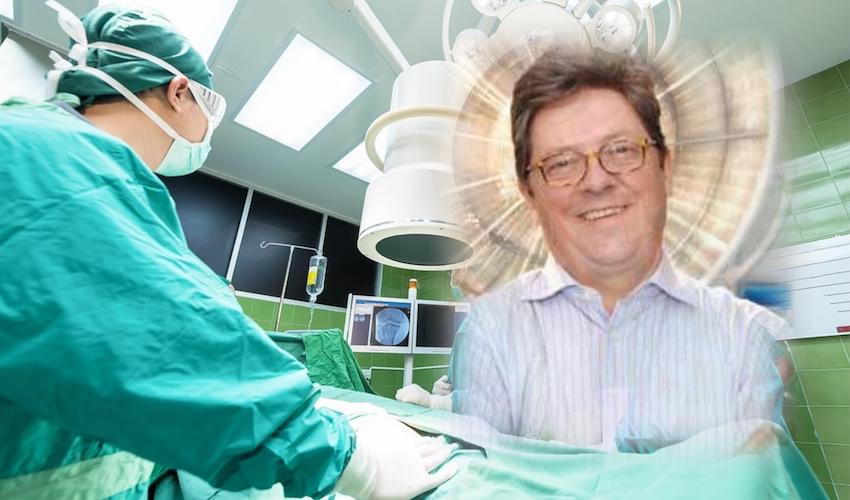
Guernsey-born Professor Simon Kay OBE recently made headlines again for performing the complicated 12-hour procedure on a quadruple amputee.
Professor Kay performed the UK’s first double hand transplant in 2016 and now the second procedure has made a quadruple amputee Connie Hutton the first Scot to receive the same operation.
The world-famous surgeon decided to pursue a career in the specialist field after severely damaging his own little finger as a child when he was growing up in Guernsey.

Pictured: The UK’s first double hand transplant patient, Chris King, claps Leeds Rhinos rugby team onto the pitch after his successful operation conducted by Professor Kay.
Professor Kay suffered the serious damage to his left little finger when it was caught in an electric fire at the family home.
By the age of 15, despite having endured 10 years of surgical procedures to try and correct the damage, Professor Kay asked GP Dr Jim Dixon to amputate the little finger, even though it was on his dominant left hand.
“What it taught me is that our desperate parents would go to any lengths for us to make up for these things. The cost [of the accident] was to have very complex surgery, I had a number of operations. In those days it involved a moulded cast which was screwed together, that went on for many months,” he said.
“I was taken to the leading doctor at the time in Harley Street and I wasn’t very impressed. I later proposed removing the finger as it had become incumbent which shocked my parents but the doctor, who was a very nice man, obviously thought it was sensible,” he said.
The accident meant that the Professor had to teach himself how to use his right hand, which he now uses to perform countless life-changing surgeries. In addition to the two double hand transplants, the leading surgeon also worked to reconstruct one man’s hand after a motorcycle accident using two of his toes.
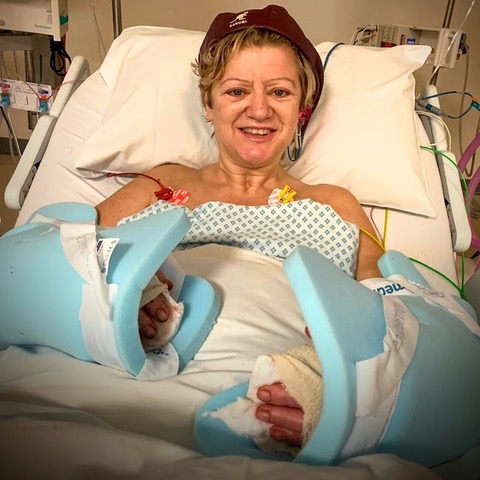
Pictured: Quadruple amputee Connie Hutton became the first Scottish person to receive the ground breaking double hand transplant procedure after a five-year wait for the operation.
Professor Kay said his childhood experiences left him more in tune to the psychological element of surgical procedures on deformities in children.
“We’ve changed the way we treat amputee patients and brought it into the common experience. It was thought about in a very technical way back then. I’ve appointed a clinical psychologist to work with me which was unusual at the time and is now becoming more prevalent,” he said.
In just over 30 years, the surgeon has brought Leeds General Infirmary from being the only Hospital left in the country without a microsurgical unit to a world leading site for those procedures.
Commenting on growing up in the Channel Islands, Professor Kay told Express: “Guernsey was a fantastic place to grow up and I had to balance when deciding whether or not to come home or go to Leeds, but there weren’t the opportunities to do the sort of surgery I was interested in on the island. Without wishing to sound smug I think there was a feeling of ‘job done’ [in Leeds] which is not a good feeling because the job is never done.”
