


Express investigates the last bid, and the potential advantages of ‘city life’ if the opportunity is taken this time…
Try and name some iconic UK city landmarks: London’s Big Ben, Canterbury’s Cathedral, Oxford’s University… Fort Regent?
The UK Government has announced that the Crown Dependencies will be able to apply for city status this year, potentially joining the collection of 69 cities across the British Isles.
It has been 10 years since the competition was last opened, with the latest round of applications coming in recognition of the Queen’s Platinum Jubilee. Local authorities from across the UK will be vying for the title, which will only be given out to a select few.
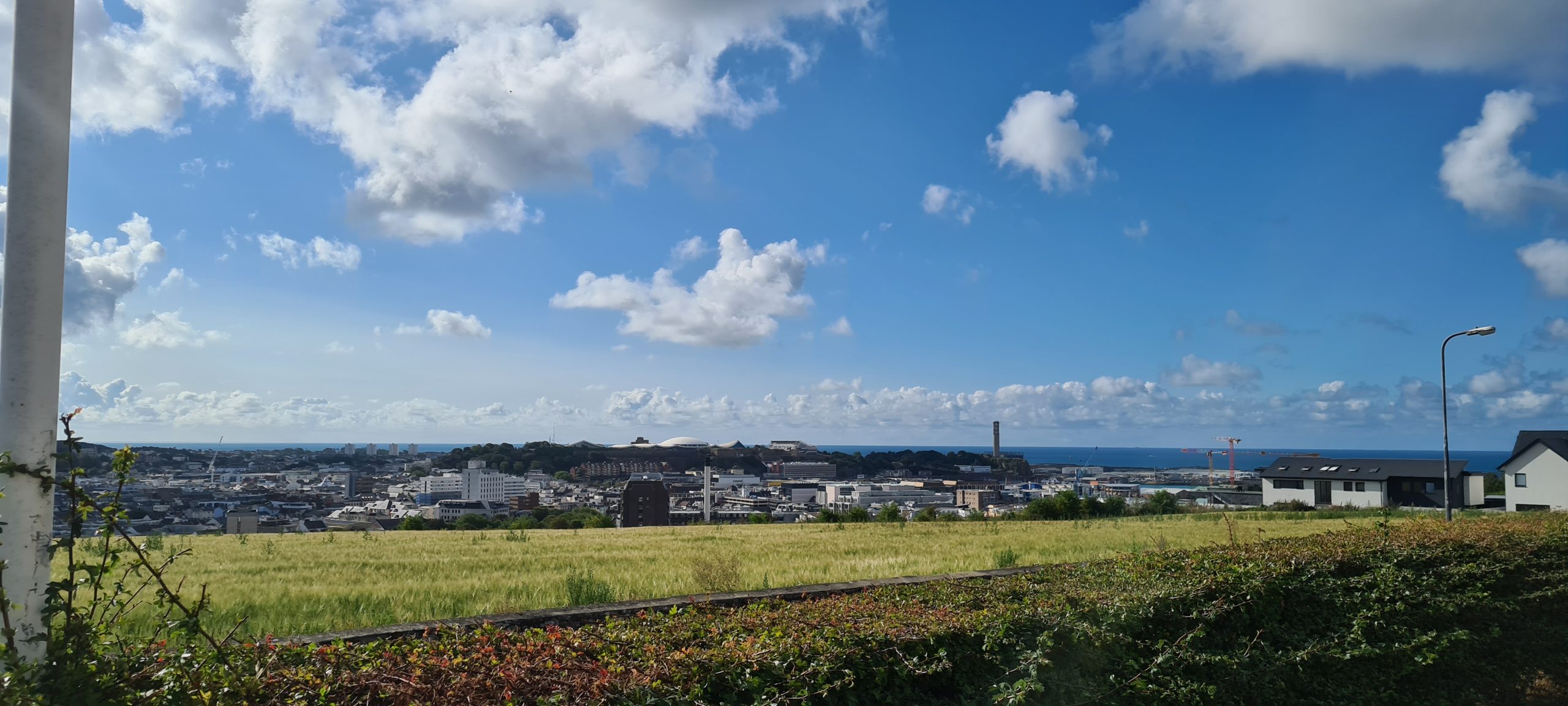
Pictured: If the Parish enter the competition, this could become a city skyline…
The last time the jubilee competition came around in 2011, the Parish of St. Helier prepared a draft bid following a working group and discussions – however, it didn’t progress past Government stages and the decision was taken not to submit it.
While the Parish and the Bailiff’s Chambers have not responded to comment on whether they will be applying this time round, they have until a December to put in their bid.
In anticipation of a decision, Express has explored the history of applying for the status, and what would be required for St. Helier to go from Parish to City…
Hang on… we don’t have a cathedral?
A common misconception about city status is that, to be named a city, a location must have a cathedral.
The association stems back to the Tudor era, when after founding six new diocesan cathedrals in six English towns, Henry VIII granted them city status.

Pictured: There’s no necessity to have a cathedral for a local authority to become a city.
However, though the link has lived on in the minds of cultures for centuries down the line, the remit is somewhat broader now, with city status being granted to towns without cathedrals as far back as 1889.
Despite a ruling in 1907 that towns must have a minimum population of 300,000, a “local metropolitan character, “and a good record of local government”, it seems that towns of all shapes and sizes have made their way onto the list.
For example, population seems to matter very little too these days – at the Diamond Jubilee in 2012, St. Asaph, which as of 2011 had a population of around 3,500, was granted the ceremonial honour.
What are the benefits?
One islander who has been espousing the benefits of St, Helier as a city, is Cooper’s Coffee owner and former Chamber of Commerce President, David Warr.
Back in 2013, during his time as President, Mr Warr penned a column arguing in favour of the move, stating that “the governance of St. Helier too needs to reflect the idea that St. Helier is becoming a city and, in turn, have the confidence to let go of the old.”

Pictured: Former Chamber President and Managing Director of Cooper & Co, David Warr, said the idea “should be considered.”
Eight years on, Mr Warr still believes that there are tangible benefits, and that it is “an opportunity which should be considered.”
Speaking about how it could help heal some of the island’s hospitality and tourist businesses from the damage wrought by the pandemic, he noted that it could promote Jersey as a “city break” destination.
“St. Helier would start to appear in a lot more categories if St. Helier were classified as a city from a citizen’s point of view,” he remarked.
He said that it could also help give “credibility” for the island as a finance centre, “attracting new business [and] major players.”
He added that it’s not “so much about what’s the benefit locally, but more the awareness it creates on a global basis”, which will have positive repercussions locally.

Pictured: Mr Warr suggested the city title could give more prestige to Jersey’s finance industry.
St. Helier’s Procureur du Bien Public and one of the men who helped draft the 2011 bid, Geraint Jennings, echoed Mr Warr’s comments.
“St. Helier [would be] the capital of a small island nation with a very large finance industry and an international reputation… which is something we can spread worldwide,” he said.
Mr Jennings added that “city status granted by the Queen, would be… marketable and actually worth something in terms of branding, in terms of identity, and in terms of pride in Jersey.”
On this note, Stephen Parkinson, who led Preston’s winning £30k bid in 2002, told the BBC 10 years ago that the status had put Preston “on the map”, and made it a “a unique selling point when talking to developers and investors.”
Dr Steve Musson, a researcher at the University of Reading, wasn’t so convinced, however. He said there was evidence wasn’t “clear” either way.
He told Berkshire Live that, although the University’s research found that some past winners of city status outperformed their regional neighbours in business growth, that “places that became cities before didn’t see any pattern of more investment or jobs.”
He added that: “There’s no particularly clear economic evidence one way or the other.”
On the other hand, there are those who say the whole idea is now a ‘status’ symbol and nothing more.
In 2011, the last time the competition was offered in the UK, Professor John Beckett, who authored a book on city status, told BBC News that it had always been a “status thing”, which “makes no sense” and just “gives a bit of patronage to government.”
Skyscraping costs?
Depending on how much a local authority wants to dress to impress, the application process itself can come with a sizeable cost – on average, Dr Musson told the BBC in 2011 that it will have cost about £10,000 for an authority to bid.

Pictured: Though a bid is technically without charge, spend from local authorities towards putting one together varies, with an average of £10,000 spent.
This can vary wildly, though. Colchester, which is preparing for its fourth crack at the title this year, has set aside combined funding of £125,000 for plans to celebrate the jubilee. In previous years, Swindon, meanwhile, has spent more than £30,000.
Highlighting potential costs, in response to the news that the Council of Welsh town, Wrexham, is once more going for the title, a Plaid Cymru councillor decried the spend and warned that it will cost its “citizens tens of thousands of pounds – regardless of whether it’s successful.”
When looking at the application forms themselves, it appears there is no necessity for a fee or incurring such costs, with the onus on the local authority to decide how they spend.
In fact, the UK Government says it “does not want local authorities to incur any undue expense in entering the competition, and that it is “the quality of the contents of the application that matters.”
With this in mind, if Jersey was to enter, it would have to write a 50-page application outlining its excellence in the following areas:
- distinct identity;
- civic pride;
- cultural infrastructure, interesting heritage, history and traditions;
- vibrant and welcoming community;
- record of innovation;
- sound governance and administration;
- associations with Royalty;
- and other particularly distinctive features, age, residents or communities who have made widely recognised significant contributions to society and cultural infrastructure.
Luckier the second time round…
Last time round, the bid got no further than Government, with Geraint Jennings noting it “sat” with them, and that “there wasn’t an overwhelming surge of public enthusiasm” to drive them forward.
Of course, if the Parish and island were to go one step further than 2011 and actually put in their bid to the Crown this time, it would require a new one to be drafted.

Pictured: St Helier Procureur du Bien Public, Geraint Jennings, said the application would have to be okayed by the state after the parish.
For those worried about whether a potential designation would rob St. Helier of its unique parish qualities, Mr Jennings assured that the Parish would retain its core characteristics.
He said that titles like Constable were already “adapted” to the Parish’s new Royal status, with roles such as Mayor and Lord Provost not necessary for a city.
Equally, if people did not like the label ‘city’ to signify the island’s royally recognised capital, there were always opportunities to explore other titles such as ‘Royal Borough’ or ‘Royal Parish’.
However, Mr Jennings added that, from past experience, if the Parish wants to get to the stage where it has these options this time round, it will require that push from the island’s authorities.
“Since St. Helier isn’t a UK municipality, it would be appropriate for it to go through to the Crown via the State, via the Government, and probably through the Lieutenant Governor,” he said.
There will be a deadline of December 8 for these authorities to decide whether they send the bid, and just as significantly, whether there’s a hunger from the island’s public to go from parish citizens into city dwellers…
