


Sam Duffy is a trainer and coach, and has observed first-hand how much organisations are struggling with employee wellbeing.
“This manifests itself perhaps most notably in long term absence, where anxiety, stress and depression continue to be the most common underlying causes and are rising year on year,” Ms Duffy explained. “It doesn’t matter what kind of organisation you are, whether you’re private or public sector, finance, hospitality or construction, mental health is challenging us all.”
Yet, she says that mental health issues still carry a stigma at work. In an attempt to break the taboo, she has shared her experience, as well as ways employers can help. This will be the subject of ‘The Diversity Network’ – a not-for-profit networking group, which aims to promote and enable diversity and innovative working practices in Jersey, that Ms Duffy co-founded – their next event is tomorrow at the Royal Yacht.
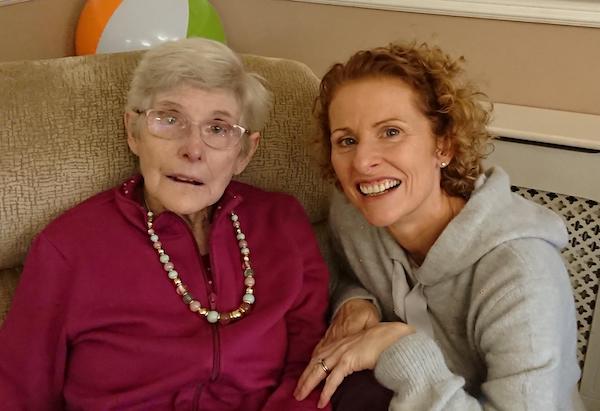
Pictured: Sam Duffy and her mother.
“I’m currently writing this from a laptop in Jersey airport, travelling back to Liverpool to care for my 83-year-old mother who has dementia. I do this every four weeks, joining a care team of family members, nurses and carers, it’s a physical and emotional battle that leaves me drained for days afterwards. I also have a family in Jersey, work full time and co-run a ‘not for profit’ organisation – quite a juggling act!
The thing is, I don’t think I’m unusual, I think many people reading this will be saying to themselves, ‘yep, me too’.
People’s lives are more complex now. Issues such as the ageing population, ‘being connected 24/7’ to social media and other technologies and even Brexit are causing uncertainty and impacting on people’s sense of well-being.
The line between work and domestic responsibilities is increasingly blurred, squeezing work–life balance. When we feel we have to leave our personal issues at home (and visa versa our work issues at the office) this creates another source of anxiety.

Pictured: ‘Being connected 24/7’ to social media is one of the issues causing uncertainty and impacting on people’s sense of well-being.
A recent report by the Chartered Institute of Personnel and Development (Health and Wellbeing at Work) highlights the rising trends of ‘presenteeism’(people working when unwell) and ‘leaveism’(people using allocated time off to work). Both are commonplace and show how organisational cultures and work pressures are currently more powerful in guiding employee behaviour than well-being initiatives.
Organisations need to be aware of the root causes of mental health problems and the changing complexity of people’s lives. Yes, many external factors are outside employers’ control, but organisations are still in a position to help people spot the signs of stress, manage their impact and make workplace adjustments to support and retain valued employees. Treating people as individuals, to provide tailored support and flexing work arrangements, could be the difference in them remaining in work.
Developing a culture that encourages people to talk about stress or anxiety and spot low level mental health problems before they escalate, can be a simple but powerful positive first step.

Pictured: Sam Duffy says employers should look into training their workforce to listen and signpost others to further support.
Training people to listen and signpost others to further support can provide many with the early intervention they need to manage their own mental health. Mind’s ‘Mental Health First Aider’ course aims to do just that.
Occasionally, someone from the senior leadership team will champion this area, sponsoring training, leading an engagement exercise to understand causes of stress at work, or speaking from their own personal experience of mental health. I’d love to see more of this. Done sincerely, this kind of positive role modelling has a powerful impact on employee behaviour and organisational culture.
Employee engagement surveys are a good way to ‘take the temperature’ of your organisation’s mental health, however, many organisations do these things in isolation and / or do not fully act on the findings. Those surveys represents an opportunity to give employees a voice and integrate positive wellbeing and resilience practices into the daily, routine events. Small things, done repeatedly, change culture.

Pictured: Employee engagement surveys are a good way to ‘take the temperature’ of your organisation’s mental health.
Finally, I would also encourage employers to think a bit more laterally, training and awareness is good, as are wellbeing initiatives, however we can’t stop there. Organisations need to look to the leadership, culture, policies and even technology and ask themselves:
- Are we contributing to poor mental health in the workplace?
- What can we do to encourage our employees to talk about any mental health problems?
In this fast-changing world of work with its constant demands, this is the very least employers can do.”
The views expressed in this piece are those of the author and not of Bailiwick Express.
