

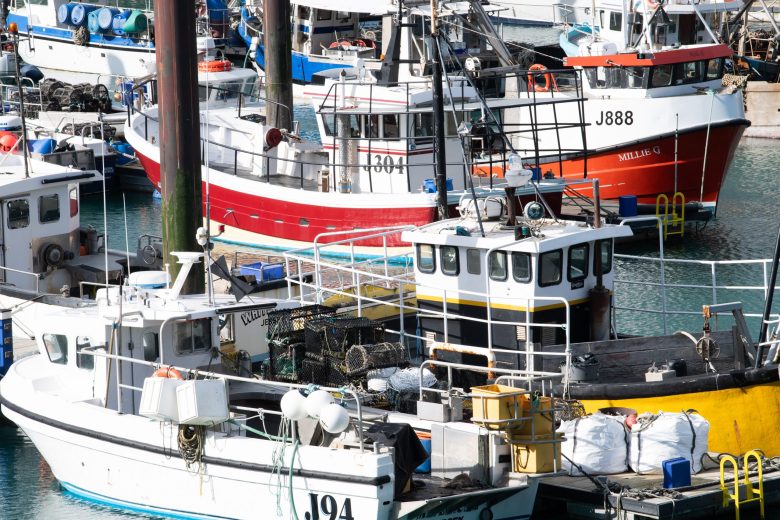
Commercial whelk fishing in Jersey – once a significant and highly profitable industry – has virtually collapsed today because of Brexit and rising sea temperatures.
In 2018, 838,926 kg of whelks were landed by Jersey vessels but by last year this had dropped to just 3,506 kg.
The increased exploitation of the common whelk in the early 1990s was fuelled by markets the Far East which later declined, although France remains a key consumer.
Seven years ago, five Jersey boats focused on harvesting whelk pots but today just two small boats are involved in the fishery, mostly satisfying Jersey’s appetite for fruits de mer.
The significant reason for Jersey fishers either leaving the industry or diverting their attention to a different metier is Brexit, more specifically rules and regulations that came in on 1 January 2021 with regard to exporting fish into the EU.
The Government’s Head of Marine Resources and Management, Francis Binney, said: “Jersey’s whelk industry was mainly focused on exports to France and the new rules meant that live bivalve and gastropod molluscs, such as scallop and whelks, had to be imported by a merchant rather than landed directly by the fishers.
“However, whelks don’t survive long out of water so by the time you land them in Jersey, transfer them to a container and ship them to Saint Malo, they are often no longer edible. And one off-whelk will taint the whole shipment.”
However, French boats continue to lay and lift whelk pots in Island waters. Licensed by Jersey but with additional limits set by their own authorities, boats mainly from Normandy landed 547,571kg in France last year.
Even this is a significant drop – by 43% – from the 963,772 kg landed in 2022.
The decrease was in part due to enhanced fishing restrictions brought in by Normandy on their permitted vessels, and in part due to falling stocks.
There are 57 French vessels with licensed access to Jersey waters for whelk fishing. Of these about 60% fish in the Island’s seas at some point in the year. Although their quotas are set by their own fishing authorities, these take account of the limits imposed by Jersey.
Stocks of whelks have fallen significantly in Jersey’s waters, likely due to rising sea temperatures.
Studies carried out in Jersey reveal that the average catch per 100 pots dropped by 75% from 284 kg in 2010 to 70 kg in 2023. This has been attributed to both overfishing as well as the increasing warmth.
The average surface sea temperature in Jersey has risen by around 0.2°C each decade since the 1960s.
Whelks have been found to have lower breeding success and are less healthy in higher temperatures. Increasing frequency of winter storms also force them to burrow more.
By contrast, its smaller, inedible relative, the dog whelk, appears to be increasing in number in Jersey waters.
Steve Viney of the Jersey Fishermen’s Association said Jersey had “lost a string to its bow” with the collapse of local commercial whelk fishing.
He said: “Brexit and sea temperatures have hit us like a perfect storm, and we only have a small number of fishers supplying the local market, who have whelk pots alongside other metier, such as lobster.
“The fishery has certainly taken a dive and I would say it is 70% down to environmental factors. French boats did initially reap the rewards in our waters while we were tied up because of Brexit but now there are not enough whelks to make it commercially viable.”
He added: “The only thing we could do is restrict fishing to see if they bounce back. It could be over the breeding season but that is arguably a chicken and egg situation because you’re still catching the same whelks.
“Also, the JFA wouldn’t want to see any closed areas within our three-mile limit of exclusivity because that is not extensively fished and supplies our restaurants.
“The industry has certainly lost a string to its bow because fishers could swap over to whelking when other catches were light; certainly, brown crab is a lot less common now.
“French activity in our waters has dropped too but it is still a lot more than us. We were told that post-Brexit, we would have full control on what happened in our waters but that hasn’t been the case.”
