

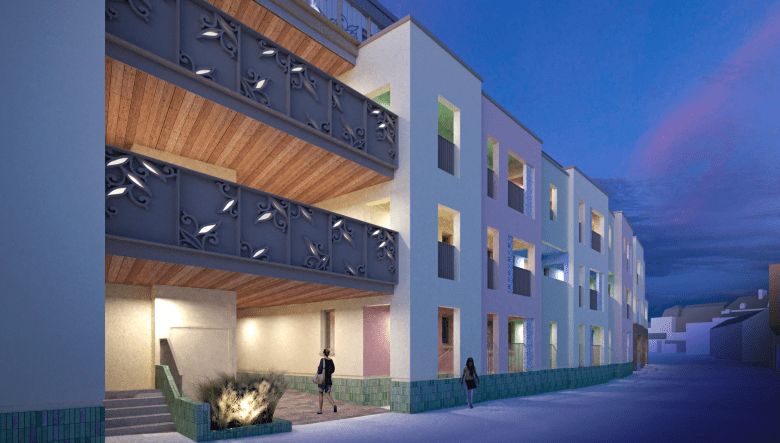
A controversial planning application that faced opposition because of its “woefully inadequate” parking facilities has been resubmitted – with the same number of parking spaces as the original application.
The original application to build 32 apartments with 13 vehicle spaces on the former site of Cleveland Garage on St Clement’s Road was rejected at the start of this year.
The applicant Lucas House Holdings Limited has now resubmitted plans for a smaller scheme of 29 apartments.
If approved, the new development would consist of 15 one-bed, 13 two-bed and one three-bed flats, and one commercial unit.
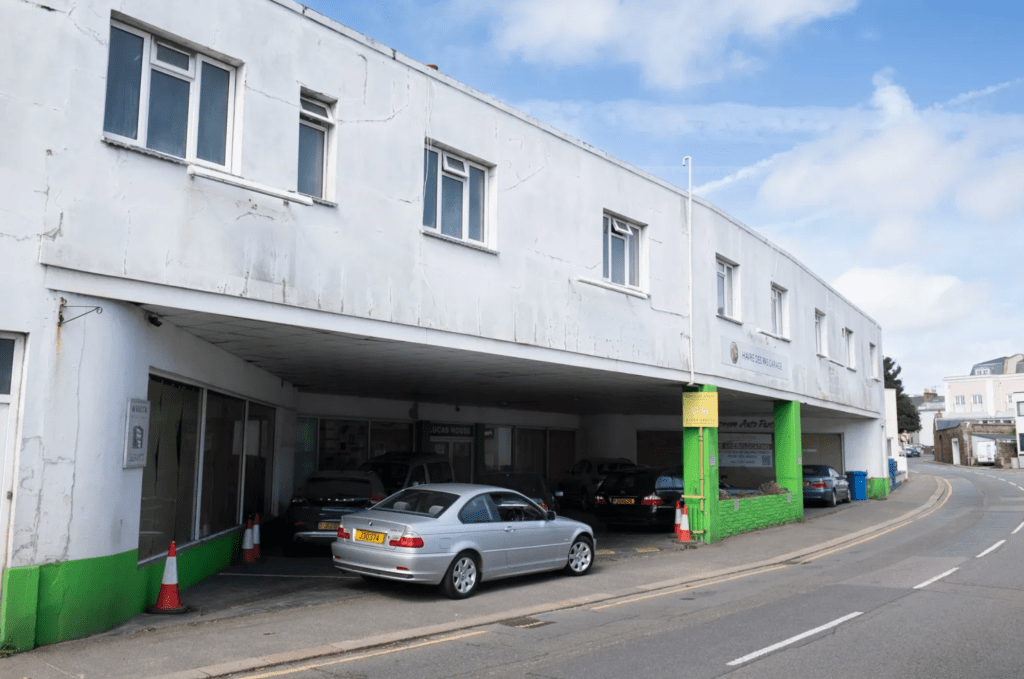
But despite the scheme’s “woefully inadequate” parking facilities being one of the reasons that the St Helier’s Roads Committee objected to the original planning application, the new plans have the same number of parking spaces as the original plans.
If approved, the 29-flat development would have 13 vehicle spaces – including two public electric vehicle spaces – three motorcycle spaces, and 55 bicycle spaces.
The development would also include “landscape amenities” comprising of new connected ‘mews’ and ‘ginnel’, shared podium gardens with play areas, and shared roof gardens.
The new application has already attract 29 public comments – all of which oppose the development.
Many raise concerns about the proposed height of the new development, and the lack of parking in the area. Others highlight the need for family homes, rather than more apartments.

In a supporting document submitted alongside the planning application, architects MS Planning pointed to the government’s Sustainable Transport Policy Framework 2020-2030.
Writing on behalf of the application, MS Planning explained that this framework acknowledges that “a car-dominated transport system is no longer sustainable and not in the best interest of the island’s future”.
The supporting document continued: “This is exactly what is delivered in the application, removing the commercial traffic (including from tight residential streets), rationalising vehicular access points, supporting non-car modes through extensive cycle parking and pedestrian spaces, and in doing so an environment is created that will enable the new community to thrive and be harmonious with the neighbouring context.”

It concluded: “Whilst the determination of the earlier planning application was naturally disappointing, the reasons for refusal did provide a clear summary of the issues that needed to be addressed in this resubmission.
“The applicant commenced the resubmission with an open-mind and engaged constructively with neighbours, the Jersey Architecture Commission and the Planning Department.
“The result is a more contextual proposal that sits comfortably in its context by reference to its scale, form and architectural presentation.
“It is also very deliberately respectful of relationships with neighbours and does not cause unreasonable harm to the amenities that they might expect to enjoy.”
The full planning application can be found online.
