


A local scientific project is aiming to protect one of the world’s most threatened sharks and three species of skate.
PhD student Rees Monet’s research is focused on the critically endangered tope shark, whose population has declined by more than 80% in recent generations.
Working with Jersey Marine Resources, the Jersey International Centre for Advanced Studies (JICAS) and the University of Exeter, Monet’s project will combine satellite and acoustic tagging with genetic sampling to monitor key species including tope and the “commercially important” trio of skate species.
Push towards more sustainable fishing regulations
The goal is to better understand their movement patterns, local habitat use, and whether Jersey’s coastal populations are isolated from the wider English Channel – with the hope of tailoring more effective, sustainable fishing regulations in local waters.

Although Jersey currently follows UK fishing quotas for rays and skates, researchers say these guidelines may not suit the island’s specific ecological conditions.
Bycatch – the unintentional capture of sharks and rays in fishing gear – is a particular threat, and fieldwork is already underway. Skate sampling took place earlier this spring, with tope tagging due to begin in July.
The work is being facilitated by Société Jersiaise, who recently awarded Mr Monet the Roderick Dobson Award as part of its Natural History Awards 2025.
Established in memory of Roderick Dobson, one of Jersey’s most distinguished field naturalists, the award was originally intended to recognise original field work by school pupils, but now includes school leavers, students, mature naturalists and even groups.
Mow vs Moo
Meanwhile, fellow JICAS PhD student Joshua Smith was awarded the Nigel Quérée Environment Award for his research project delightfully dubbed ‘Moo vs Mow’.
Created in memory of local politician, environmentalist and Société committee member Nigel Quérée, who passed away in 2022, the award is intended to recognise relevant research, field work and other projects.
Mr Smith’s study will assess the environmental impact of three grassland management techniques: conservation grazing with Jersey’s flock of Manx Loaghtan sheep, Guernsey’s dairy steers, and traditional hay-cutting methods.
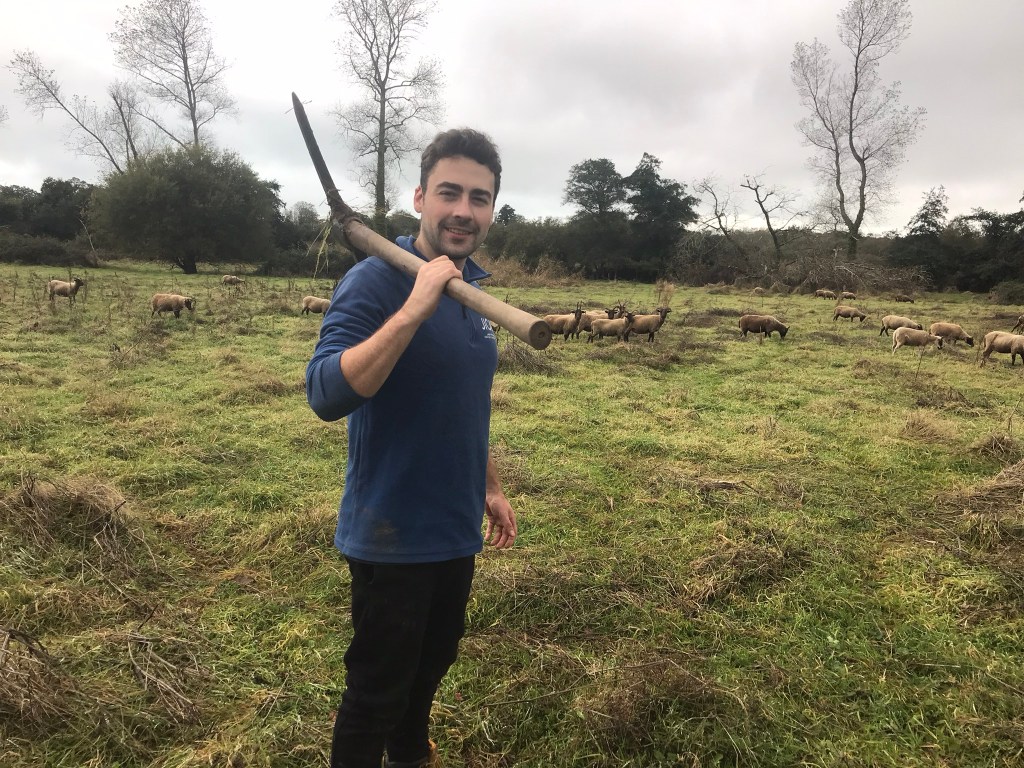
Grasslands in the Channel Islands have been in decline due to agricultural abandonment and land conversion, with consequences for biodiversity and soil health. One species particularly affected is the skylark, which has disappeared from Guernsey and sharply declined in Jersey.
Smith’s project will measure both biodiversity and carbon storage in grazed and cut grassland sites. With the growth of voluntary carbon markets, the study could also demonstrate the financial case for conservation grazing if it shows net biodiversity gain and significant carbon sequestration.
Both projects were praised for their scientific rigour and relevance to Jersey’s natural environment. More details on the Société’s grants can be found at here.
