


The latest average earnings index has landed… what does it tell us about Islanders’ wages over the past 12 months?
Statistics Jersey has published the latest earnings figures for June 2026, which reveal how wages are faring in Jersey, which sectors are earning the most, and how much of an impact inflation is having.
The report measures changes in average earnings paid between June 2025 and June 2026 on a full-time equivalent (FTE) basis, and is based on earnings data collected from firms in the private sector and from all Government of Jersey departments.
Express took a look at the key findings…
Small growth in wages
On average, earnings were 4.1% higher in June 2026 than in June 2025, the smallest annual increase since 2021 (3.3%).
By contrast, during a period of generally low inflation between 2009 and 2020, the annual increase was never higher than 3.5% and on occasions as low as 1.1%.

When applying the inflation rate of 2.8%, average earnings in June 2025 increased in real terms by only 1.2%, compared with 1.9% 12 months earlier, 1.3% in 2024, and a 2% real-terms fall in 2023.
Looking at the longer term, average earnings have fallen by 0.8% in real terms over the last ten years.
Public and private sectors
Over the 12 months to June 20 26, average earnings in the private sector overall increased by 3.7%.
This latest annual increase is below the preceding five -year annual average of 5.8% per year, and lower than the increase seen for the previous 12-month period (4.5 % to June 2025).
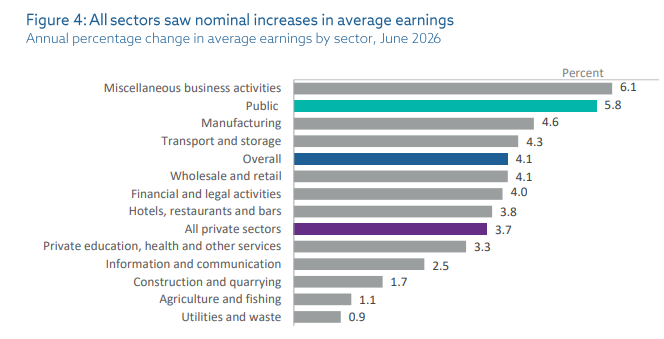
In contrast, the public sector saw an increase in earnings of 5.8% over the same 12-month period to June 2026, 1% higher than the equivalent figure last year and more than twice the rate of inflation.
The report notes that a headline pay award of 3.8% was made earlier this year – 1% above inflation.
By industry
“Miscellaneous business activities” recorded the biggest annual change, up 6.1%. Statistics Jersey said this sector included a range of different employment categories, including estate agents, property managers, architects, engineers and advertising, as well as cleaning, landscaping and office administration.
Manufacturing rose by 4.6%, while the other sector outscoring the overall figure of 4.1% was transport and storage (4.3%).
No sectors recorded falls; the smallest increases were in construction and quarrying (1.7%), agriculture and fishing (1.1%) and utilities/waste (0.9%).
On average
Median weekly earnings for a full-time employee were £930 in June 2026, up £40 on last year. The mean average was £1,100 per week.
Across sectors, average monthly pay ranged from £2,712 in hotels, restaurants and bars, a rise of 7.2%, to £5,484 in financial and legal services (up 3.4%).

Real-term earnings have risen by 18.5% since 1990 – the majority of this growth took place in the period up to 2001, with the picture for the past 25 years being virtually unchanged.
