

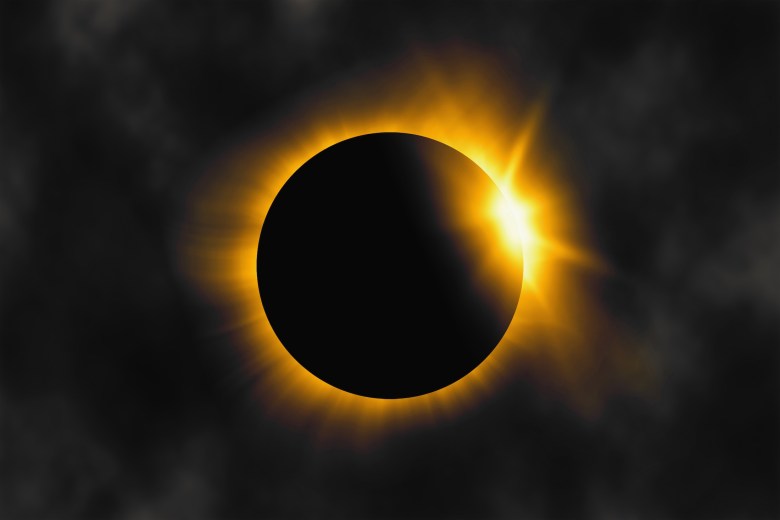
Thousands of Islanders are expected to be gazing up at the sky this evening for the eclipse – but there are some vital steps those hoping to catch it should take to ensure their safety.
The Channel Islands will be one of the best places in the British Isles to see the eclipse, with a number of viewing events and gatherings being organised across the island.
The solar eclipse is due to start at 6.21pm and finish at 8.10pm, with the peak at 7.17pm.
An eclipse is a rare astronomical event with the next total eclipse in Jersey not taking place until 2081.
But looking directly at the sun without the right protection can cause permanent damage to your eyesight.

Where can I watch the solar eclipse?
Jersey Astronomy Club is organising a viewing event for Islanders to safely watch the eclipse.
Neil Mahrer, who founded the club in 1990, said: “This will be the best partial eclipse that we have had in a long, long time – we had a total eclipse in 1999, and this one will see a vast part of the sun obscured.”
Due to the eclipse taking place in the evening, the sun is quite low in the west, therefore, the Astronomy Club is staging their viewing at Le Braye, for a view overlooking St Ouen’s Bay.
Why can it be unsafe to watch a solar eclipse?
As an eclipse takes place, the sun appears to be dimmer than usual, due to its positioning behind the moon.
Therefore, this reduced brightness makes it easier for Islanders to gaze directly at the sun, allowing intense sunlight to reach and damage the eye retina.
Islanders watching may not feel the body’s natural reflex to look away, meaning that the damage can be caused with minimal pain, but long-term harm.
How can I watch the eclipse safely?
Derek Jepson, honorary treasurer of the Jersey Astronomy Club offered some helpful tips to keep you safe during tonight’s eclipse.
Mr Jepson urged that “safety is paramount when viewing an eclipse” and that as a club they “wholeheartedly support and agree with what the professionals say” when it comes to the high dangers in eclipse sightings.
“We cannot stress strongly enough – do NOT look at the sun directly. Do not use regular sunglasses and do not squint through fingers,” Mr Jepson continued.
He also encouraged parents to not leave children unattended during the eclipse, and to make sure they aren’t making direct eye contact with the sun.
Islanders should also not look at the sun through camera lenses, telescopes, binoculars or any other device, in order to avoid eye damage and even blindness, he added.
In terms of safe approaches to enjoy this astronomical marvel, Mr Jepson advised two safe approaches: specialist eclipse viewers, or indirect viewing methods.

Specialist eclipse viewer equipment
Special solar eclipse glasses, which may seem to look like 3D cardboard glasses, have high-strength filters that block out harmful solar radiation.
Don’t be tempted to catch a glimpse of the eclipse with your bare eyes, and even your regular beach sunglasses will not protect you.
“If you want to use eclipse glasses or handheld solar viewers, make sure they are genuine eclipse glasses with specially designed filters that meet the international safety standard ISO 12312-2:2015,” Mr Jepson said.
He also cautioned the use of any products that may not be certified and meet the requirements. Also, any glasses that have lenses scratched or damaged will not provide adequate protection for the solar eclipse.
With perfect condition eclipse glasses, ensure to put them on before looking up at the sky, and look away before taking them off.
Indirect viewing methods
Alternatively, Islanders can watch the eclipse indirectly without any specialist equipment at all.
Mr Jepson explained to Express some of these DIY at-home methods…
The colander method – this involves viewing the sun’s image projected onto a sheet of white card through a colander. Stand with your back to the sun, and hold the colander up to a plain wall or paper. You should see lots of tiny crescent suns projected at once.

The pinhole projector – safely view the eclipse by projecting the sun’s image onto a sheet of paper using a simple pinhole projector (a hole punched on an index card).
Mr Jepson added that “there are several YouTube instructions on how to make indirect viewing equipment, but again, do not look at the sun directly when using”.
Skin Safety
During partial or total eclipses, it is easy to overlook the effects of sunlight. When waiting and watching an eclipse you may be in direct sunlight for hours, so remember to wear SPF protection, a hat, and protective clothing.
