

As the island’s fourth hospital planning application in a decade was submitted yesterday, Deputy Tom Binet stressed that much of the recent feedback on proposals for the acute facility at Overdale had outlined a need to “just get on with it”.
If the application is successful, construction could begin in 2025 and finish in 2028.
Its submission represents an important step for the New Healthcare Facilities Programme, which involves building across several locations including creating a health village in St Saviour.
What number application are we on now?
It was all the way back in 2012 that politicians officially recognised the need for a new hospital, with the then-Health Minister Anne Pryke investigating a two-site option. However, in the years that followed, focus shifted to upgrading and expanding the current Gloucester Street premises – but two planning applications to do this were refused in 2018 and then in 2019.
Under Chief Minister John Le Fondré’s government, the then-Deputy and now current Chief Minister Lyndon Farnham led plan to create a single-site health campus at Overdale, estimated to cost around £800m. The concept received planning permission, but the scheme was thrown out by the then-Infrastructure Minister Tom Binet when Kristina Moore’s government came to power in 2022 over concerns that it was “unaffordable”.
They then began to progress plans for a multi-site solution, involving the construction of a new acute health facility at Overdale, where the remaining buildings were demolished.
A public consultation for the new Overdale plans was launched in May, while engagement sessions had already been taking place with Health and Community Services staff and residents in the area.
An Outline Business Case involving detailed costings was put together looking at two options: ‘Recommended’ (acute facility at Overdale, new building at Kensington Place and a Health Village in St Saviour) and ‘Do Minimum’ (refurbishment and two new builds at the current hospital site). It was concluded that the latter would be more costly, and lead to “insufficient acute beds by 2030”.
However, in contrast to previous applications, the business case has not yet been made public – though the Government says that it “has undergone thorough scrutiny by governance and assurance groups and will be published in full when feasible to do so”.
How do the new plans for Overdale differ?
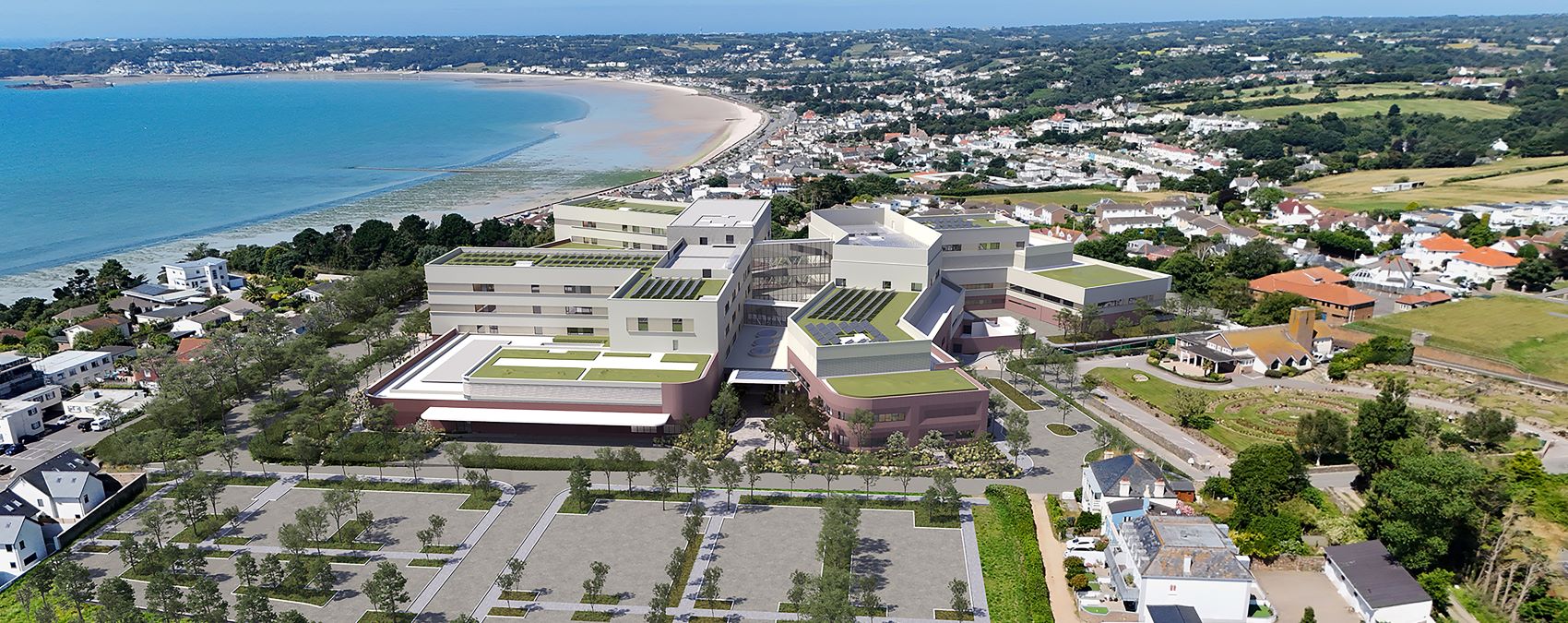
The main building will consist of a lower-ground, ground, first, second, and third floors, though there will also be a fourth floor for the hospital’s plant.

Pictured: The latest imagery outlining the proposed new acute hospital at Overdale.
The facility will provide a range of emergency and elective care services for islanders, including an emergency department, critical care, elective and emergency operating theatres as well as the majority of inpatient wards.
Its design was developed around a “campus” concept, and many of the materials used in the design were aimed to reflect Jersey, with some inspiration even apparently taken from Gorey Castle.
The emergency department will be located on the ground floor, with direct access for ambulances from Westmount Road.
How big is it? And will it need a “super highway”?
Unlike the previous Our Hospital Project, Westmount Road will now only be subject to minor works, such as increasing footway and carriageway widths, if the plans are approved.
This means the retention of houses to the east as well as the bowling club.
Additionally, at 51,000m2, the facility is two-thirds the size of the previous government’s controversial Overdale plans that were ultimately abandoned.

A planning application for the new hospital has been submitted.
Deputy Binet said he believed the application, which was lodged last week, was “fit-for-purpose”.
He explained: “The plans seem to have gone down well; the consultation process has been very positive all the way through and I think the end product is good.
“Given all of the circumstances that we were confronted with I genuinely do believe that this represents the best outcome islanders could hope for.”
How much will this all cost?
The cost of the new plan is estimated to be £710m, while the ‘Do Minimum’ option to upgrade the current site only was estimated to be at £1.3bn. It’s hoped that the new corporation tax – multinationals whose global annual turnover exceeds 750 million euros will pay 15% tax on profits under a new worldwide OECD initiative – will help to fund the facility.
The Government says that the project itself will generate additional financial benefits – up to £59.2m is estimated to be contributed to the economy, with 450 construction jobs created and 10 apprenticeships.
It’s also hoped that at least £10m-worth of buildings will be able to be sold off or redeveloped, thatprivate patient revenuecould increase by up to £1.1m a year, and that the new facility may help “attract highly skilled staff and increase existing staff retention”, which could see a reduction in agency staff costs of up to £2.2m a year.
What hurdles might stand in the way?
The Government is, however, conscious that there could be hurdles along the way.
As Express previously reported, “political interference” sits at the top of the hospital’s project’s risk register, and supply chain robustness, the impact of inflation on costs and capacity in the construction sector are also concerns being monitored.
There is also a concern that “there may be insufficient funding for the wider digital health strategy prior to the opening of the facilities, limiting transformation”.
How confident is the Health Minister feeling?
Deputy Binet also said that he had his “fingers crossed” that the scheme would be deliverable politically, but added that he was “very hopeful”.
“One has to be realistic and the plans have gone down well with everyone who has seen them.
“The public mood seems to be ‘just get on with it’ – all the consultation processes are telling us that, and that’s just what we are keen to do.”
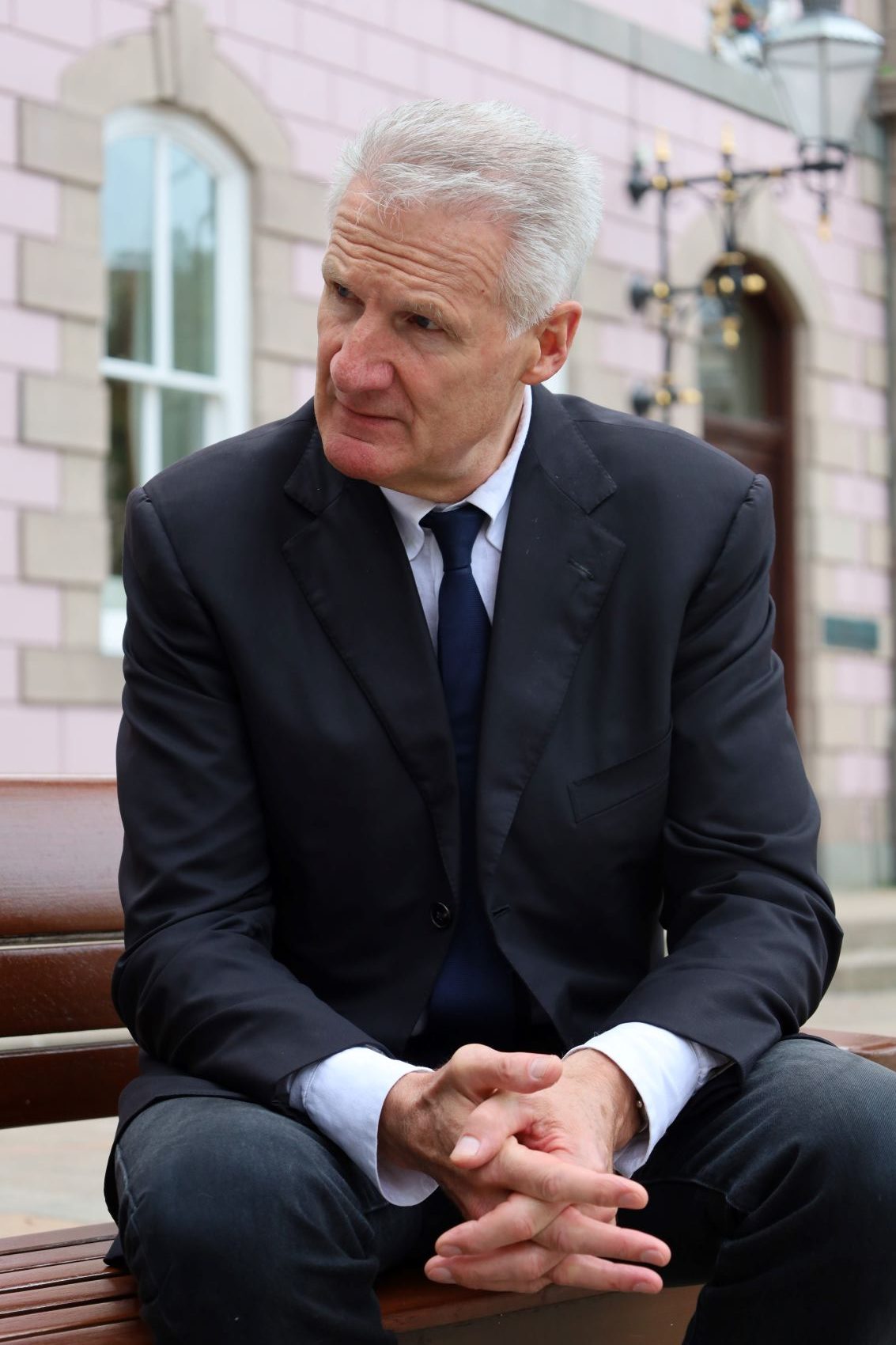
Pictured: Deputy Tom Binet described the planning application for the new acute hospital at Overdale as “fit-for-purpose”.
Deputy Binet continued: “I am very grateful for the team that has put this together and I consider myself lucky to have inherited such a good bunch of people who do a grand job.
“We are within a hair’s breadth of where we would like to be – possibly a couple of weeks later than where we would like to have been in an ideal world but all credit to the team for getting the scheme together in the time they have had available.”
He added: “The hope – and I have to be very cautious what I say – is [it will be open at the] end of 2028.
“Things have gone smoothly so far but we might have a few interruptions – who knows? It’s a big scheme to run seamlessly without any problems but, with a fair wind, [it will open at] the end of 2028.”
READ MORE…
TIMELINE: A decade of (in)decision
FOCUS: 10 years since we agreed a ‘New Way Forward’ for Health… What happened?
