


After years of scrutiny over empty theatres, broken equipment, staff shortages and long waits, new figures suggest some of the hospital’s most persistent surgery problems may finally be easing – though challenges remain, as Express explores…
For years, Jersey’s operating theatres have been the subject of concern, with cancelled operations, equipment failures, capacity shortages and long waiting lists repeatedly coming under the spotlight.
Now, a combination of newly released Freedom of Information data and the hospital’s latest performance figures suggest that some key measures are moving in the right direction.
The number of elective operations cancelled on the day they were due to take place fell by more than a quarter last year, while the hospital says theatre utilisation – a measure of how much operating theatre time is actually spent carrying out procedures rather than sitting unused – is stabilising.
The latest performance report also shows a continuing downward trend in non-medical cancellations, with the number of operations cancelled on the day falling to its lowest level in the reporting period by April 2026.

However, the FOI data showed that one area was moving against the overall trend at the end of last year, with the number of surgeries cancelled on the day as a result of staff shortages increasing from 36 in 2024 to 51 in 2025.
A long-running issue
The figures are likely to attract particular attention because workforce pressures have repeatedly featured in debates about theatre performance over recent years.
In 2021, elective surgeries were temporarily suspended due to non-covid-related staff absences.
Hospital performance data released at the time following challenges from Express surgeries showed that theatre usage rates were “below the industry standard” and that operation theatres were routinely lying empty as a result of poor planning.
To help remedy these scheduling problems, the then-Director General of Health told Express that the hospital was setting up a ‘Theatres Task and Finish Group’.
An Express investigation later uncovered a damning £12,000 report by a UK consultant which revealed that one of the key issues affecting surgery was unresolved allegations of bullying in operating theatres, with some staff refusing to work in the same room as certain colleagues, further pushing up waiting times for patients.
As of January 2025, hundreds of patients were waiting over a year for elective surgery, with Health reporting that they had lost “more than a quarter” of their capacity in 2024 due to a catalogue of failures including unusable ventilation systems and broken microscopes.

Plans were made to add a minor operating theatre to the then-newly refurbished Rayner Ward, but it emerged last June that these had to be abandoned due to ventilation constraints in the ageing General Hospital.
Then, just last month, three operating theatres at Jersey General Hospital have been temporarily closed after a “mechanical failure” linked to high temperatures.
During a February meeting of the Health Partnership Board – an independent body which holds health leaders to account – the chair commented that achieving a theatre utilisation rate of 80% was “critical” and asked the Director of Clinical Services Claire Thompson for assurance that this was “achievable”.
While Ms Thompson said that some surgical specialties were already meeting this target or even operating above it, the hospital team were aware that some areas would need more “targeted” work. This, the health board papers noted, would include “reducing late starts, ensuring bed availability, reviewing surgeon level utilisation and procedure volumes”.
Why do operations get cancelled?
According to Health’s response to the recent Freedom of Information request, the most common reason for a cancellation in both 2024 and 2025 was that the operation was deemed no longer necessary. There were 102 such cases in 2025, compared with 69 in 2024.
Patients failing to arrive on the day or at the planned time was another major factor, accounting for 88 cancellations in 2025 and 151 in 2024.
Alongside staffing availability issues, other significant causes in 2025 included patients being declared clinically unfit by the hospital (71 cases), later appointment requests (44), administration errors (40), and list overruns (35).
In 2024, the largest categories after patient non-attendance were patients being declared clinically unfit by the hospital (105 cases), later appointment requests (79), equipment being unavailable or out of service (61), operator error (59), bed availability problems (56) and clinic closures due to absent doctors (54).
Gastroenterology recorded the highest number of day-of-surgery cancellations in 2025, with 138 cancellations, followed by dermatology with 102 and ENT with 82.
In 2024, gastroenterology again had the highest total with 214 cases, followed by general surgery with 135 and respiratory medicine with 100.
Cancellations linked to patients not attending dropped from 151 to 88 year-on-year, while equipment-related cancellations fell from 61 to 28, and bed availability issues from 56 to 29.
So, are things actually improving overall?
The FOI stats showed that patients were far less likely to have an operation cancelled at the last minute in 2025 than they were the year before.
A total of 670 elective operations were cancelled on the day they were due to take place, down from 930 in 2024 – a reduction of 28%.
Health and Care Jersey said those cancellations represented 8.4% of all scheduled theatre activity in 2024, falling to 5.8% in 2025.
At the same time, activity increased overall.
The number of elective procedures completed rose from 10,198 to 10,844, while the total number of procedures carried out increased from 11,807 to 12,574.
Health and Care Jersey compared Jersey’s figures with published NHS England data.
It noted that research by University College London, examining NHS treatment activity in November 2024, found that 9.9% of scheduled non-emergency procedures were cancelled within 24 hours.
Health said its equivalent rates were 8.4% in 2024 and 5.8% in 2025.
Meanwhile, in relation to theatre utilisation, the department struck a cautiously positive note in its April 2026 quality report.
Theatre use stood at 77.2%.
While that remains below the NHS benchmark of 85%, it represents a marked improvement on 2024, when utilisation fell to around 70% on two occasions.
The 85% benchmark has not yet been reached in any month covered by the latest report, but Health and Care Jersey described performance as having “stabilised”.
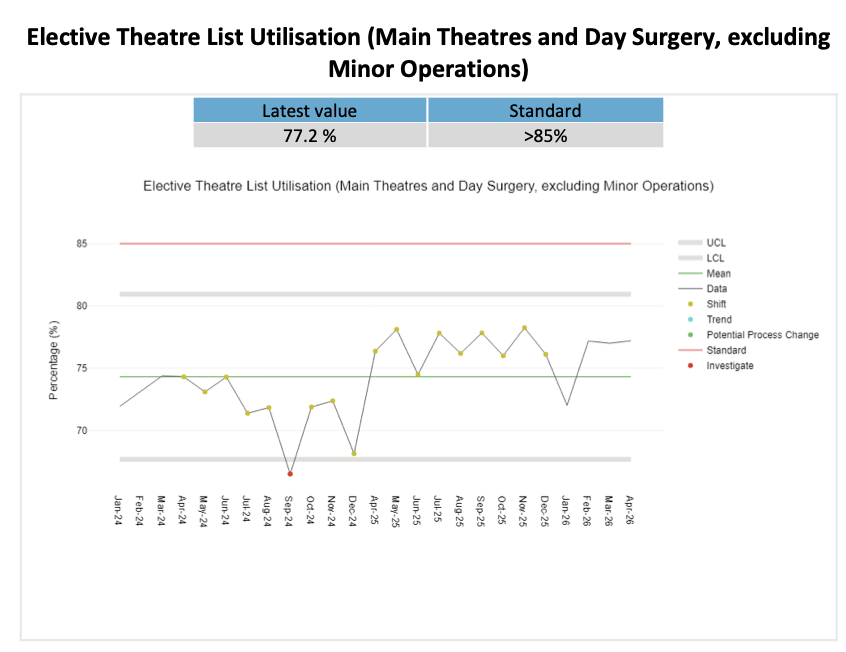
“We are now on a positive footing to start to make further improvements in utilisation across 2026,” the report said.
It added that both speciality and clinician-specific data was being “reviewed weekly to drive performance”.
Had your daily Bailiwick Express-o?☕
Your free daily news email – freshly brewed every day with Jersey’s latest news, breaking stories and essential updates.
Sign up for free