

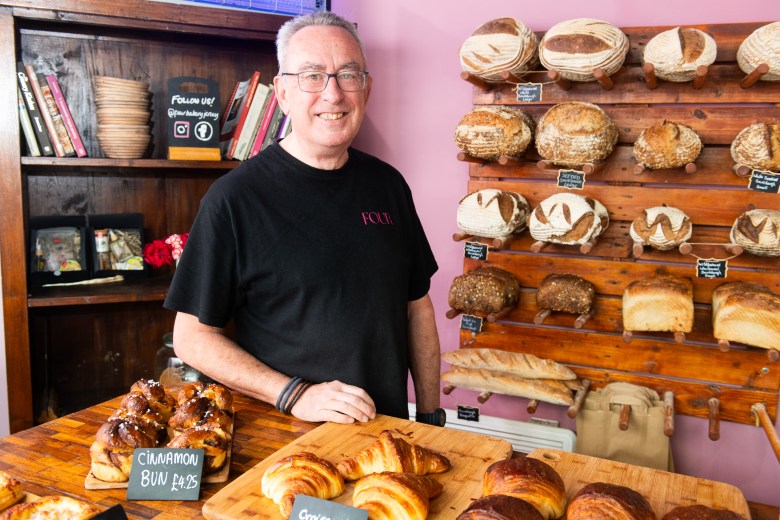
Approaching his 70th birthday, former finance worker Simon Rodgers had planned to enjoy retirement. Instead, he now spends his days running Four – the artisan bakery and chocolaterie on Bath Street – where every loaf, pastry and chocolate is made with ingredients chosen to keep processing to a minimum.
For Simon, the bakery is about far more than good food. It’s the result of a life-changing cancer diagnosis that forced him to rethink his health, his diet and what he wanted from life.
“I could do something positive or wait for the Grim Reaper”
In 2017, Simon was diagnosed with bowel cancer after ignoring symptoms for months.
“Being a typical bloke, of course, I’d had symptoms for a while but thought it would go away,” he said.
“I eventually went to my doctor, and they said I needed to go to the hospital right away. I went and found out that I had bowel cancer.”

Thankfully, the cancer was caught early. Looking back, Simon has one piece of advice: “Go and get checked.”
His diagnosis also prompted him to reassess the food he was eating.
“I started looking at my diet, as I had something called diverticulitis, when your intestine has folds that food gets stuck in, causing flare-ups,” he explained.
“I was also struggling to eat because I was hugely anaemic. I looked at what I ate, and I thought I ate quite healthily – but while working in the finance industry, I was sat at my desk, busy, busy, busy.
“I wasn’t getting up to get the sandwich, and I was drinking around two litres of Coca Cola a day – it’s ridiculous, you know, but at the time you didn’t think about it.”

As he began paying closer attention to food labels, one product in particular surprised him.
“Everybody knows there are all sorts of ultra-processed food, but I hadn’t really taken notice – and it particularly struck me how much rubbish goes into baked goods.”
A conversation with friends sparked an idea.

Having always enjoyed cooking and baking, Simon was encouraged to start making his own bread using traditional methods and carefully sourced ingredients.
But then Covid arrived.
While undergoing cancer treatment during the pandemic, Simon decided there was no point waiting for retirement to enjoy life.
“Either I could do something positive about my life, or I could sit waiting for the Grim Reaper,” he said.
“So I decided to open the bakery, and the ethos from the start was to find the very best ingredients that we could find and go back to the way that baking used to be done before the 60s.”
Returning to traditional baking
That philosophy still shapes Four today.
Simon believes industrial breadmaking moved away from traditional methods with the introduction of the Chorleywood process in the 1960s, and he wanted his bakery to do things differently.
“I wanted to go back to the way that bread used to be made in the good old days, the way my mother used to make it with the very best ingredients – no preservatives, no additives, all natural.
“The flour that we use is called Wildfarmed flour that uses ancient grain, with no genetic modification, and their farmers aren’t allowed to use any artificial fertilisers.”

The flour costs around twice as much as conventional alternatives, but Simon believes it’s worth the investment.
“The wheat is thrown in amongst the wildflowers, and animals graze on the land,” he explained.
“They harvest everything together and then it is stone milled so there’s no conversion – the processing is kept to the absolute minimum.”
The bakery does use a different flour for its French pastries to achieve the best results, but Simon says he still avoids unnecessary additives.
From 50 loaves to one of Jersey’s best-known bakeries
The business began modestly.
“The original idea was just to make 50 loaves a week for family and friends,” said Simon.
Originally trading as R&R Bakehouse, the business later became Four after head baker Ellen Johnson persuaded Simon to embrace its now-iconic pink branding.

“I remember going to B&Q, after we’d just decided to rebrand, and she asked, ‘What shade of pink should we have?’. There were so many shades – there were hundreds of the bloody things,” he laughed.
The team also knocked through the wall separating the bakery from the shop floor, allowing customers to see their food being made and filling the space with the smell of fresh bread.
Nearly seven years on, Simon has no plans to slow down and is eager to delve into his most recent passion of chocolatiering.
