

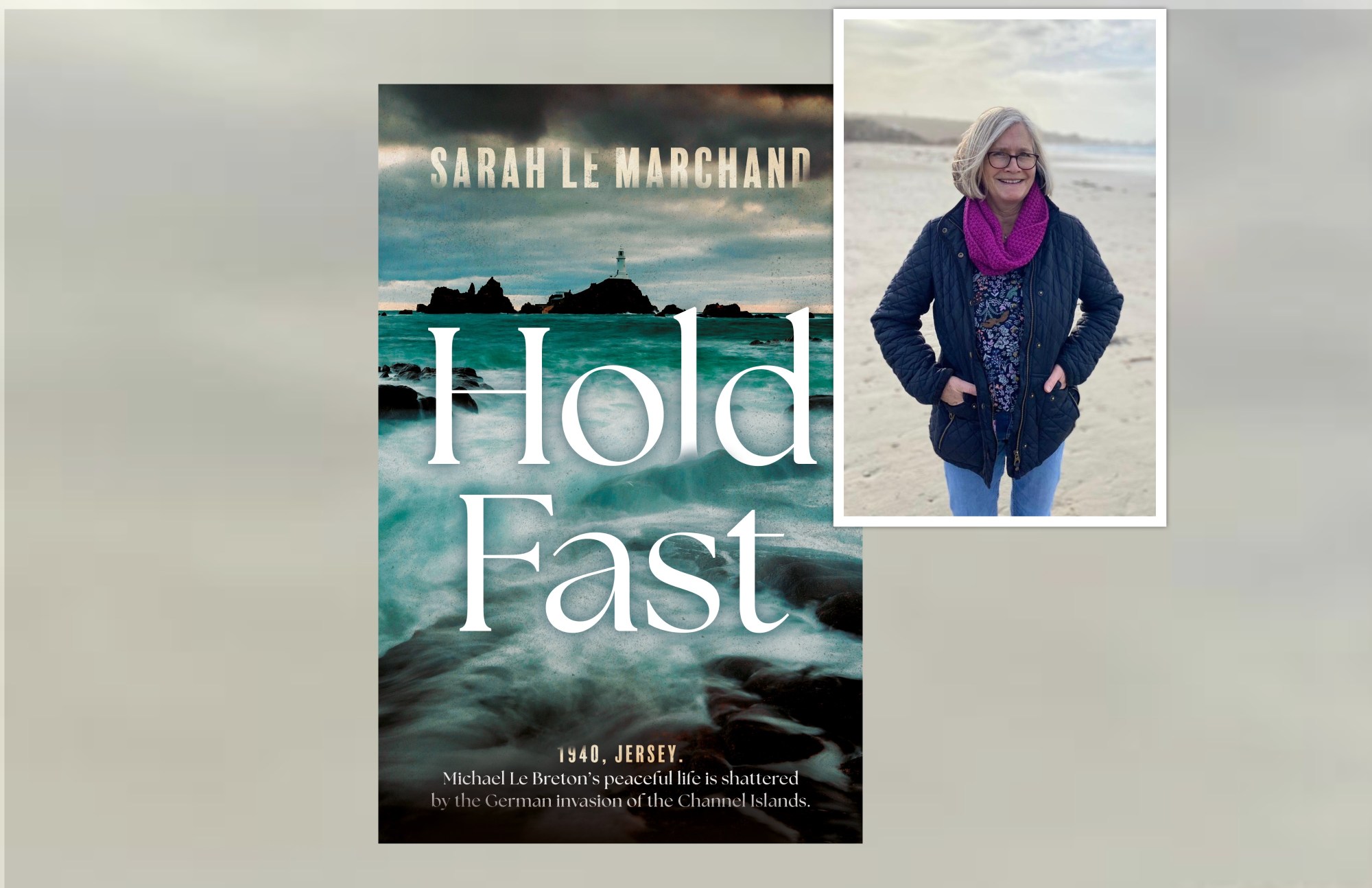
Although Yorkshire-born writer Sarah Le Marchand has never lived in Jersey, her family roots run deep in the island’s history – and were the inspiration of her debut novel which follows a local family living through the Occupation.
‘Hold Fast’ by Sarah Le Marchand is set to be published on the 28 March.
Ahead of the novel’s official release, Express sat down with the former English teacher to discuss her work, why she was motivated to begin a new career in retirement, and to offer readers the chance to win signed copies of her island-based book…
“Literature has just always been a love”

Following a thirty-five-year career teaching English in her home county of Worcester, Sarah decided to take the plunge and completed an MA in Creative Writing at The Open University.
She described it as “wonderful” to be a student again.
Sarah said that creative writing was something she had “always wanted to do” –but “never thought” she would get a novel published.
“Literature has just always been a love,” she explained.
“My first degree was English and teaching is one of those routes that you can use when you’ve studied English.
“I had fantastic career. I absolutely loved it. But it’s a busy life and you don’t get time to do some things. So, when you retire, it’s wonderful, you can do all these things.”
“I’ve always been very interested in Jersey’s history”
Although Sarah has never lived in Jersey, her mother’s family did – and the stories they passed on about living through the German Occupation inspired her novel.
“My mother and her quite large family lived through the Occupation, and I was always interested in their stories,” she said.

“They had a lot to say about it. I’ve just always been very interested in Jersey’s history, not just the Occupation, but other periods are really interesting as well, which I’m hoping I might write about in future novels.”
Using her family’s experiences as a starting point was “an obvious place to start” for her debut historical fiction novel, and Sarah also loosely based some of the characters on her relatives.
Sarah said: “I began writing the novel shortly after my mother died.
“She’d written down some of her memories which sparked a number of ideas, and discussions with my Aunt Hélène, the last living sibling of my mother, were very helpful.
“In fact, I named the fictional family’s matriarch after her.”
She added: “Then when I started doing the MA, it was very encouraging.
“I wrote some sections, which are now part of the novel, for my assignments and fellow students and one particular tutor said I should get on with it, and so after I finished the course, I just ploughed on.”
“That story horrified me and stayed with me”
As all writers experience, research and re-writing formed the majority of work needed to get Sarah’s book to publication.
Researching her family’s history and consolidating their stories proved the “most interesting part”, she said.
“You think you know what you’re talking about, but actually there’s a wider picture,” explained Sarah.
“I did discover that my mother’s stories were terribly narrow in lots of ways, because she was a teenager and they were out in St Clement, and they didn’t really know what was going on a lot of the time.”
Conversations she had with other relatives while in the island as a child also informed her narrative, specifically those about the imported Russian slave workers that the German’s sent to Jersey.
“I remember when I was very young, I was walking with a cousin along one of the sea walls, where the walls are built up as concrete fortifications,” said Sarah.
“My cousin, who was much older than me, said, ‘There are probably dead bodies in that in that wall’, and he told me the story that when the workers were not working hard enough or quick enough, or they were older, they just shoved the bodies into the concrete.
“That story horrified me and has stayed with me. So, that’s one of the things that has forced me to find out more.”
Writing from a teenage perspective
‘Hold Fast’ is narrated by Michael Le Breton, who is fourteen at the start of the Occupation.
He’s part of a large family who eventually hide a Russian slave called Konstantin who has escaped a work camp.
“It is really based on how this family cope with the Occupation and the challenges it brings,” Sarah said.
“Writing from the point of a teenager was partly because my mother and her siblings lived through [the Occupation] as teenagers.
“It dramatically affected their day-to-day lives: food was scare; there were essentials like shoes which they couldn’t buy and their schooling was disrupted.”
But Sarah’s bigger challenge was to depict how the family hides the Russian slave, who they come to call Stan, and the differences in opinion towards him that each family member has.
Sarah said: “I thought about how enslaved people, the imported prisoners used to build the massive fortifications you can still see in Jersey, might feel after such treatment.
“They were brutalised. They were treated as nothing; treated worse than animals.”
She added: “It isn’t an easy relationship between Stan and the family and I wanted to highlight that.”
But offering to stow an escaped prisoner and actively resisting German rule – which Michael does with his brother Jacques in the novel – was not something all islanders were prepare to do.
The different ways in which locals responded to the Germans was another aspect of the Occupation which Sarah was interested in.
“I tried to suggest the clash between people who were passive during the Occupation and just tried to let things happen and survive, and people who were active and wanted to do something,” she said.
The challenges of “marrying fact and fiction”
Real people, including Jersey’s Bailiff at the time, Lord Alexander Coutanche, who made the decision to surrender to the Germans and work with them, are also re-imagined as characters in ‘Hold Fast’.
But having a ream of facts is one of the things that makes writing historical fiction a challenge for a writer, Sarah explained.
“You’ve got to be careful if you’re writing historical fiction, as making it fact-heavy turns it into something which isn’t a good story,” she said.
“The story has got to be intriguing; that’s what the readers want. So, marrying fact and fiction is also a really interesting part of the process.”
Sarah’s decision to go back to university and launch a new career in retirement, was not only inspired by her family but also came from a desire to do other things she wanted to do with her life.
She said: “I actually hesitated a lot over retiring, because I loved teaching.
“It was a great school; I just loved everything about it, but I decided to do it in the end because there were things I wanted to do.
“If you do retire, you need to put in place things you want to do, and [writing] was something I always wanted to do.
“You need the impetus, the focus and the momentum if you’re going to enjoy your retirement. I mean, you have a lot of years ahead of you if you’re healthy, and why not?”
Themes “not entirely without relevance” today
Sarah’s official launch takes place in Worcester and falls on 9 May – 80 years to the day that the island was liberated, which she described simply as a “happy coincidence”.
Anticipating what readers will make of her work, Sarah hopes ‘Hold Fast’ will continue the conversation about the island’s history and unlock some new perspectives about how Jersey’s people lived through life under Nazi rule.
Not giving away any plot spoilers, she said: “I hope readers will find out more about or enjoy the discovery of what could have happened.
“I hope they will see the dilemma and the challenges.”
Sarah added: “There have been arguments that Jersey didn’t do very much [resistance].
“So I hope I get people to question that, because I think it did happen.”
Even though its story is based on the events of 80 years ago, Sarah said that her novel’s themes of prejudice and inferiority are “not entirely without relevance” in today’s world.
You can pre-order a copy of Sarah’s novel in paperback or an e-version here.
To win your very own signed copy of ‘Hold Fast’, you can enter our reader competition below:
