

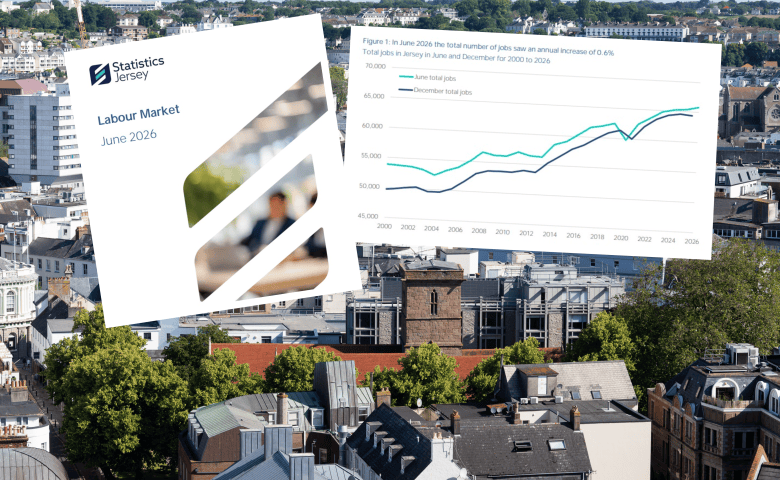
The main drivers of growth in the number of private and public sector roles are among the findings outlined within Statistics Jersey’s latest snapshot of the island’s workforce.
Released yesterday, the most recent Labour Market report contains information about the 65,790 jobs that were filled in Jersey as of June 2026.
Express took a look at the data…
The main figures at a glance:
- In June 2026 there were 55,740 jobs in the private sector and 10,050 jobs in the public sector. The overall totals were the highest recorded to date.
- The total number of jobs increased by 440 compared with June 2025, representing annual growth of 0.7%.
- Private sector jobs increased by 330 (0.6%), while public sector jobs increased by 110 (1.1%).

- Within the private sector, the largest annual increase was in private education, health and other services, which grew by 440 jobs. Financial and legal activities increased by 80 jobs. These increases were partially offset by decreases of 130 jobs in wholesale and retail and 50 jobs in hotels, restaurants and bars.
- The annual increase in public sector jobs was driven by growth in core staff within Health and Care Jersey, partially offset by reductions in other departments.
- Compared with five years earlier, the total number of jobs increased by 3,250, or 5.2%. This comprised an increase of 1,990 jobs in the private sector and 1,260 jobs in the public sector.
The report differs in scope from the public sector staffing statistics produced by the Government of Jersey, with the Labour Market report covering the wider public sector including the 12 parishes, which employ around 460 staff.
Its publication comes amid continued efforts to curb public sector growth, with Chief Minister Lyndon Farnham revealing earlier this year that the civil service recruitment freeze will continue into 2027.
He said that the freeze, which was initially introduced in 2024 and targets back-office functions while prioritising staff recruitment to frontline services, was estimated to have saved £31 million by the end of last year in annual staffing costs avoided.
Deputy Malcolm Ferey – vice-chair of the States Employment Board – told Express on Friday that: “The latest public sector staffing statistics show that, excluding healthcare and education staff, headcount and Full Time Equivalent (FTE) numbers in the public service decreased by 4.7% at the end of June 2026 compared with the same time last year.
“We are delivering on our commitment to limit growth in the size of government while ensuring islanders continue to receive the healthcare and other essential frontline services they rely on.”
