


Despite no-one knowing how many people live in Guernsey – and no end in sight to the population data vacuum – the States is committed to sticking with the island’s rolling electronic census system.
It replaced the traditional census around 20 years ago, after the then-States decided to save money by scrapping the censuses planned for 2006 and 2011.
The rolling electronic census system seemed to work well for a few years, before it was revealed that it had failed to accurately capture the island’s population in 2023.
Since then, no population data has been published by the States after it admitted the estimated population for 2023 was off by around 1,000 people.

Helen Walton, the Head of Data & Analysis for the island, told Express that despite the ongoing problems, the States remains focused on its rolling electronic census system – saying it is more cost and time effective than a traditional census.
“In other jurisdictions, planning is starting now regarding running a 2031 (traditional) census, from which results will be published in 2032,” she explained.
“It is a huge undertaking and, as such, there is a long lead in time. Our focus remains on recovering our rolling electronic census, which will provide up to date population information each quarter much sooner (and for lower cost).”
The problem
The rolling electronic census was introduced in 2014, after the States decided not to hold a census in 2006 as a trial.
The States then decided to scrap the 2011 census and any future ones on a permanent basis.
At the time it was estimated that holding a census in 2011 would have cost the island between £500,000 and £600,000.
Instead, data was collated from numerous States databases including Income Tax, Social Security, Population Management, Health, and Driving Licenses and Vehicle Registrations.
This combined data around immigration, emigration, births, and deaths into one system producing the island’s estimated population ever since.
Fast forward to 2026 and the island’s population data is now three years out of date, with the Revenue Service and Population Management office both needing additional staff to work through huge backlogs of tax returns and employment permit applications.
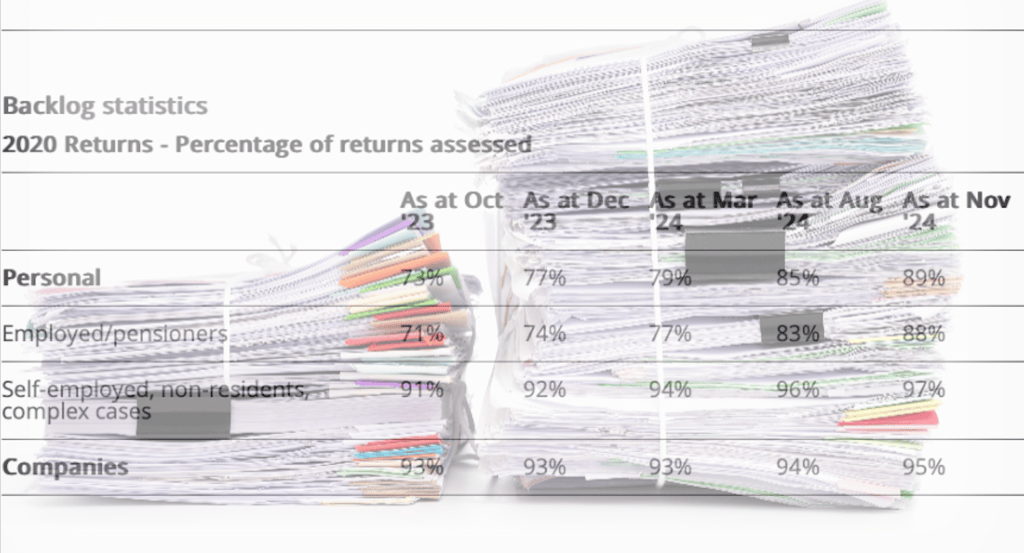
With that information feeding into the States’ rolling electronic census system, the population can’t be confirmed until the backlogs are in a much better position.
The housing crisis that has developed since the pandemic also raises questions about the island’s population.
As the island seems to outgrow the number of properties available to house its unknown population, rental costs have risen to an average above £2,000 per month with people outbidding each other to secure a home, and the States facing increased amounts of criticism for offering relocation expenses and rent allowances to essential workers moving to the island.
A new charity was formed in 2024 to help the growing number of people at risk of homelessness, while another charity, Caritas, brought two emergency sleeping pods to the island last year and is now working on plans to put an additional two at the harbour.
Data vacuum
The current lack of data is mainly down to problems at the Revenue Service, where £24 million was spent on a new IT system which ultimately failed.
Staff are now working through a huge backlog of tax returns dating back up to six years, with some of the people waiting for their assessments having changed jobs, left the island, retired, or even died in the meantime.
106,444 outstanding tax assessments were in the backlog at the end of August.
Since then it has also been revealed that the Population Management office has a backlog of its own with 3,886 employment permit applications and 324 immigration applications waiting to be dealt with, according to data released in September.
The Home Affairs President admitted there had been little progress on that backlog in the October States meeting.
With the information caught up in these backlogs feeding into the island’s rolling electronic census, Ms Walton admitted there’s no end in sight yet to the population mystery.
“While progress has been made, it is not currently possible to provide a definitive completion date for this work, so a publication date cannot yet be confirmed,” she said.
“The Revenue Service has largely completed the work needed to be able to extract the relevant data from the new Revenue Service IT system and Rolling Electronic Census system adaptations have been made in parallel.
“The final piece of work involves carrying out a series of checks to confirm that the data we need for these statistics has been correctly carried across from the legacy Revenue Service systems to the new system and then to tidy up the data to ensure it’s complete and in the format we need it to be in.
“This has to be undertaken methodically and carefully to avoid introducing new issues. While progress has been made, it is not currently possible to provide a definitive completion date for this work.”

Ms Walton also admitted that the ongoing backlogs at the Revenue Service and the Population Management office mean it will take a while for the data to feed through reliably again.
“These longer-than-usual backlogs may mean the usual time allowed to ensure population information is sufficiently complete before statistics are published (usually 10 months), needs to be extended (temporarily, until the backlogs are reduced) in order to achieve the previous level of accuracy,” she said.
“However, having a better understanding of the extent of backlogs hasn’t otherwise had an impact on publication dates.”
The final census
Guernsey’s last traditional census was held in April 2001 with each household asked to fill in details about who lived in the property.
It revealed that 59,807 people were living in Guernsey at the time – the highest the population had ever been.
Turning the clock back to 2001
25 years ago Sir Graham Dorey was Bailiff, Sir John Foley was Lieutenant Governor, and Eric Walters and Frances Quin were among Guernsey’s 45 deputies.
Tony Blair was the UK’s Prime Minister.
Jacques Chirac was the President of France.
George W Bush was America’s 43rd President – leading the United States through the response to the 9/11 terror attacks that claimed 2,977 victims.
‘Harry Potter and the Philosopher’s Stone’ was the blockbuster film of the year, and ‘Lady Marmalade’ by Christina Aguilera, Lil’ Kim, Mýa, and Pink was the top-selling single of 2001 globally.
Queen Elizabeth II and Prince Philip visited Guernsey in July, unveiling the Millennium Stone on L’ancresse Common.
The data collated revealed that 29,138 males (48.7%) and 30,669 females (51.3%) lived in the island, sharing 22,664 properties with an average occupancy of 2.51 persons per unit.
46,541 people were residentially qualified with 4,923 people on housing licences.
St Peter Port was the most densely populated parish with 16,488 residents, while Torteval was the least with 973 residents.
Moving to an e-census
Between 1801 and 1961 Guernsey carried out a census every 10 years, before moving to a five-year programme between 1971 and 2001.
When planning started for the 2006 census, the States decided to look at changing things again.
Initially a decision was made in 2005 to not run a traditional census in 2006 on a trial basis. Monitoring population data electronically got off to a good start and in 2010 the then-States agreed to replace the traditional census with a rolling electronic census on a permanent basis.
In 2021, the States reminded residents why a traditional census isn’t necessary in Guernsey, citing an estimated saving of around “£700,000 to date, in addition to providing more frequent information”, said Colin Vaudin, the States’ then-Chief Information Officer.
“The Rolling Electronic Census is a brilliant, cost-effective solution providing us with information more frequently than any traditional census ever could,” he said.
“Because of its success, we’re aware of other jurisdictions that are looking to replicate our award-winning system.

“Having more up to date and accurate information that we can trust means that we are in a very good position to develop policies and plans that are right for our islands.”
Today’s population
The most recently available data “indicates that the population was 64,781 on 31 December 2023”.
The States has said that figure is probably around 1,000 higher than the reality, because hundreds of people who had already left the island were incorrectly counted as still living here.
Data for 2024 was delayed while the States’ data team tried to work out what had gone wrong, with it admitting in 2025 that a growing backlog of tax returns at the Revenue Service was partly responsible.
At the time, Ms Walton said she was keen to ensure the accuracy of the rolling electronic census in the future.
“We routinely restate our more recent population statistics by small numbers as new information becomes available but will restate them more extensively before our next publication in order to reflect the updates that have been made to Revenue Service records,” she said.
“Being transparent about this issue and re-establishing the accuracy of the census statistics are both extremely important to us, so that government, industry and members of the public can continue to have confidence in the information we provide.
“We will have a better idea of an anticipated publication date for affected statistics within the next couple of weeks.”
At the time of writing we are still waiting for the anticipated publication date to be shared, with Ms Walton telling Express that “it is not currently possible to provide a definitive completion date for this work, so a publication date cannot yet be confirmed”.
