


One in four children are already overweight or obese by the time they start primary school in Jersey – rising to almost one in three by Year 6.
The latest Jersey Child Measurement Programme has highlighted the “serious implications” of childhood excess weight after measuring around 1,700 pupils during 2025 and 2026.
But what do the figures actually tell us? Express broke down the numbers…
1,700 children measured
The most recent JCMP report included analysis of the height and weight of children in reception and Year 6, with around 1,700 children measured in total over the course of 2025 and this year.
It marked 13% of measured children in the former group as overweight, 8% as obese and 3% as severely obese.
For Year 6, the figures stood at 14%, 13% and 3% respectively.
24% – Reception children overweight or obese
Almost one in four Reception pupils were classified as having excess weight.
However, the report noted that the proportion of reception children classified as overweight or obese had decreased from around 29% in the early 2000s to 24% in recent years.
30% – Year 6 children overweight or obese
By Year 6, the proportion was higher, with almost one in three children classified as overweight or obese (31%).
The figures stood at 14% overweight, 13% obese and 3% severely obese.
Unlike among younger children, there has been little movement over time.
The report said the proportion of Year 6 children with excess weight has “remained stable” over the past decade.
“Childhood obesity and excess weight are significant health issues for children and their families,” it stated.
“They can result in serious implications for a child’s physical and mental health, which can continue into adulthood.
“The JCMP data enables the government to monitor progress and plan services to tackle child obesity.”
10 years… Jersey consistently above Guernsey
Guernsey has also recently published its latest Child Measurement Programme – and its figures suggest fewer children there are carrying excess weight.
The other Channel Island’s programme included analysis of the heights and weights of pupils in school Years 1 and 5, recorded annually during the spring term.
Of the children measured in Year 1, around one in five had “unhealthy levels of excess weight” (10.6% overweight and 10.6% with obesity), with the figures rising to 12.8% and 16.9% respectively for Year 5.
Pointing to differences in analysis, including the year groups measured, the Sarnian document acknowledged that “exact like-for-like comparisons cannot be drawn” between the islands.
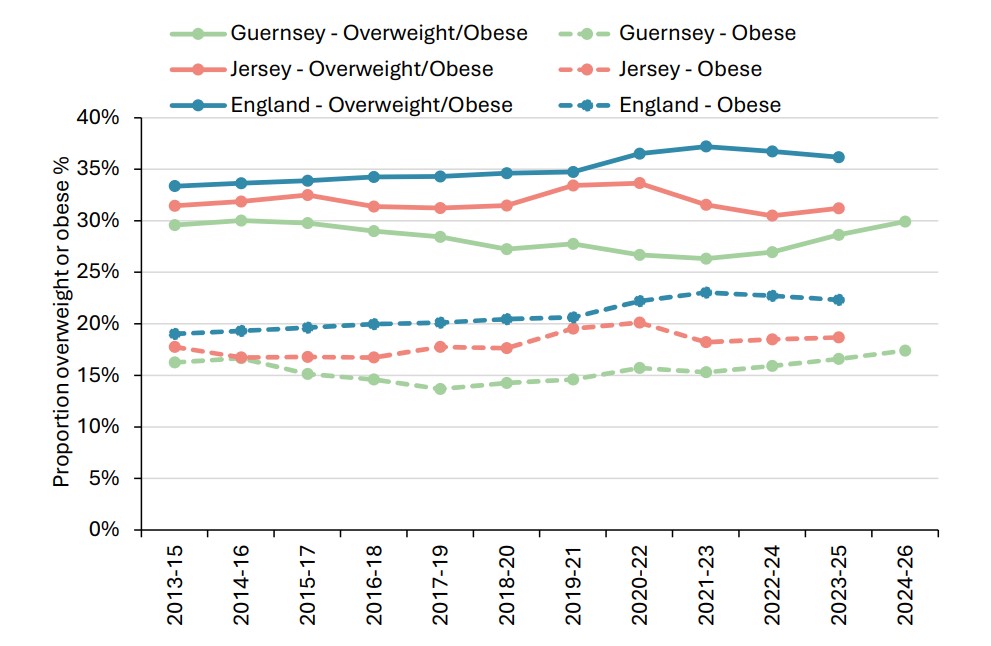
counterparts (GCMP).
However, it also referenced data from the past ten years (pictured above) and stated that: “The proportion of children in Guernsey with overweight or obesity is consistently and notably below Jersey and England, despite the Guernsey children measured being older.”
The Jersey report also states that the year groups measured in the GCMP “are slightly different to the year groups measured in the Jersey and English programmes” and “therefore direct comparisons cannot be made”.
