


A tracing agent had to be sent to rural Cumbria to track down a bankrupt builder who had accumulated around £1m in debt before fleeing the island.
The case ended up becoming a legal first for the island, as Express explores…
Thomas McLaughlin had operated as a sole trader but, when he was close to being bankrupt, he created a company.
When this collapsed, the 29-year-old stopped collaborating with the Viscount’s Department and fled to a farmhouse in Cumbria.
But the company, Restore Builders Limited, was never going to avoid bankruptcy. Mr McLaughlin had created it to hide how bad his own financial position was.
Concealing cash woes
The company had been in financial difficulty shortly after incorporation, the Royal Court heard in December.
It also heard that Mr McLaughlin hadn’t cooperated with the Viscount. He returned one form “sparsely completed” and some replies “did not actually make any sense at all,” the Royal Court heard.
Throughout the first part of 2023, he missed deadlines and payments.
In August 2023, the court heard, the Viscount issued a summons sent to Mr McLaughlin’s correspondence address, and got a response from a person who he thought was Mr McLaughlin’s partner, saying she was “not a point of contact”.
Mr McLaughlin then told the Viscount’s Department that he was away from Jersey after the death of his mother, but he ignored a notice to declare any possible inheritance.
“It then appears that Mr McLaughlin left the island permanently,” the court heard.
What is a wrongful trading order?
A company that is close to failing financially can either go through a creditors’ winding up or be declared “en désastre” by the courts. But they can’t continue trading if, or the directors themselves could be liable for the company’s debts.
To do this, the court issues a wrongful trading order.
This happens if they knew that the company had no chance of avoiding bankruptcy.
This is regulated under Article 44 of the Bankruptcy (Désastre) (Jersey) Law 1990 and Article 177 of the Companies (Jersey) Law 1991.
He ignored further mail, warning him that he would be referred to the Law Officers’ Department.
The missing documents meant that the Viscount’s Department didn’t know how much income Mr McLaughlin had or if he could pay his bankruptcy.

Mr McLaughlin had also misrepresented the company’s assets when he declared its bankruptcy.
In his judgment, the Deputy Bailiff, Robert MacRae, said: “There is evidence that Mr McLaughlin may have mixed the Company’s assets with his own and it was unclear where the assets and the liabilities truly lay.
“The Viscount says that Mr McLaughlin has demonstrated contempt to the Court and his creditors.
“There is also evidence that Mr McLaughlin knew or ought to have known that there was no prospect that the Company would avoid bankruptcy and accumulated approximately £1 million in debt in his personal capacity prior to incorporating the Company.
“It appears that Mr McLaughlin incorporated the Company in order to improve his position with creditors.”
The Viscount’s Department staff member who had been dealing with Mr McLaughlin said her “working assumption” was that he had created the company to limit his personal liability when he was in a bad financial situation.
But, the court heard, “by then it was too late, and the company soon collapsed into insolvency”.
Tracking him down…
The Viscount’s Department had to use a tracing agent to find Mr McLaughlin.

They eventually found him in “a rural area near a small town called Wigton in Cumbria”, living in “a farmhouse enclosed by an area containing goats and a camping area”.
In the area, the tracing agent found two vehicles with Jersey numberplates, a black Range Rover and a grey Mercedes van.
Having been served more proceedings, he eventually wrote in an email that there wasn’t much more he could have done and that he had used customer pre-payments to pay debts and wages instead of, for example, ordering the equipment the money was aimed at.
“Tantamount to an admission”
The Deputy Bailiff commented: “This is tantamount to an admission that he was acting dishonestly in using customers’ deposits not for the purpose for which he received them, but for other purposes entirely.”
In December, he became the first person to be served a wrongful trading order in Jersey.
Mr McLaughlin didn’t attend the Royal Court hearing.
Timeline
July 2022: Mr McLaughlin starts his company, Restore Builders, where he is the only member
25 July 2022: Restore Builders is incorporated by the Registrar of Companies
7 October 2022: Restore Builders ceases trading
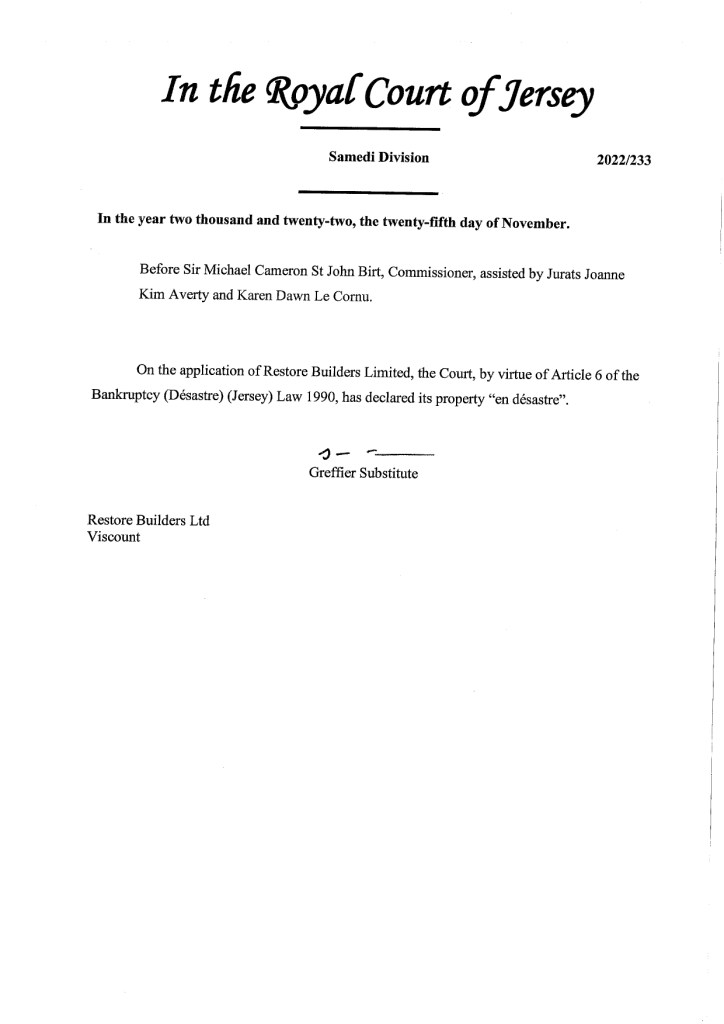
25 November 2022: The Royal Court declares both Restore Builders and Mr McLaughlin to be “en désastre”
November 2022 to June 2023: Mr McLaughlin misses various meetings and deadlines with the Viscount’s Department
October 2024: Mr McLaughlin is found in a Cumbrian farmhouse
20 December 2024: The Royal Court issues a wrongful trading order against Mr McLaughlin, meaning he is personally liable for the company’s debts.
The Deputy Bailiff found that Mr McLaughlin had gone against the Désastre Law and that he hadn’t given any reasons for leaving the island.
He said: “Mr McLaughlin failed to keep in contact with the Viscount; he failed to attend appointments; he failed to make the payments he promised; he failed to provide genuine assistance to the Viscount.
“His conduct made it very difficult, if not impossible, for the Viscount to pursue the debtors of the Company.”
People should not “play fast and loose with the rules”
Having accumulated £964,057 in debts in his personal capacity, Mr McLaughlin “knew, or ought to have known, that there was no reasonable prospect that the Company which he incorporated would avoid bankruptcy”.
The Viscount’s Department said people “should not be able to play fast and loose with the rules and the [Désastre Law]”. The court agreed.
Mr McLaughlin was disqualified from being a director of a company in Jersey for 10 years and was made personally responsible for the Restore Builders’ debts.
