
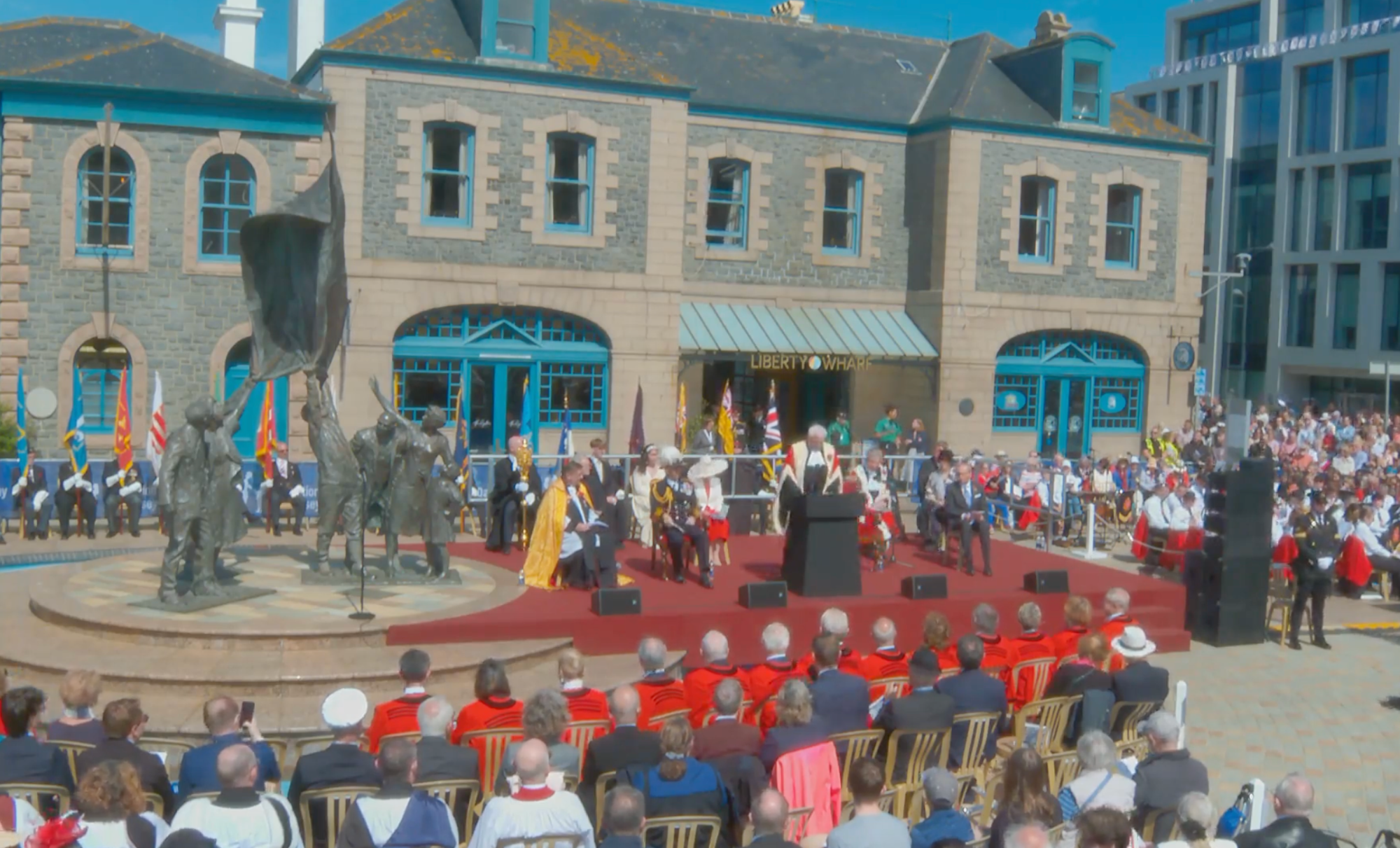

As islanders gathered for the 81st anniversary of Jersey’s Liberation, the Bailiff of Jersey, Robert MacRae, delivered his first Liberation Day address since taking office – speaking of remembrance, resilience and the importance of passing the lessons of the Occupation to future generations.
Reflecting on the hardships endured during the five years of German Occupation, he paid tribute to those who lived through the uncertainty and deprivation of wartime Jersey, while also celebrating the peace, tolerance and freedoms enjoyed by the island today.
You can read his speech in full below…
Ladies and gentlemen, esteemed guests. This is my first chance to address you on Liberation Day, our national day, as Bailiff and it is an honour to do so.
Liberation Day is not only a day when we all come together as an island to celebrate the events of 9 May 1945, but it is also a day when we may reflect on the events of the Occupation, and think about what it meant for those who suffered five harsh years deprived of so many of their liberties, cut off from friends and families outside the island – including those who took the very difficult decision to evacuate in 1940 and those who were forcibly interned in Germany in 1942.
It is hard for us now to understand the uncertainties that all those islanders experienced – including not knowing when or even if the Occupation would end. And for those evacuated or interned, when they would see their beautiful island of Jersey again. But people did not lose hope.
The other day, I was reading Nan Le Ruez’s wartime diaries. Many of you will know that she was a young woman in her 20s living on the family farm in St Peter during the Occupation, and she kept a diary – never expecting it would be published decades later.
Nan Le Ruez was separated for five years from her fiancé in England – hearing from him very infrequently, only when a Red Cross message, limited to 25 words, made it through to her.
Her diary speaks of the gradual worsening of conditions. The shops running out of household goods and clothes, many of them bought up by the Occupying Forces.
Even simple pleasures such as swimming were forbidden, and cruel punishments were imposed on islanders who broke some of the new rules imposed upon them. Fuel and food became increasingly scarce as the war entered its final phase after D-Day in 1944.
But she and her family and friends were sustained by each other, by a belief that the war would come to an end, and by her and her family’s strong faith in God.
They were also encouraged by the knowledge that they had not been forgotten – reinforced by the RAF dropping leaflets on the fields near her home and listening to BBC broadcasts on the radio until they were forced to surrender it in 1942. The BBC broadcasts included recordings of the song we will sing together later this morning – Beautiful Jersey.

We reflect today, not only on the events of those wartime years but on what has happened since. Despite conflicts elsewhere, we can be proud and grateful for the fact that Jersey – and most of Western Europe – has known peace for the past 80 years.
In that vein, I am delighted to welcome Her Excellency Susanne Baumann, the German Ambassador to the United Kingdom, here today. We were glad to welcome your predecessor on Liberation Day, and we are pleased and touched that you have chosen to join the people of Jersey on this special day for Islanders.
I should also like to offer a warm welcome to His Excellency Sven Sakkov, Ambassador of the Republic of Estonia, Monsieur Hervé Mariton, President of the Franco-British Council and to welcome back to Jersey the Rt Hon Lord Peter Ricketts, Chair of the Franco-British Council. We are honoured that you are all celebrating this occasion with us.
It is said that those who fail to learn from history are doomed to repeat it. The forces of Nazi Germany which led to the Second World War and appalling atrocities, including the Holocaust, promoted intolerance, division and brutality.
The Jersey we know today – and the European democracies we regard as our neighbours and friends – have been built on tolerance and a commitment to human rights and fairness. Liberation Day is an opportunity for us to reflect on that.
As to the future, the torch of remembrance is now being passed to new generations of young people. And to people from all over the world who have made Jersey their home. Liberation Day is and must remain for all of us a day of celebration and reflection on the precious freedoms we now enjoy. It is a task we all share to ensure that it does.
During the past 12 months, I have been fortunate to see young people from two schools perform plays about the Occupation, both of which were extremely moving and evocative: St Mary’s School performing ‘Make Do and Mend’ in May last year at the Arts Centre and Jersey College for Girls performing ‘Barbed Wire and Teddy Bears’ in December.
When I was at school, we were not really taught about Occupation or Liberation. That was perhaps in part because the memory of both was so fresh in the minds of so many, and partly because in those days, we were taught primarily about British history and not Jersey history and culture.
Things have changed, and for the better. The other day I was speaking to the headteacher of d’Auvergne School which is one of the largest primary schools in the island. I was delighted to hear that children in that and many other schools learn about Jersey’s Liberation and its significance.
At d’Auvergne School on Wednesday, there was a community Liberation tea party and yesterday the whole school wore red and white, the colours of the Jersey flag, and carried the flag as they embarked on their annual Liberation walk. D’Auvergne is a school where the pupils speak a total of 20 languages when they are at home and in the words of the headteacher: “Through their lessons and assemblies, the children are taught that peaceful co-existence, mutual respect and treating one another with fairness are reflections of the liberties we enjoy as a result of the sacrifices of those who have gone before us.”
Other schools have marked our national day in different ways, and Liberation Day and its significance is alive and well in the schools of Jersey.
So I think that we can face the future with optimism. As the first-hand recollections of Liberation pass into history, the stories of those who lived and struggled during those years will not, and the joy of watching the re-enactment that we are about to witness will never fade.
I wish you all the happiest and most joyful Liberation Day. À la prochaine.
