


“Warmer nights” contributed to Jersey experiencing its seventh warmest year on record in 2024 – with a red stripe added to the Climate Wall at the Waterfront.
The average annual temperature last year was 12.94°C, according to Jersey Met, which said that the island should be prepared for the potential of “more extreme weather events as our temperature rises”.
There are now a total of 131 stripes on the wall, each representing a year from 1894 through to 2024, with the colour reflecting the year’s average temperature.
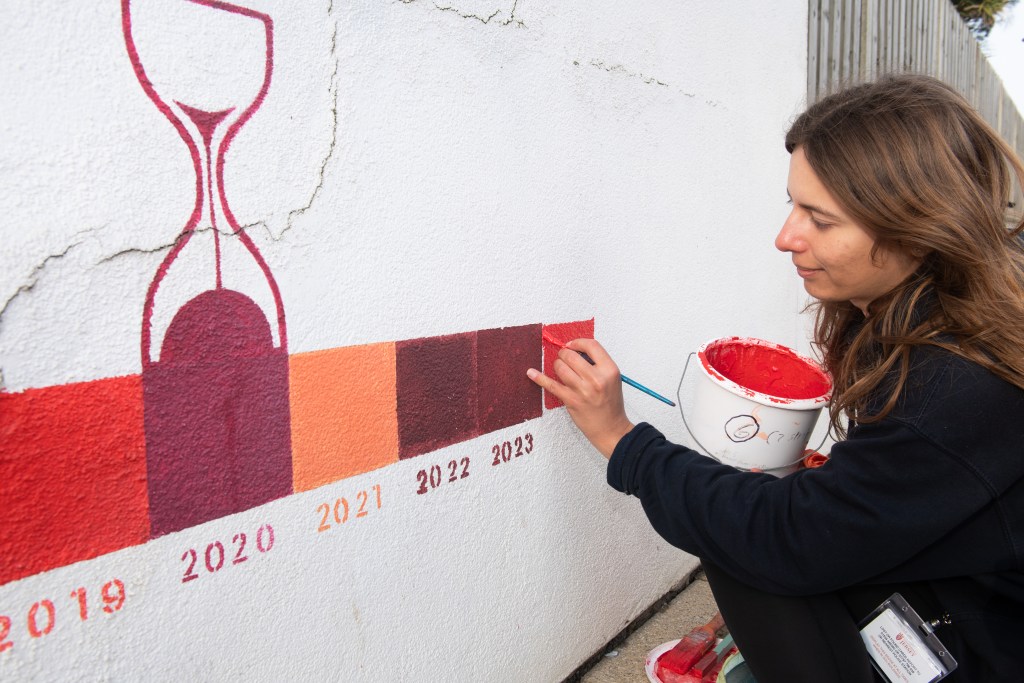
The stripes are used to demonstrate how the island’s climate is warming over time, serving as a visual reminder of climate change, with individual years shown as colder (blue) or hotter (red) than the 30-year average temperature between 1971 and 2000.
Environment Minister Steve Luce said: “The trends we are witnessing have a huge impact on everyone. With increasing temperatures are associated impacts on biodiversity, food security and sea levels – which, as an island, is greatly concerning.”

Deputy Luce said he would “continue to encourage islanders to reduce their carbon footprint through the policies in our Carbon Neutral Roadmap”.
The Minister thanked Jersey Met for providing “crucial information”, which he said came after an announcement by the World Meteorological Organisation that January 2025 was the hottest January ever recorded across the globe.
Jersey Met head of meteorology Paul Aked said: “The daily maximum temperatures for 2024 were on average 0.32°C higher than the long-term average.
“However, the night-time minimums were 0.81°C above the long-term average.

“It is in this detail you can see the impacts that warmer nights are having, contributing to the overall annual temperature being the seventh warmest on record.
“Along with temperature rise, for every degree our atmosphere warms, the atmosphere can hold 7% more moisture, adding to the wetter weather.
“As a result, we should be prepared for the potential to see more extreme weather events as our temperature rises.”
Jersey artist Ian Rolls created the climate stripe mural showing how average air temperatures are rising.
It was originally unveiled in June 2020 but a new version came in 2021 after the artwork became the target of vandals sometime between Christmas and Boxing Day when climate change denying messages were painted over the stripes in bright orange paint.
