

Ministers are due to respond to a petition calling for investment in a PFAS water treatment plant after it gained more than 1,000 signatures since its launch last month.
It comes as the ‘PFAS Scientific Advisory Panel‘ of experts prepare to meet tomorrow to discuss treatment options and costs for the 50 St Ouen residents living under the airport runway affected by elevated exposure to the chemicals from their private supplies.
Paul Le Claire’s petition calls on the Government to adopt global best practices for regulating PFAS and set up healthcare services for testing and treatment.
Jersey Water, however, maintains its drinking water is fully compliant with current regulations and said it will continue to do so if these change in future.
The organisation added that it already carries out regular testing, with 16,656 conducted last year alone.
CLICK TO CATCH UP: How Jersey PFAS pollution came to light…
PFAS (perfluoroalkyl and polyfluoroalkyl substances) are a group of man-made chemicals, often referred to as ‘forever chemicals’ due to their inability to break down in the body or the environment.
PFAS was an ingredient added to everyday items such as frying pans, outdoor jackets and floor tiles because of its ability to repel water, heat, and oil.
Mains drinking water in Jersey contains only trace amounts, and a report recently published by Jersey Water said that 99.95% of water samples across the island meet regulatory standards, although some islanders disagree with the current limits.
The chemicals can, however, be found in higher concentrations in some parts of the island.
One type of these ‘forever chemicals’, called PFOS, was an ingredient of firefighting foam sprayed at Jersey Airport for several years until the chemical was banned in the 1990s.
Concerns that this may be affecting the health of St Ouen residents living under the runway were first raised publicly by Sarah Simon, who suffers from skin, thyroid and autoimmune disorders, as well as joint and nerve pain and revealed to Express how she had tested her own blood to prove that she had elevated levels.

Her concerns were backed by others living in the area.
The following year, an Express investigation uncovered a secret contract between the Government and the foam’s manufacturer, US multinational 3M.
Agreed by the States Assembly in January 2005 after a behind-closed-doors debate, the deal resulted in 3M giving the government of the day £2.6m, which went towards cleaning up the contaminated training ground and building a new rig on the site.
It also meant the Government was legally bound to help the manufacturer defend any claims made against it, including by islanders who believed their health had been damaged.
Two years later in 2022, 78 islanders volunteered to have their blood tested for PFAS as part of a Government-sponsored programme. Every one of them was found to have it in their blood, with 80% having at least one type of PFAS at a high concentration.
The PFAS Scientific Advisory Panel was set up the following year to explore options to support approximately 50 islanders affected by elevated exposure to PFAS and make recommendations to Ministers and the Director of Public Health.
One of their earliest recommendations in September 2023, which was accepted by Government, was to “investigate the introduction of a therapeutic phlebotomy service”.
But it has since emerged that other types of treatment are on the table – and the Government confirmed to Express earlier this month that it will be considering whether “less invasive and more effective options” should be pursued instead.
What’s on the agenda for tomorrow’s meeting?
The PFAS Scientific Advisory Panel, chaired by Steve Hajioff, will meet tomorrow morning to evaluate treatment methods, associated costs, and potential funding.
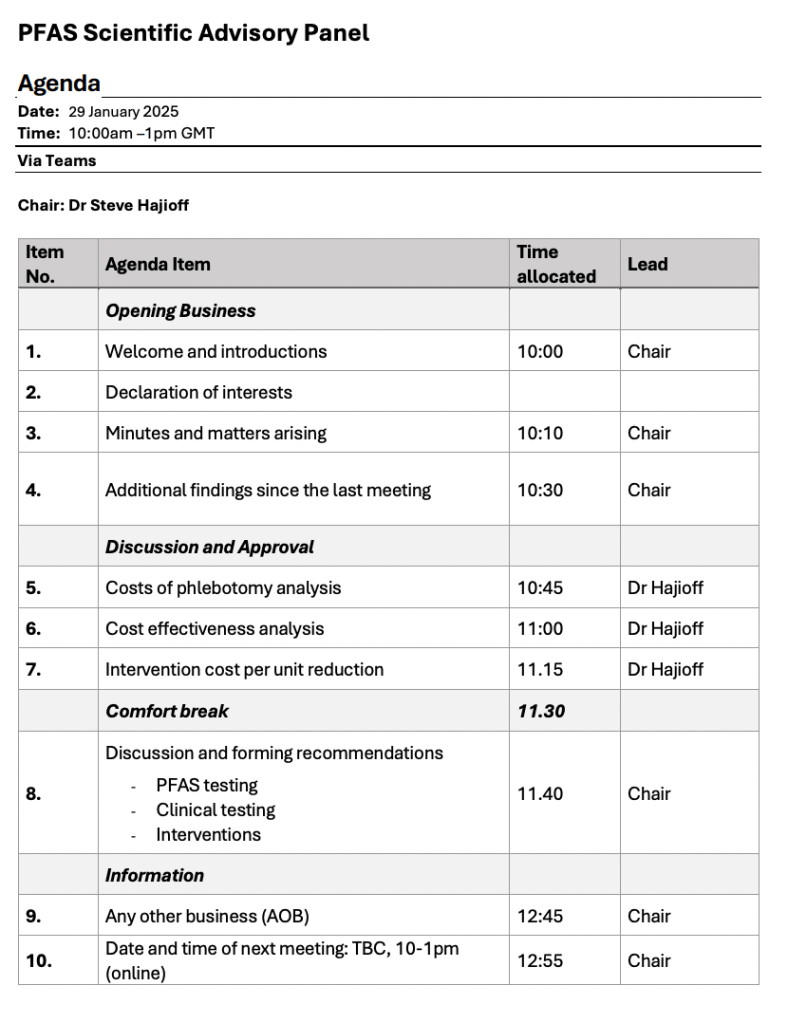
Options under consideration include:
Bile Acid Sequestrants: Uses medications that bind to substances in the intestines to prevent reabsorption. Annual treatment costs range from £8,700 to £23,000.
Haemodialysis: A process typically used for kidney failure that filters toxins from the blood. It is resource-intensive, with annual costs exceeding £1.3 million.
Probenecid: A gout medication that may prevent PFAS from being reabsorbed by the kidneys. This non-invasive option costs approximately £45,000 annually.
Psyllium Husk: A fibre supplement that helps remove PFAS through the digestive system, with costs ranging from £1,500 to £26,000 annually.
Plasma Removal: A hospital-based procedure that involves separating plasma (the liquid part of blood) from other blood components, costing £300,000 in its first year and £250,000 annually thereafter.
How would this be funded?
Each of the costs remains an estimate at present, and it’s not yet clear how exactly any of the treatments would be funded.
At a meeting in November, Deputy Public Health Director Grace Norman, said understanding the possible funding requirements was “very important”.

However, meeting minutes noted, “these estimates are likely to under-estimate the cost to Government as they do not include on costs, some implementation costs and the costs of evaluation and monitoring for any programme or intervention implemented”.
Dr Hajioff agreed – and also noted that islanders should be aware that “there may be an additional burden on the Government of Jersey and islanders via taxes, as there are for delivering any new services”.
Changing standards
With growing global recognition of the potential health impacts of PFAS exposure, international standards are due to change, with EU and UK regulations tightening in 2030.
Jersey Water CEO Helier Smith told Express last year: “Once those UK regulations come into place, it’s always going to be our intention to be fully compliant.”
The company has also conducted promising trials of treatment technologies, with one filtration system which separates PFAS from water using small air bubbles called SAFF being trialled back in 2022.
Mr Smith said the trial of SAFF had been “widely successful”, though Jersey Water clarified that this was a small-scale laboratory test and that they had not yet made a decision on which treatments to use.
READ MORE…
INSIGHT: Blood letting, pills, plasma removal… The Jersey PFAS treatments under consideration
Hundreds call for PFAS water treatment plant
Key meeting after expert papers link PFAS exposure to cancer and cholesterol risk
Study into spread of toxic chemical completes first round of sampling
PFAS experts to discuss offering blood-letting to islanders
FOCUS: How will panel investigating toxic PFAS in our water work?
Panel to advise Government on PFAS response is formed
Doctor appointed Gov’s lead adviser on toxic chemical in water supply
New research uncovers ‘concerning’ levels of forever chemicals in fish
Gov identify experts to recommend action on toxic chemical in water
Official results confirm high levels of toxic chemical in islanders’ blood
Trial of new tech to remove cancer-causing chemical from water
Promised study into dangerous toxin in water still not started
Islander tests own blood in bid to prove chemical contamination
