
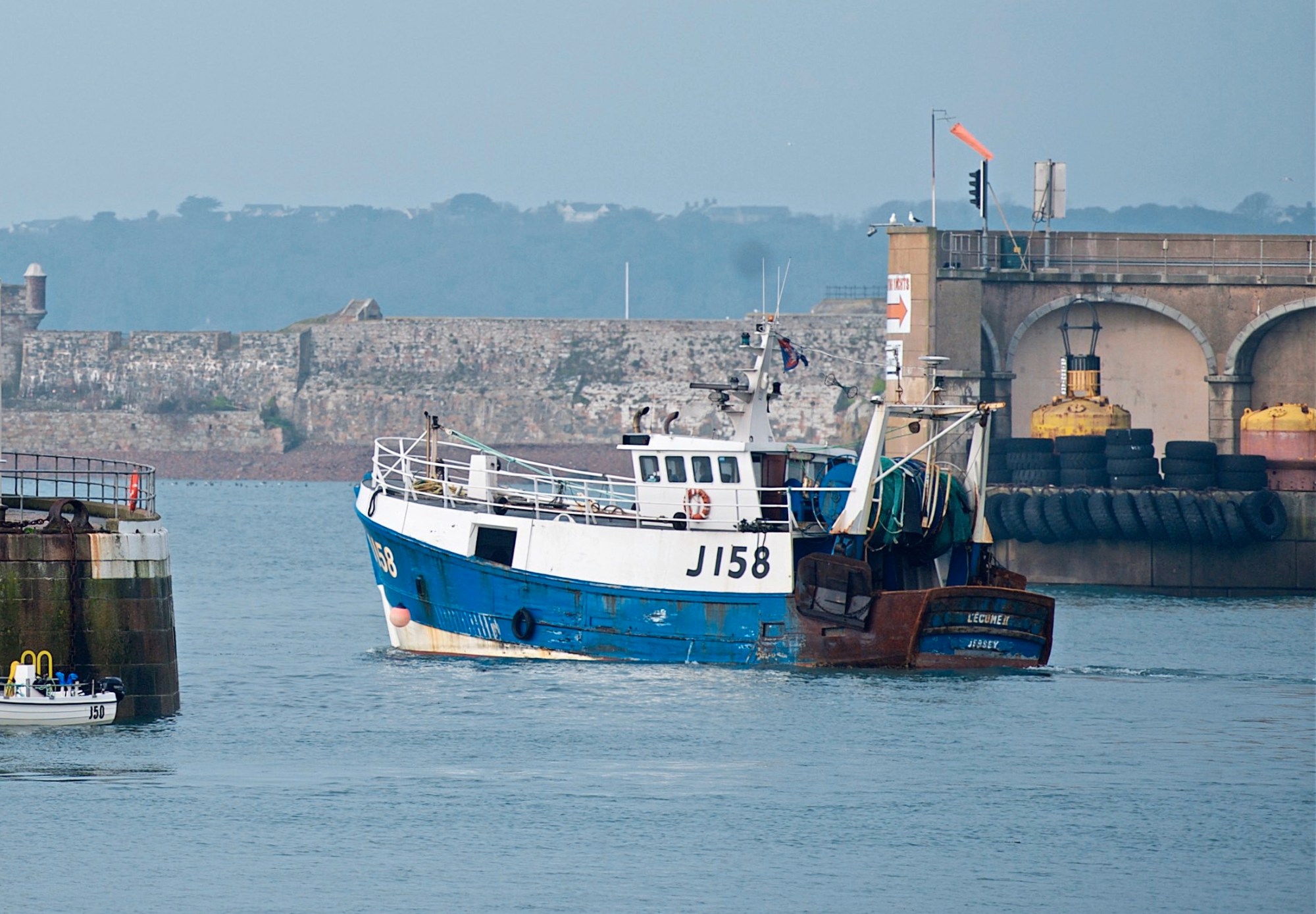

The most senior officer on the bridge at the time of the Commodore Goodwill’s collision with L’Ecume II had not received bridge management training after it was stopped during the pandemic, the Royal Court has heard.
The Condor ship’s captain this morning gave evidence in the trial of Lewis Carr (20) and Artur Sevash-Zade (35), which is entering its second week.
Mr Carr and Mr Sevash-Zade were the only two crew members on the bridge at the time of the collision at 05:35 on 8 December 2022, which killed the three men onboard fishing trawler L’Ecume II.
The two Goodwill crew members deny three charges of manslaughter.
The prosecution say that no-one will ever know what skipper Michael Michieli and crew members Larry Simyunn and Jervis Baligat were doing in the moments before the early-morning collision, but they have created reconstructions of the Commodore Goodwill’s radar screens during the trip.
At the time of the collision, Captain Radoslaw Zelazny was in his cabin, preparing to come to the bridge to steer the ship into harbour in Jersey. Mr Carr was officer of the watch and Mr Sevash-Zade was his lookout on the bridge.
Mr Zelazny last week told the court how he heard the ship’s horn blast and said that Mr Carr called him up to the bridge. He made a man-overboard announcement and turned the ship back towards the collision site, hoping to recover the fishing boat crew from the water.
This morning, the captain was cross-examined by Advocate Simon Thomas, who represents Mr Carr.
Mr Zelazny told Advocate Thomas that the crew was trialling a new shift pattern called “rolling eights” – where two officers of the watch alternate eight-hour shifts.
“The second officers requested some changes to help them get some rest,” he said.
“We were trying to find a happy medium so that everybody was well-rested.
“Rolling eights was a wart of such a trial. It was suggested by the officers of the watch… [we] agreed that they would like to try this arrangement and see how they feel. We were trying this out.”
In the shipboard manual, the captain had described that communication on the bridge could be “a work in progress”.
Mr Zelazny added in court: “I would say we’d aspire to certain standards but it didn’t always happen.”
And he described receiving “pretty good training” on bridge procedures, which included “quite a lot of time spent in the bridge simulator”.
But Mr Zelazny explained that bridge management training offered to Condor employees stopped with the covid-19 pandemic. This meant that Mr Carr had not received it, as he only started working with the company after the pandemic.
Advocate Thomas also pointed to the radar settings at the time that Captain Zelazny handed over control of the ship to Mr Carr at 04:50.
The captain said the radar should be set to at least one nautical mile or 12 minutes and “certainly not less”. However, one of the two radars was set to 0.3 nautical miles, or seven minutes, when Mr Carr took over.
The advocate asked: “Does that surprise you, to see that?”
The captain said: “Yes.”
Asked why, he said: “Because it shouldn’t be set to that. It doesn’t make any sense. It’s too low.”
There were more questions about officers of the watch allowing lookouts to leave the bridge or take breaks. Mr Sevash-Zade had been allowed to have breakfast when L’Ecume II first appeared on the screens, returning to the bridge half an hour before the collision.
Another one of the Goodwill’s captains allowed some breaks, the court heard.
Captain Zelazny said his own Standing Orders left the most senior officer on board some choice.
He said: “If the circumstances are right, so if the officer of the watch felt that they don’t need their assistance… it was at the officer of the watch’s discretion.”
Advocate Mike Preston, defending Mr Sevash-Zade, asked the captain about the collision warnings on board.
There was no audio alarm, Mr Zelazny said.
The captain described “perfect” conditions at sea that morning, saying: “You could see Corbière from Guernsey.”
The jury trial is scheduled to last four weeks. Commissioner Sir John Saunders is presiding.
READ MORE…
The L’Ecume II trial

WATCH: Condor seaman jailed for 20 months for L’Ecume II collision
The seaman who was in charge of a Condor freight ship when it hit a fishing trawler off the coast of Jersey in December 2022,…
WATCH: Condor seaman jailed for 20 months for L’Ecume II collision
The seaman who was in charge of a Condor freight ship when it hit a fishing trawler in December 2022, killing its three crew members,…
Condor crew member’s sentencing underway
The sentencing of the seaman who was in charge of a Condor freight ship when it hit a fishing trawler in December 2022, killing its…
PODCAST: Inside the investigation… The last voyage of L’Ecume II
On the morning of 8 December 2022, the Jersey fishing boat L’Ecume II set out to sea with three men on board. Just after 5.30am,…
Something went wrong. Please refresh the page and/or try again.
