

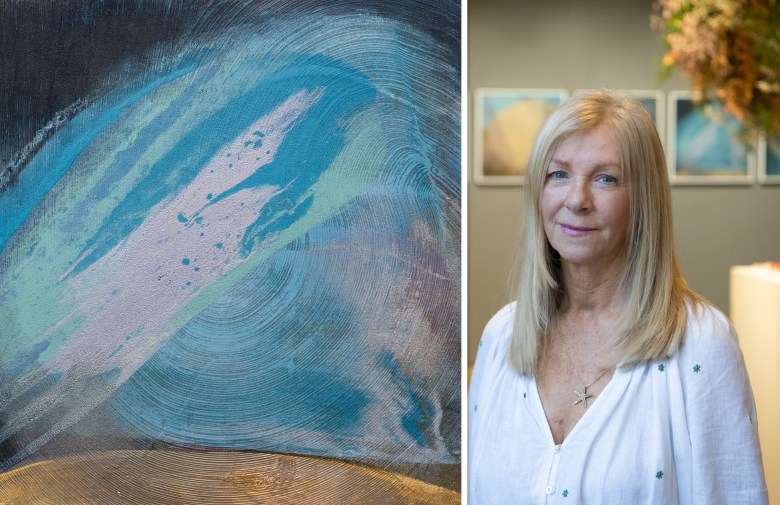
The debut solo exhibition of a Jersey-born artist exploring the fragility of the planet is set to open tonight in a St Helier gallery.
Hazel Wynn’s new exhibition ‘The Overview Effect’ draws inspiration from a term first coined by space philosopher Frank White, which describes the psychological experience of astronauts when they view Earth from space.
The artist, who originally trained in textile design at Chelsea College of Art in London, has a passion for colour and draws inspiration from the world around her to create vibrant and emotionally resonant paintings.
Hazel uses a unique method to create painted canvasses which aim to depict emotional responses to the natural world.
A public preview evening of her new exhibition takes place from 17:00 tonight at the Private & Public Gallery, alongside a drinks reception.
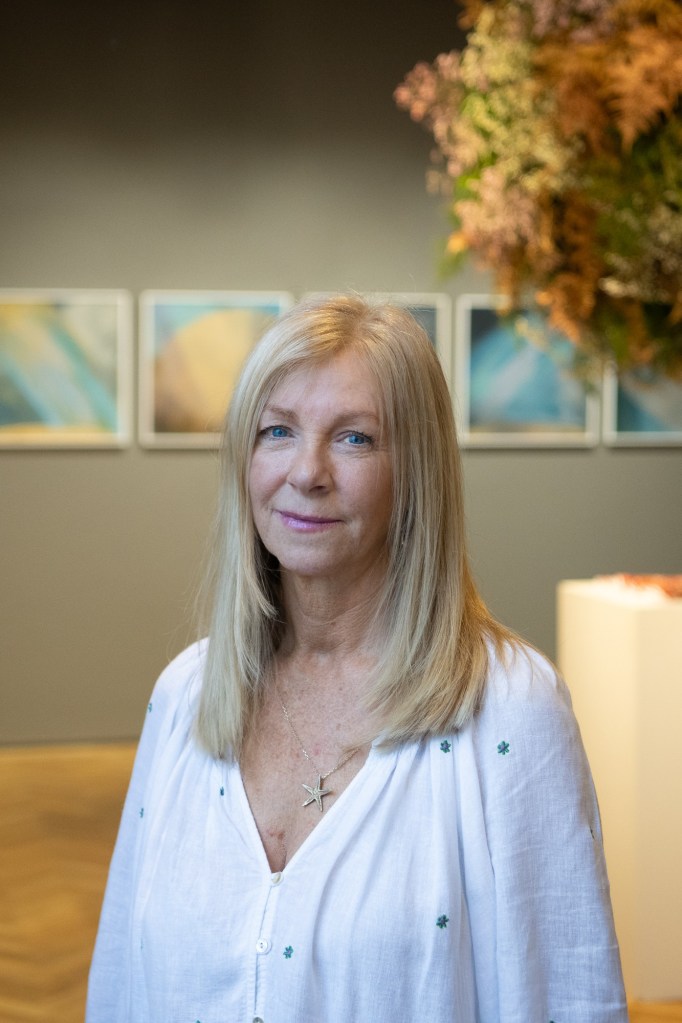
Ahead of the opening, Express sat down with Hazel to chat about the inspiration behind her latest work…
The title of your exhibition is inspired by a term coined by a space philosopher – what drew you to that idea, and how does it translate into your paintings?
The reason I picked the title ‘The Overview Effect’ for my exhibition is because I had initially been inspired by an interview Frank White had given on Radio 4 some time ago.
I remember feeling completely transfixed. I listened to him talking about these interviews he had made with at least 29 astronauts, many of whom described this incredible phenomenon.
White later coined this ‘The Overview Effect’ – a profound shift in cognitive awareness that astronauts experience when they view Earth from space. This made me feel compelled to buy the book. I really wanted to know more about their experiences and how they felt so changed when returning to Earth.
The book brought to me a very powerful message about how fragile our planet is, how delicate the protective atmosphere surrounding it is, and how small Earth is in the vastness of the universe.
For the astronauts in space, they don’t see a collection of nations; instead they see a borderless unified planet where divisive political boundaries simply vanish unlike the fractured, detail-oriented perspective that dominates life on Earth
hazel wynn
For the astronauts in space, they don’t see a collection of nations; instead they see a borderless, unified planet where divisive political boundaries simply vanish, unlike the fractured, detail-oriented perspective that dominates life on Earth.
As I read about this unified vision and this incredibly universal awe that they all experienced, I wanted to try and translate that into my artwork.
I started working on wooden boards for their uninterrupted flow of natural grain, allowing this organic, continuous line to remain visible beneath my painted layers, establishing a foundational sense of unending life.
Subsequently, I worked on layers of veiled colour to build complexity upon this natural and painted continuity, suggesting the rich, deep structure beneath the surface of things.
The palette is a direct reflection of my inspiration, specifically the beach walks where I marvel at the natural patterns in the sand. To bring this sense of materiality and texture into my work, I mixed the sand into my paint. This helps to add traction so that when I pull colours across the board, unexpected organic patterns emerge.
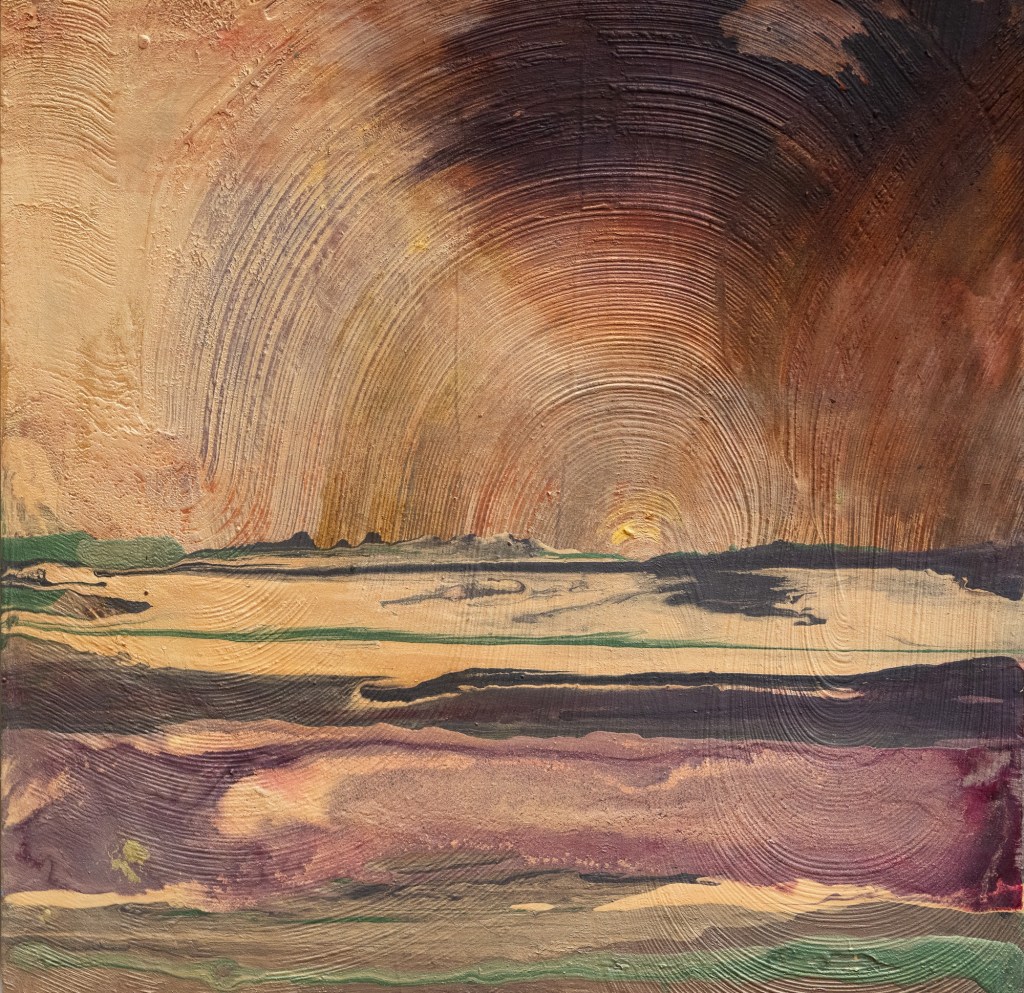


I also incorporate metallic paints (gold and silver) to evoke a feeling of preciousness and connection between the Earth and the cosmos. These metallic pigments, with their inherent reflectivity, transform mere colour into light and richness, immediately evoking the valuable resources of the Earth while simultaneously mirroring the starry brilliance and vastness of the universe.
By catching and shifting light, they establish a visual dialogue between the material world and the sublime, transcendent feelings of awe and unity, suggesting that the delicate beauty and fragility of our planet are intrinsically linked to the immense, shared structure of the cosmos.
I’ve spent time exploring the fluidity of paint with the aim of trying to capture an illusion of effortless flowing colours, yet the poured paint is meticulously controlled.
Through a process of trial and error, the paint is tilted and turned, creating a dynamic ebb and flow, eventually pooling and swirling into one unified mass, visually mirroring how individual streams and textures merge – a direct expression of ‘The Overview Effect’ on the canvas.
What do you hope people experience when they stand in front of your canvases?
I hope these pieces offer a truly resonant experience.
Just as the astronauts gain a new perspective, I invite the viewer to connect with their own inner landscape and the meditative quality of the work.
I want the viewer to feel their busy external world quiet down, opening a space for introspection.
Ultimately, the work aims to help them recover that sense of wonder we often lose – that feeling of immense awe inherent in the natural world.
Embrace a shared vision for the stewardship of our planet, and perhaps, glimpse that unified perspective gained by astronauts experiencing ‘The Overview Effect’.
You trained in textile design at Chelsea College of Art before moving into fine art. How has that background shaped your approach to colour, layering and texture?
My textile design background has deeply shaped my love for colour and pattern, forming the core of my artistic practice.
Inspired by the vivid beauty of the world, I create paintings that seek to connect with viewers on an emotional level.
Studying at London’s Chelsea College of Art was transformative – I spent countless hours drawing and painting, often escaping to Kew Gardens.
The lush tropical greenhouses became a sanctuary, where I sketched exotic flora that fuelled my creativity.
As a textile designer, involved with creating patterns for furnishing fabrics and selling to manufacturers, I often felt very frustrated at not being able to build up truly complex colours due to the print restrictions. I believe this constraint has directly fuelled my passion today.
Now, as an artist, layering is my form of expression; it’s how I translate the rich, complex and beautiful tapestry of life onto the canvas.
Your process involves laying the canvas flat and pouring paint – what is it about that physical, almost meditative process that resonates with you?
My primary method involves working directly on the floor, which enables me to use highly liquid paint, pouring it and manipulating those pools across the flat surface.
This technique allows for intentional placement while celebrating the unpredictable freedom of the flow.
I am always seeking the balance point between controlled application and the mesmerising, fluid marks that the paint naturally creates.
For me, the entire process is a meditative experience – a way to connect and paint purely from intuition.
Your use of light and colour has been compared to artists like Helen Frankenthaler and JMW Turner. Which artists or movements have most influenced you personally?
I’ve been fortunate to draw influence from many sources, but the early abstractionists and the Washington Colour School have been central.
Artists like Helen Frankenthaler, Morris Louis and Paul Jenkins have profoundly influenced my approach to colour, driving my exploration of its nuances and dynamic interactions.
Frankenthaler, in particular, provided a framework for embracing mistakes and playfulness, allowing the creative act to be a spontaneous engagement rather than a planned execution.
Similarly, I have drawn influence from Louis in the way I utilise gravity and multiple layers of veiled colour to explore transparency and continuous flow.
Finally, the ambition to convey the sublime and capture the emotional effect of light connects my work to the Romantic movement, particularly the enduring power of JMW Turner’s atmospheric canvases.
You’ve spoken about awe and stewardship of our planet. Do you see your art as a form of environmental reflection or activism as well as aesthetic expression? And has creating this series changed the way you see the natural world?
I absolutely see this body of work as both environmental reflection and an aesthetic expression, though perhaps less as direct “activism” in the traditional sense.
My goal isn’t to preach or propose policy, but to use the painting to foster ‘The Overview Effect’ in the viewer.
That profound, unifying feeling of seeing the Earth as a single, fragile entity is the necessary precursor to stewardship.
By translating the fluidity of our oceans, the fragility of the atmosphere and the interconnectedness of systems, I hope to gently nudge the viewer toward that realisation.
So, while the final piece is indeed aesthetic – meant to evoke beauty and awe – its underlying purpose is to recover a sense of preciousness for our shared environment.
The awe and the reflection are inseparable from the desire to protect what is beautiful.
Finally, what lies beyond this exhibition? Have you got your sights set on any future projects?
I’ve already picked up the follow-up book to ‘The Overview Effect’ – it’s called ‘The Cosmos Hypothesis’.
This suggests I won’t be moving too far away from exploring themes of interconnectedness and universal unity, but perhaps expanding the scope even further beyond Earth.
However, the powerful connection I made in this series to the environment and the urgency of stewardship will certainly remain a core foundation.
The fragility of our ‘blue marble’ is an inescapable truth, and those themes of continuous flow and essential materiality will undoubtedly play a large role in the next collection.
Ultimately, I anticipate my future work will continue to use aesthetic expression to prompt a deeper look at our place in the universe and our responsibility to our planet.
GET INVOLVED…
The exhibition is free to visit and will run until Friday 28 November at Private & Public Gallery – which is open weekdays from 12:00 to 18:00, and Saturdays from 10:00 to 15:00.
