
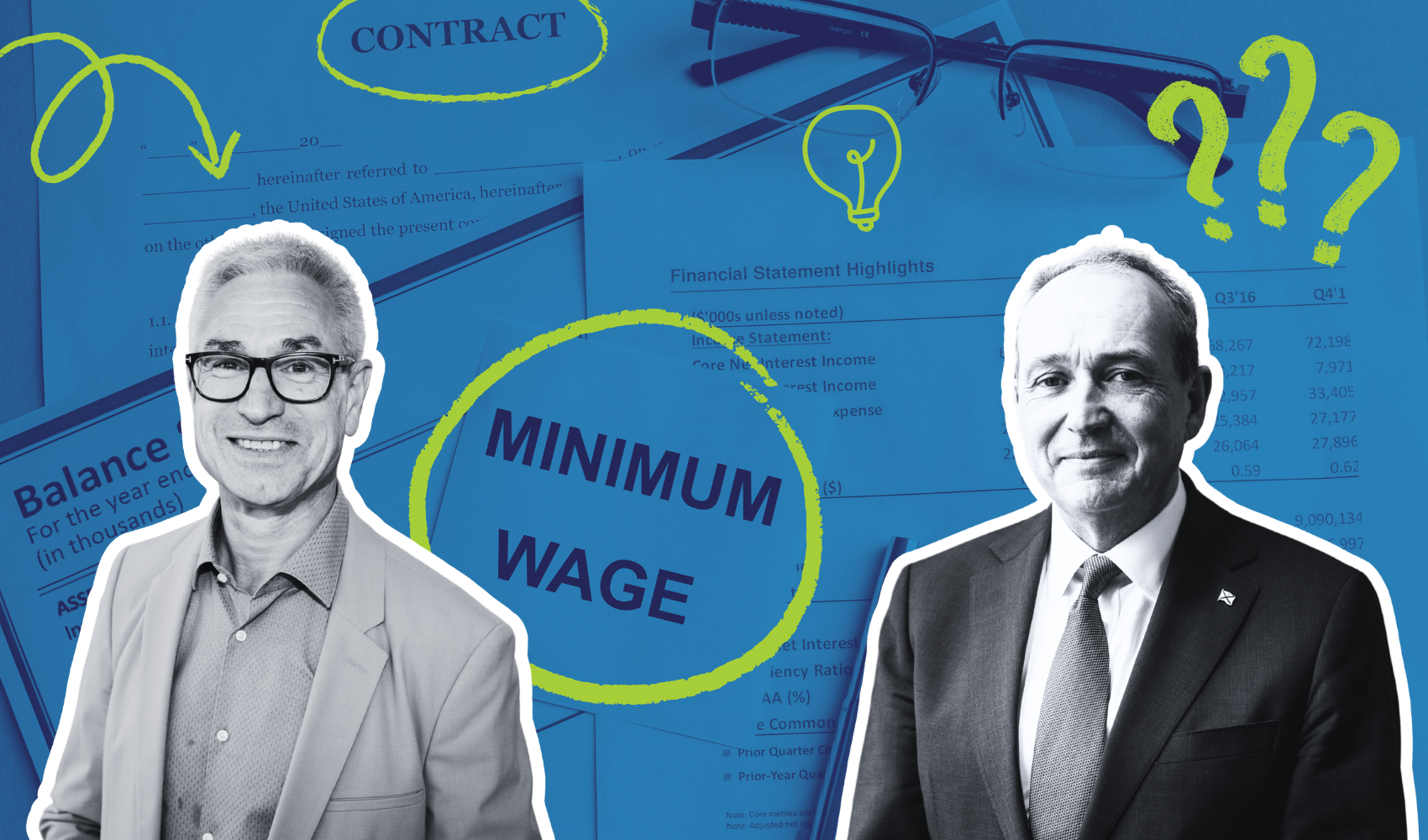

Jersey’s Economic Development Minister has sparked fierce debate by questioning whether the Island should have a minimum wage at all – more than two decades after he voted for the law that created it.
Deputy Gerald Voisin argued in a letter to the JEP this week that the current £13.59-an-hour rate was “strangling the economy” and “turbocharging inflation”, and questioned whether the Island should consider abolishing the statutory minimum altogether.
The suggestion was swiftly rejected by Chief Minister Lyndon Farnham, who said it did not reflect the position of the Council of Ministers.
But both politicians have a history with the legislation stretching back more than 20 years.
Deputy Voisin served on the Employment and Social Security Committee during the early development of Jersey’s modern employment protections, while he and then-Deputy Farnham were both among the States Members who backed the law which ultimately provided the legal framework for the minimum wage.
Express looks back at how the policy came about…
1993 – The first proposal
The idea of introducing a minimum wage in Jersey dates back more than three decades.
An Employment Forum report published in 2003 recorded that the policy was first proposed in March 1993 by Senator Dick Shenton, before the then Industrial Relations Committee brought forward a report and proposition in 1996.
Momentum increased the following year when the States agreed, as part of its Strategic Policy Review, that a statutory minimum wage should be introduced “as soon as possible”.
1999 – States back a minimum wage
On 16 March 1999, the States formally approved the principle of minimum-wage legislation.
Members agreed that Jersey should have a single hourly minimum rate, alongside a trainee wage, enforcement through JACS and an Employment Tribunal, and an independent body to advise on the wage and how it should be increased.
A report and proposition on the move at the time said that, whatever rate was decided, it should “support a competitive economy; be set at a prudent level; be simple and straightforward; and yet make a difference to the low paid”.
The Employment Forum was subsequently established in August that year.
[The rate] should support a competitive economy; be set at a prudent level; be simple and straightforward; and yet make a difference to the low paid
“Minimum Wage” Report and Proposition to the States, March 1999
Mr Voisin was not a States Member when that landmark vote took place. He was first elected later in 1999.
2000–2001 – Deputy Voisin joins the committee overseeing employment reform
Following his election, Deputy Voisin became a member of the Employment and Social Security Committee – the political body responsible for developing the Island’s new employment legislation.
In December 2000, the States backed the next stage of the reforms, including legislation needed to facilitate a minimum wage and protections against unfair dismissal.
The proposals followed the committee’s “Fair Play in the Workplace” consultation, which argued that Jersey needed a legal “safety net of rights, responsibilities and protections”, while ensuring regulation remained affordable and supported a competitive economy.
Records show that Deputy Voisin remained a member of the committee until his resignation in June 2001.
2003 – Voisin and Farnham vote for Employment Law
The Employment (Jersey) Law finally came before the States in July 2003.
Crucially, Part 4 of that law created the legislative framework through which Jersey’s minimum wage would operate.
Both Deputy Voisin and Deputy Farnham – then serving during earlier spells in the States – were among those who voted in favour as the Assembly considered the legislation.
The law was subsequently approved by the Privy Council and registered in the Royal Court.
2004 – £5.08 recommended as Jersey’s first rate
Attention then turned to the question that remains politically contentious today: how high should the minimum wage actually be?
In 2004, the Employment Forum recommended that Jersey’s first rate should be £5.08 an hour.
Its report described the issue as the most difficult it had considered, noting the challenge of balancing benefits for low-paid workers against the potential impact on employers and jobs.
The £5.08 figure was based on a notional £4.80 rate in October 2003, increased to account for expected inflation.
Reiterating previous discussions, the Forum said the principles behind the policy were that the wage should support a competitive economy, be prudent and straightforward, while still making a difference to low-paid workers.
2005 – Minimum wage finally comes into force
After more than a decade of political discussion, Jersey’s minimum wage finally took effect on 1 July 2005 at £5.08 an hour.
The accompanying Employment Law also brought in wider workplace rights and enforcement mechanisms which policymakers had previously concluded were necessary before a minimum wage could operate effectively.
Deputy Voisin and Deputy Farnham were both serving in the States when the new system came into force, but both stepped down at the end of 2005.
2007–08 – A formula for increases
The minimum wage initially rose relatively cautiously.
It increased to £5.24 in 2006 and £5.40 in 2007, before the Employment Forum recommended a new formula based on 40% of average weekly earnings.
That produced a 7.4% rise to £5.80 from April 2008.
Neither Mr Voisin nor Mr Farnham was serving in the Assembly at this time.
2009 – Minimum wage reaches £6.08
By April 2009, the statutory minimum had climbed to £6.08 an hour.
Statistics published that year found that average earnings in agriculture had risen by 5.9%, driven predominantly by the 4.8% increase in the minimum wage introduced that April.
The debate over the relationship between wages, inflation and competitiveness was hardly new.
In the early 2000s, Jersey had been grappling with unusually high inflation.
A report looking at the Island’s economy at the time recorded inflation of 4.4%, compared with 2.4% in Guernsey and 1.8% in the UK, while unemployment stood at 0.4%.
2018–19 – Voisin warns against large increases
Years after leaving politics, Mr Voisin continued to contribute to minimum-wage consultations in his capacity as a retail employer.
In submissions recorded by the Employment Forum, the Voisins owner warned of pressure on businesses from rising employment and regulatory costs.

During the consultation for the 2019 rate, Mr Voisin argued that significant increases in staffing costs, alongside other regulatory pressures and competition from online shopping, were damaging small businesses.
2022 – Farnham backs move towards a living wage
Deputy Farnham’s position evolved as Jersey began debating whether the statutory minimum should ultimately reach the higher living-wage benchmark.
In a States debate in 2022, he said he did not believe “a single Member” would oppose making progress towards a living wage and congratulated Reform Jersey leader Sam Mézec for pushing the issue.
However, he warned that small businesses and some sectors would need government help to make the transition.
2024 – Farnham pledges living wage as Chief Minister
When seeking election as Chief Minister in January 2024, Deputy Farnham reaffirmed his living wage commitment.
Asked about future increases, he said the Assembly had made a commitment to the living wage and “we have got to stick to that”, while again stressing that businesses in sectors including agriculture, tourism, hospitality and retail could require financial support.
Later that year, amid pressure from employers, he sought to delay the next increase from January until April 2025 to give businesses more time to adjust.
At a Chamber of Commerce event, he defended the broader policy, saying minimum wages protected workers against exploitation while living wages were intended to provide a better standard of living.
2026 – Voisin suggests scrapping the minimum wage
Now back in the States and serving as Economic Development Minister, Deputy Voisin has questioned the principle of the statutory wage itself.

In a letter published in the JEP on Monday 17 August, he argued that the current £13.59 rate was “strangling the economy” and “turbocharging inflation”, and floated abolishing the minimum wage as part of a more liberal approach to the economy.
His comments prompted criticism from Caritas chief executive Patrick Lynch and Reform Jersey Deputy Lee Carpenter, while lawyer Marcus Stone described abolishing the wage floor as “a step backwards”.
Election candidate Kevin O’Connell, who stood as a Reform Jersey candidate for St Helier North but failed to gain a seat, pointed to Deputy Voisin’s history in government – arguing that there was an irony in his latest position given his involvement in the employment reforms of the early 2000s.
Newly elected Reform Jersey politician Deputy Lee Carpenter accused Deputy Voisin of “a reckless and cavalier attitude to economic policy which would see the taxpayer facing tax hikes to offset the huge jump in income support required”.
Meanwhile, Chamber of Commerce interim president Eliot Lincoln confirmed that “scrapping the minimum wage is not Chamber policy”.

He added: “We would support an evidence-led review, including consideration of greater flexibility for younger people, entry-level workers and those seeking their first opportunity in employment.
“The objective must be fair pay, sustainable jobs, improved productivity and successful businesses. Jersey needs all four.”
The Chief Minister has distanced his government from the suggestion, stressing that Deputy Voisin’s comments were personal and did not reflect the views of the Council of Ministers.
Senator Farnham added: “I also want to be absolutely clear that the government has no plans to propose the abolition of the minimum wage.
“Any such proposal would ultimately be a matter for the States Assembly to determine, but it is not a course of action the government is pursuing.
“We remain committed to supporting economic growth, improving living standards and ensuring Jersey remains an attractive place to live, work and do business.”
