

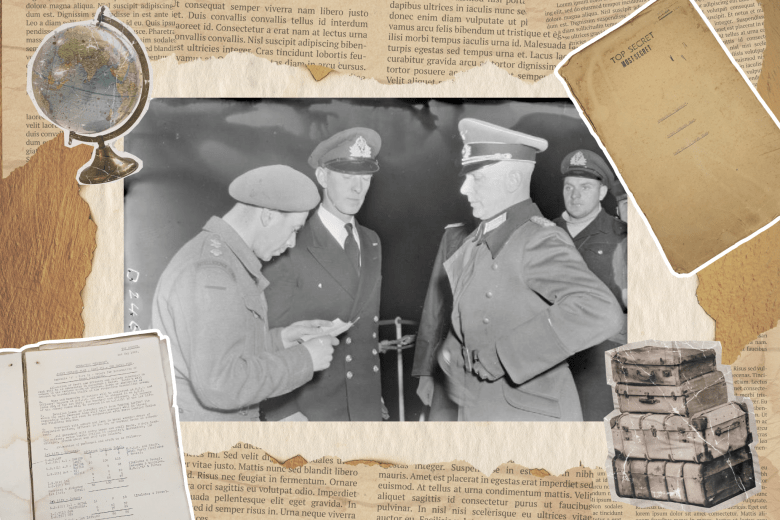
A top-secret document outlining Britain’s military plan to liberate the Channel Islands – code named ‘Operation Nestegg’ – is due to be sold at auction after it was discovered in a cardboard box over 80 years after the Occupation.
The 50-page document, detailing the mission to free the German-occupied islands, will go under the hammer at Hansons Auctioneers’ sale in Derby on August 13.
It has a guide price of £800 to £1,200.
Operation Nestegg
While the liberation of Jersey and Guernsey ultimately did not involve armed conflict – with surrenders signed in both islands in May 1945 – it was initially not known if the German troops would give up without a fight.

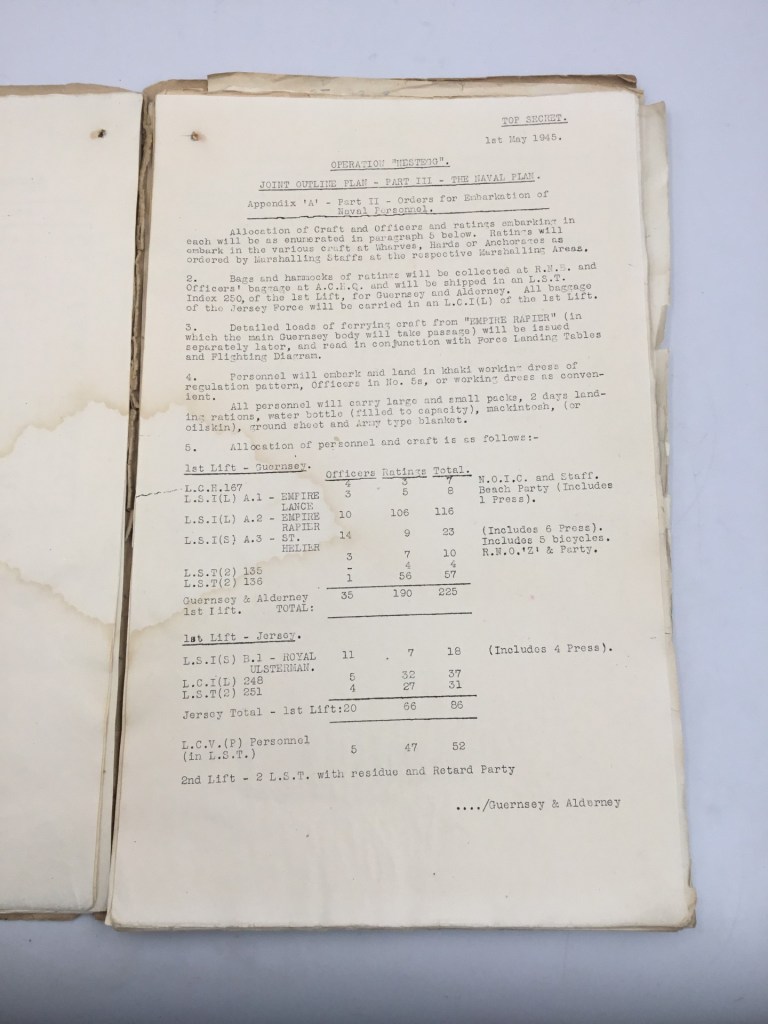
The Operation Nestegg document shows how the British forces planned to “occupy the islands of Guernsey and Jersey as nearly simultaneously as possible by landing the occupying forces through the ports of St Peter’s Port (Guernsey) and St Helier (Jersey)”.
It includes intricate details of how the operation would proceed, stating that: “Personnel will embark and land in khaki working dress of regulation pattern. Officers in No. 5s, or working dress as convenient.
“All personnel will carry large and small packs, 2 days landing rations, water bottle (filled to capacity), mackintosh (or oilskin) ground sheet and Army type blanket.”
A “dusty” discovery
The document being sold later this month was discovered in a cardboard box as part of a job lot at a previous auction.
Hansons Auctioneers’ militaria expert Matt Crowson said: “It’s an incredible story.
“The document had been part of a dusty box of papers in a UK saleroom, the value of which was considered negligible.
“But on closer examination the vendor came across a piece of WWII history detailing the freeing of the only Nazi-occupied area of the UK.”
Mr Crowson said that the discovery was “even more special” given that the document had been found in the 80th anniversary year of Liberation Day.
“A document like this really brings home the suffering of the Channel Islanders during the German occupation, some 2,300 of whom were deported to German prison and internment camps,” he added.
“By the time of the Liberation in 1945 many were close to starvation.
“The essential role played by the men and women involved in Operation Nestegg, and their story of freedom, cannot be underestimated.”
