


Many Islanders are familiar with the parish St Helier, but how many people know the full history of the Patron Saint behind its naming?
The story of Saint Helier has been brought to life in a new collection of stamps for Jersey Post.
British artist Becca Thorne, who specialises in lino print artwork, is behind the new Jersey Post collection, which will be available from 10 August.
Reminiscent of medieval tapestries, the stamps celebrates key moments in Saint Helier’s life, from his birth and journey to Jersey to his martyrdom and lasting legacy.
The sixth-century religious figure was born in Belgium before moving to Jersey and living in a rock hermitage off the coast, now the site of Elizabeth Castle.
Recognised as bringing Christianity to Jersey, he was martyred in AD 555 by pirates or robbers and is commemorated annually on St Helier Day on 26 July.
Ms Thorne said: “I love the way myth, magic and fact are entwined in the history of the Middle Ages, and the art of the time is a huge influence on my own visual language, so I was really excited to be asked to illustrate this series.”
Jersey Post’s philatelic team said Saint Helier was a “significant figure” whose story reflected Jersey’s “rich heritage and culture”.
Research for the collection was assisted by the library team at the Société Jersiaise.
Express sat down with Ms Thorne and the Jersey Post’s philatelic team to map out the key stages and significance of Saint Helier’s lasting legacy…
1. Miracle birth

Helier was born in Tongeren, in modern Belgium, to influential Saxon parents who struggled to conceive until a Christian priest helped them pray to God.
This stamp shows the relieved, happy parents enveloping their miracle baby with love.
2. Cured of the incurable

The young Helier was raised pagan, but when he was paralysed by a childhood illness, the priest was called back to pray for God’s help.
When Helier eventually recovered and regained mobility, it was considered a second miracle.
3. Performing a miracle
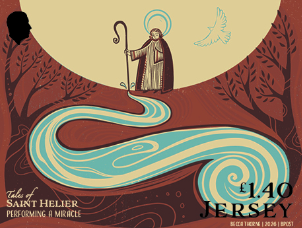
Young Helier converted to Christianity and travelled to a monastery in France, performing healing miracles and converting people along the way.
In one tale, he’s said to have passed a pagan shrine in an oak tree and struck the ground to Christianise it, causing a healing spring to flow forth.
4. Journey to Jersey

In this tale, Helier and Romard, a fellow monk, were sent to Jersey to convert the islanders to Christianity.
Any sea travel was dangerous during this period, with constant threat of Viking and pirate raids.
This stamp shows the two men praying for safe passage across potentially treacherous seas. Their peaceful appearance suggests their belief that God will aid them.
5. A local inspiration
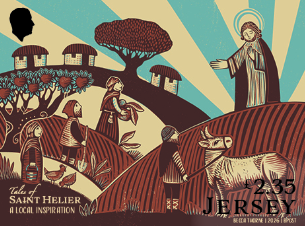
The priests were apparently well received by the locals.
In this stamp, Islanders go about their daily lives while Helier preaches to them.
6. Living in solitude
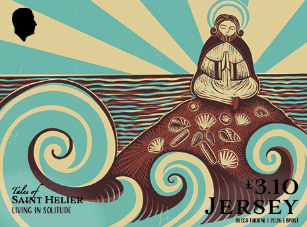
Helier wanted to live a simple, ascetic life, dedicated to prayer. He chose a cave in a rocky outcrop, on what is now the site of Elizabeth Castle, to create his hermitage, subsisting on a frugal diet of foraged sea food and spending his days in quiet contemplation.
7. Martyr against invasions

From his tidal hermitage, Helier was able to warn the locals of approaching Viking and pirate raiding ships, giving them time to flee to safety.
Helier was eventually beheaded by raiders, leading to his martyrdom and sainthood.
8. Paying tribute to a saint

A monastery was built at the site of St Helier’s cave and became a place of pilgrimage throughout the Middle Ages.
In the early 20th century the tradition was revived, and on the 16th July each year, modern Christians process across the causeway to The Hermitage to pay tribute to St Helier and lay a wreath in the rocky nook now known as St Helier’s Bed.
