

In my roles as Founder of Apollo and College Listener at Elizabeth College, I am on the frontlines when it comes to the mental health of young people.
Generally, I work with young people whose mental health has been compromised, be that from issues in the past, disruption in the present, or anxiety about the future.
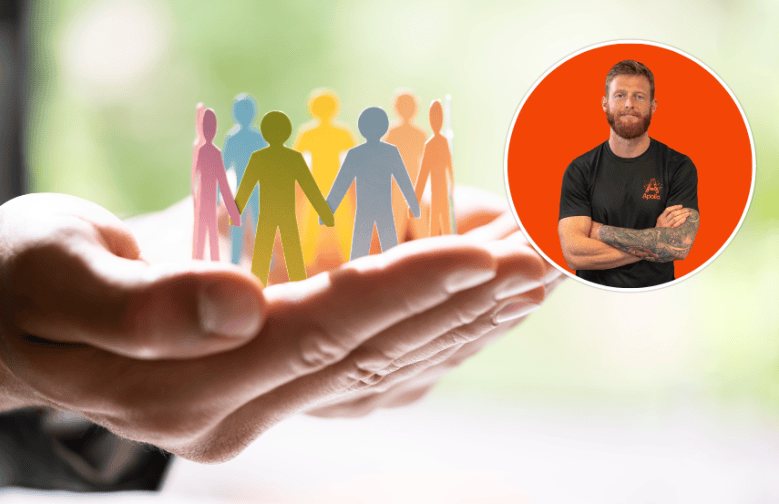
The main lens through which I look at mental health in my work is community, and I think it was an apt choice of theme for this mental health awareness week — don’t get me started on smartphones and social media! — and it sings with my own definition of mental health.
Defining Mental Health
I define mental health as the internal harmony which emerges when an individual feels safe and connected within their family, and safe and connected within their community.
In my definition, the internal state of mental health is dependent on familial and social circumstances, external factors, so to speak, but ones which have an inextricable connection to and profound impact on a person.
I wince at many definitions and discussions of mental health, which tend toward defining and diagnosing and treating poor mental health as a purely internal issue — an illness, a disease, a ‘chemical imbalance’. As if mental health issues develop spontaneously within individuals as isolated specks of life, rather than as part of a living, breathing organism, as part of a community. That very approach is part of the problem.
No Man is an Island
“No man is an island , entire of itself”, wrote John Donne.
Even more so, no child is a child without community; literally, they cannot exist independently of connection with other people.
We are all nodes in a complex human organism, and the mental health of each individual node is largely determined by the quality and quantity of all the other nodes to which they are inextricably connected.
These dynamic networks can be disrupted by chance or design, by humans or nature, by everything from the weather to a sporting injury, public policy to an uncomfortable PSHE lesson, from economic fluctuations to a change in diet. (I have seen each of these examples significantly impact a young person’s mental health.)
If an individual node of the human organism is disconnected, then their resilience to such disruption becomes critically impaired. Adversity becomes more likely to create catastrophe, rather than a case of “what doesn’t kill you makes you stronger.”
Our answer should be, in my humble opinion, community.
One of the aspects of my work is to reach and connect with these disconnected young people; build real human-to-human relationships with them on a one-to-one basis, and once established, connect them to a community — or create a community, as I have done with 6 different youth groups at Apollo and College in the last year.
What does this look like in practice? Peter’s Story
Let me share with you one example of a lad I have been working with for a year now, whom we’ll call ‘Peter’.
I started working with Peter through Apollo after a referral from social services.
Peter was in a dark hole. He quit his sport and stopped going to school. He spent all of his nights playing video games and much of the day sleeping, intermittently eating junk food. His relationship with his caregivers was strained, and there was a change in care arrangements. There were umpteen professionals in his life, a couple consistently, most of them transient.
Any one of these disruptive factors could be destabilising. All of these factors together, with no community to soften and heal these blows, his mental health was in a poor state, to put it lightly.
The boy had rock bottom self-esteem. Too anxious to be around other members of the public. Zero eye contact. Poor hygiene and presentation. Absolute disdain for professionals. Nocturnal. Massive mood swings.
Peter had developed a dark view of the world, reflected in the dark things he would say about it. Sadly, I think that was the only outcome that could be generated from his life circumstances.
I got to work building a relationship with Peter, getting him out of the house and back into the real world. Even though it was a cloudy day, Peter squinted when he left the house on our first session, daylight being too bright for him.
That summer, we played badminton, basketball, football, frisbee. Peter helped me re-pot my car plants and prepare for youth groups. Responsibilities like this are like Miracle Gro for young people. I even managed to get him into the water for a sea swim (by promising to do a frontflip into the water if he did – not pretty).
I mentioned that Apollo runs a youth group he might be interested in. His response was dismissive and final — he wasn’t ready.
Turning the Corner, Seeing the Light
The improvement in Peter’s mental and physical health was slow but sure. He was no longer out of breath walking, I wouldn’t have to rouse him from his bed every session, and he even started reengaging with school.
“What are you doing at the club tonight?” Peter asked me one afternoon, in a rare bout of curiosity.
“Ah, you wouldn’t be interested in that, I don’t really want you to come anymore anyway,” I replied, smirking.
Peter persisted.

I had been drip-feeding him stories from our youth groups, activities we had been up to; adventurous things like kayaking and camping and building fires; fun and playful things like a chip shop survey, scavenger hunt, and playing hide and seek at different spots.
Peter’s mental health had recovered enough to be interested in the world outside of his bedroom and himself. Now was the time to pounce.
Since then, he has attended that youth group every week for two terms, and has just started his second youth group.
He has made friends in real life, doing real world activities.
Peter has made a fire on the beach and cooked smores, he has been on an overnight camp in Herm, he has been swimming in the sea in March (!).
I picked him up last week, and he asked me if I wanted to go for a swim.
Peter even came along to a small group session Apollo set up to ease a new young person into our youth group. Peter welcomed him and played something of the role I played in his life.
After our camping trip, Peter was abuzz with excitement and ideas, helping us to plan what we are doing for our next summer adventure.
Peter stands taller, he speaks clearer, he holds eye contact; he laughs and jokes and engages with activities; he asks questions and shows interest.
The boy seldom left his room a year ago, leaving the house was out of the question.
Now Peter is blooming.
We Are The Answer
This is one example – of too many to mention – of the way in which connection and community can radically alter the life trajectory of a person.
Disruptive factors can send a person’s mental health into a tailspin.
Interventions that prize and nurture human-to-human connection, and that empower young people with agency, can work to rebuild a sense of hope and belonging, a solid base upon which they can reconnect with their community.
The course corrections in life trajectory that I have seen are no less critical than any major surgery; the mental health implications are incalculable. I just wish the same urgency was shown in community work as it is when someone is rushed to hospital for appendicitis or cancer treatment.
How is it that in 2025, in one of the richest,safest and most beautiful spots in the entire history of planet earth, spending untold sums on our social services and education, there are so many young people who are so disconnected in our community that their life trajectory is deadset on misery?
Much more empowering and relieving to say, we have the answer and the solution right here, in our very own hands.
It takes a village to raise a child: our answer lies in community.
Liam Doherty
Liam Doherty is the Founder and Director of Apollo, a social enterprise in Guernsey with a vision of a Bailiwick of resilient young people who are empowered to play their best hands in life, irrespective of the cards they have been dealt. Apollo does this through child-led activities in its 1:1 Mentoring, Youth Groups and Adventures, delivered by its crack team of staff and volunteers. Liam also has a part-time role at the Elizabeth College as College Listener, a pastoral support role created by the college for its students to receive support and explore their thoughts and feelings in a nonjudgmental space. Liam is also a Boxing Coach and Safeguarding Lead at Guernsey’s Amalgamated Boxing Club.
