

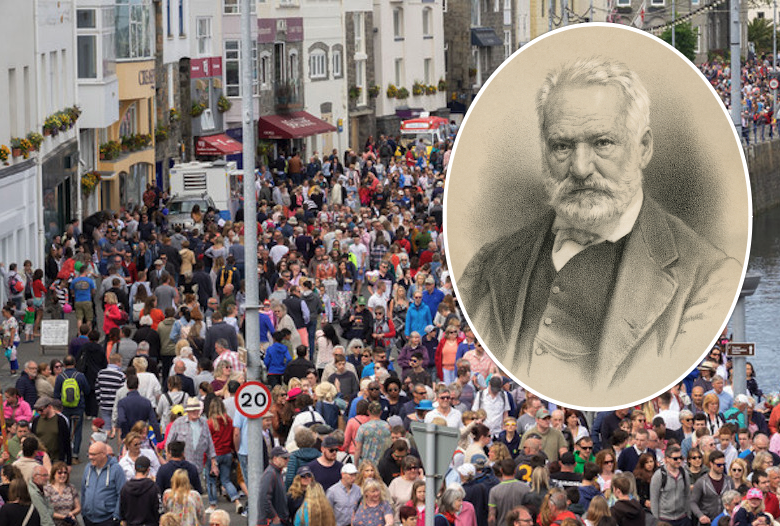
Dr Bradley Stephens, Professor of French Literature at the University of Bristol and frequent visitor to Guernsey, has been reflecting on why Victor Hugo would have enthusiastically supported the island’s 80th Liberation Day celebrations…
Guernsey’s famous resident reminds us of the importance of 9 May celebrations and of the island itself to today’s conflicts
It might seem obvious that VictorHugo would have joined in with the Liberation Day celebrations. The author of Les Misérables – and the man who called Guernsey his home for 15 years – would cheer the Channel Islands being freed from a totalitarian dictatorship. But what this iconic French writer of the nineteenth century had to say about the fight against tyranny bears repeating.
The date, 9 May, draws together two of Hugo’s great passions: freedom from oppression; and peace between all countries. These ideals were not easy to hold onto for someone who lived through many of his own century’s twists and turns. After Louis-Napoleon’s 1851 coup d’état ushered in the French Second Empire, Hugo was forced into exile, fleeing Paris for Brussels and then Jersey before settling on Guernsey in 1855.
Hugo had many reasons for choosing this ‘rock of hospitality and liberty’ as he called it. He described Guernsey as a mix of land and sea – and of France and Britain – offering asylum to refugees from across Europe. The island’s geographical and cultural blend was ideal for a mind like his, which saw the world as interconnected and which therefore rejected any worldview that wanted to divide and dominate. It is why he set his 1866 novel The Toilers of the Sea in Guernsey and dedicated this bestseller to the island and its people. They inspired both his imagination and his sense of purpose.
Whilst in Guernsey, Hugo expanded his reputation worldwide as an outspoken advocate for social justice, such as the abolition of slavery in the United States and an end to capital punishment, from Colombia to Portugal. He completed some of his most commercially successful works on the island and rejected the French Emperor’s offer of amnesty in 1859, insisting that he would only return home when liberty did the same.
Guernsey was a microcosm of what civilisation should look like to Hugo: honest, hard-working, and welcoming – a stark contrast to those societies that silenced opposition and suppressed freedom of expression. For Hugo, whether they called themselves shah, tsar, caliph, king, prince, or president, all autocrats block the path of progress by stifling the human right to liberty and equality. What he told his fellow deputies in the French National Assembly early in 1871 after Prussia’s victory over France could have been reiterated after Germany’s defeat in 1945: that humanity’s ultimate victory against tyranny must be a world bound together in solidarity, in which the hand of friendship was stronger than any fist.
Hugo’s plea remains compelling today, as does his fight against all forms of censorship and his warning against European apathy in the face of imperialist aggression. In an era of ‘fake news’, hardening nationalism, and political polarisation, his belief in the European Enlightenment’s values of truth, tolerance, and free speech still has power.
It’s unsurprising, then, that Hugo would have particularly enjoyed how Liberation Day falls on the same date as the European Union’s Europe Day. It’s a symbolic pairing of the fight against tyranny with the commitment to an international community. We may well despair that the battles of the nineteenth and twentieth centuries have persisted into our own. We might equally take heart from the resilience that Hugo built here in Guernsey, where the view helped him to develop an outlook on life that was anything but insular.
Hugo’s thoughts and words continue to resonate in the world today, and that is why the VictorHugo Centre and The VictorHugo in Guernsey Society promote his visionary legacy of human dignity, social justice, peace and freedom.
The VictorHugo Centre will include a museum and interpretation centre, performance space and learning hub. The Centre will celebrate Hugo’s literary and humanitarian legacy and Guernsey as an island of inspiration, creativity and imagination for every generation.
Professor Bradley Stephens
Chair of the Victor Hugo Centre Expert Advisory Panel and Vice President of the Victor Hugo in Guernsey Society.
