

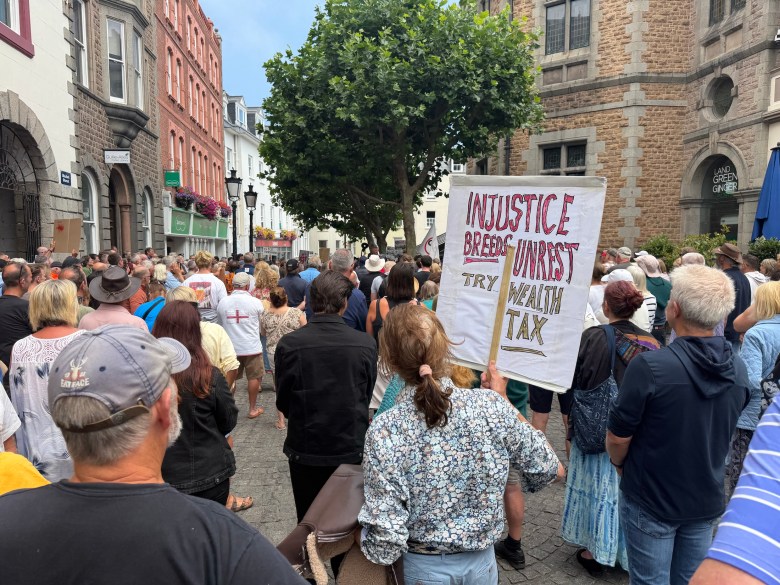
The sprawling masses that choked the seafront during previous anti-GST rallies did not return to Market Square this weekend.
This latest protest was measured in the hundreds rather than the thousands – a turnout supporters of P&R’s tax package will undoubtedly use to claim local people support GST, or are least apathetic.
But on the cobblestones, there was little sense of deflation among the 500 or so demonstrators. Instead, Sunday’s rally felt purposeful and resolute.
This was a crowd focused not just on protest, but on a detailed critique of the island’s financial direction.
The “broken clock” of government expenditure
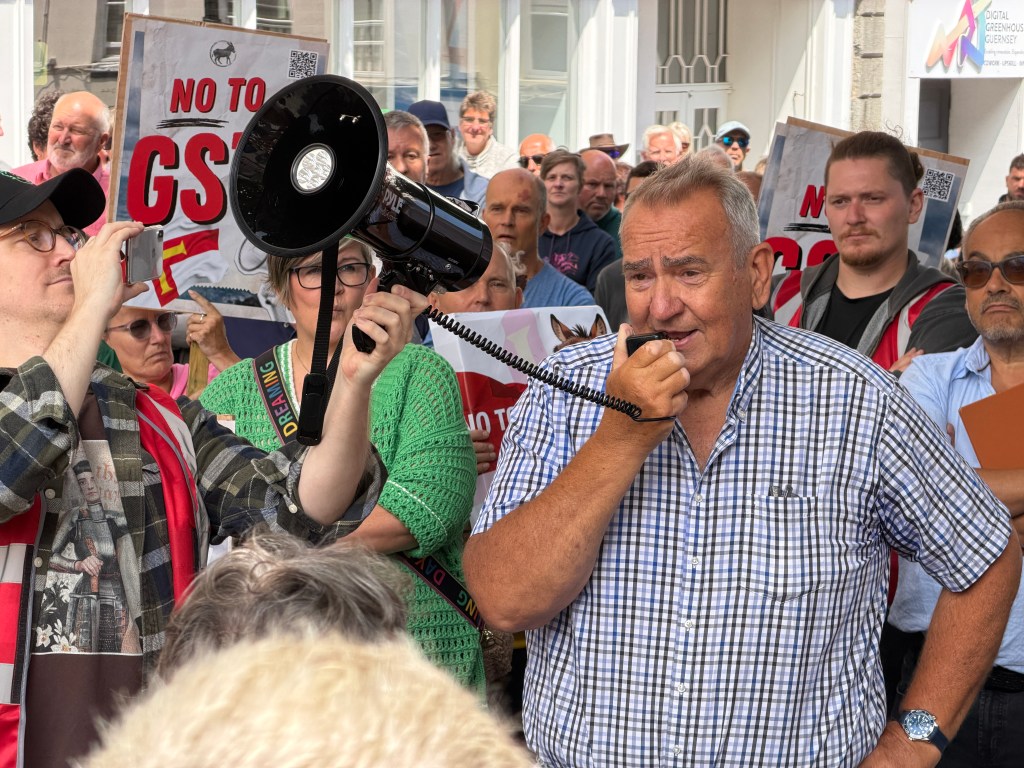
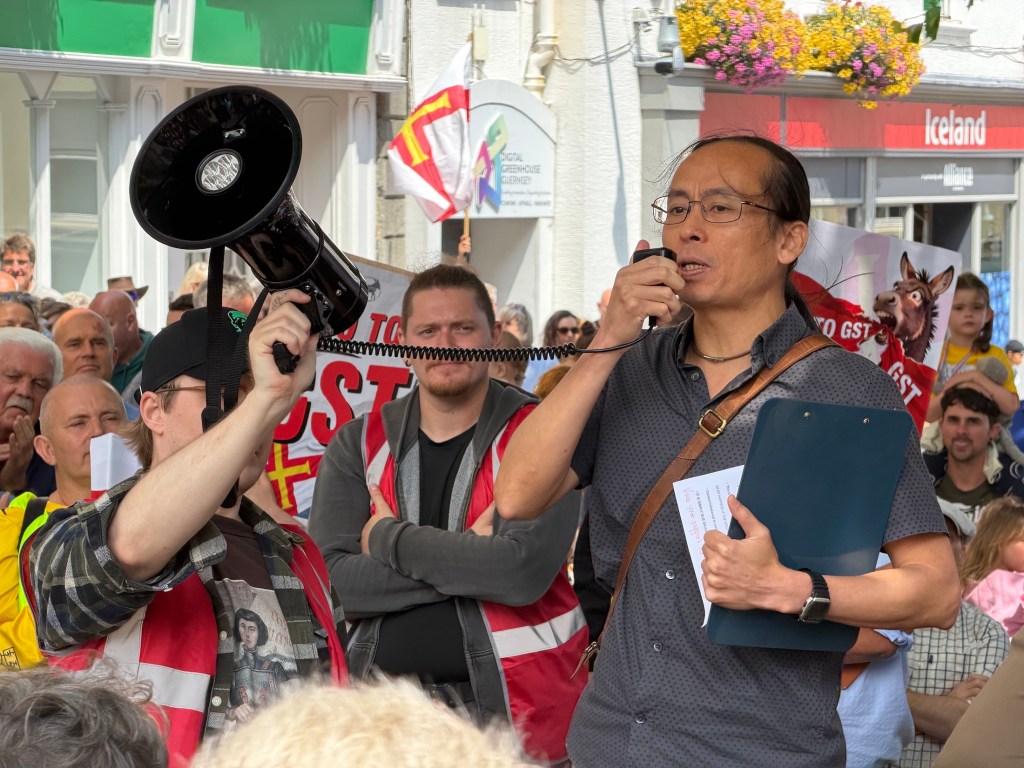
With ten current deputies standing alongside former States members, the rally took on the air of an outdoor parliament.
The speeches relied on sharp domestic metaphors to illustrate the opposition’s frustrations with current government inefficiency.
Deputy Haley Camp compared the States’ financial management to a teenager who asked for £10 pocket money to tidy their room up front.
“There will be no tidy room, but he’ll have gone and bought some energy drinks or some such rubbish.
“[With my own son] I say, ‘Tidy your room first, and then, then and only then do you get a £10 note from me.'”

She said her example was the “simplest form of economics”, but that “the States of Guernsey seems to think, ‘No, we’ll go back to that big old money tree and we’ll pluck a few more leaves.'”
The metaphor captured the core grievance of the attendees: a belief that the government has failed to do the basic internal homework of reducing expenditure or resolving its 20,000-case tax backlog before asking citizens for more money.
The friction within the States itself was laid bare when Deputy Camp recalled a colleague admitting the GST package was “awful” but stating they would vote for it anyway because “even a broken clock is right twice a day”.
Her response from the megaphone was scathing: “Thank God the aviation industry doesn’t calculate risk that way, because if your clock is broken, the failure rate is 99.9%.
“That is what some of these deputies are voting for: a package that’s 99.9% broken – think on that.”
Snippets of information
Deputy Camp also criticised the lack of transparency from P&R and the civil service, claiming that politicians have been denied access to the full data behind the GST projections.
Rejecting any suggestion deputies had seen the GST figures, she told the crowd: “We haven’t – we are allowed to see snippets.”
“We are told to look at appendices in a policy letter that does not contain the information we need to be able to make the biggest decision in a generation for this island.”
She criticised P&R for spending £1.6m looking into GST and corporate tax reform over 18 months, while ‘Workstream 3’ – looking at savings – was introduced “at the 11th hour” and had no budget.

£36k survey results ‘buried’
Deputy Rob Curgenven accused P&R of burying the results of a £36,000 survey into the popularity – or otherwise – of GST, accusing the committee of “contempt” for the public.
“Have you seen the results?” he asked, “No – neither have I.”
“When they don’t like your answer, they don’t publish it – they bury it.
“Thirty-six thousand pounds, to learn what any of us could have told them for free.”
He also doubled-down on accusations of government waste, highlighting a “whole team” hired to “write a strategy for hornets”.
He said: “When [the States and civil servants] run out of things to run badly, they invent new things to run badly.”
“Now, I’ve got nothing against protecting our bees.
“But, let’s be honest with each other: the biggest sting on this island isn’t coming from any hornet’s nest – it’s coming from Sir Charles Frossard House.”
Not looking on the beach for stones
Continuing the attack on the States’ spending, Deputy Garry Collins said: “This is my island. I was born here. I was raised here.
“Three years ago I had a daughter – and I can’t see a future here unless we can control expenditure, unless we can keep costs down.”
He said he was “not convinced” P&R had turned over every stone, adding: “I don’t even think P&R has been to the beach to look at the stones.”
Deputy Simon Vermeulen warned GST would severely damage the high street and hospitality sectors, arguing “retail is going to lose businesses” and “tourism is going to be hit.”
Those key industries employed thousands of islanders who contribute heavily to income tax, he argued, urging the States to focus on economic growth rather than penalising local trade.
Rejecting the idea of forcing the tax through without public consent, Deputy Vermeulen called for an “island-wide referendum where the people can have the vote on whether they want it introduced or not.”
‘What are we losing if they leave?’
The debate shifted toward fairness, as speakers challenged long-held assumptions about who funds the island’s public services.
Deputy David Goy targeted the common belief that the wealthiest residents shoulder the heaviest financial burden.
“You’ve always been told that the rich pay the most tax,” Deputy Goy said.
“No, they don’t – the middle class pays the most tax.”
To back his claim, he quoted P&R’s own figures, which he said showed the roughly 560 households living in Guernsey’s largest properties pay less in overall income tax and social security than the average household, due to existing loopholes.
“Do not blame the wealthy,” he told the cheering crowd, “Our system allows it.”
“But if you want to change it, you change the system – you don’t slap the entire island with GST.”
Deputy Goy also dismissed warnings that tax reform would trigger a catastrophic exodus of wealthy people, arguing that the only people who would walk away are those without roots in the island.
“If they are here solely for the reason of not paying taxes, what are we losing?” he asked.
However, Deputy Goy was keen to draw a distinction between wealthy individuals and the finance industry, which was a “huge” economic driver that “contributes 46% of our economy” and “provides thousands of jobs”.
He said the majority of the finance industry’s income came from international clients who were “not even here”.
Instead of focussing on wealthy people, he urged the States to pivot its concern toward ordinary working families, warning that the flight of the island’s workforce – its local teachers, nurses, and tradespeople – was the far greater demographic threat.
Unattainable dream
The afternoon’s focus shifted sharply from political rhetoric to the raw, personal realities of Guernsey’s working population.
The crowd fell silent as organisers read firsthand testimonies from locals, collected as part of a ‘Flight Risk’ survey – capturing the stories of local people struggling financially to the point they might leave.

A 30-year-old, Guernsey-born man said he and his partner earned £80,000 between them.
“In most areas of the UK and Europe that would be more than adequate enough for us to save for a house and have a family: That is not the case in Guernsey.”
The man said saving for a deposit felt “like an unattainable dream”, while having children was “not even a dream anymore”.
It doesn’t matter how pretty or safe this island is to bring up children when you wouldn’t be able to afford to clothe or feed them.
30-year-old Guernsey-born man
Equally stark was the testimony of a 50-year-old mother, who despite earning what many consider a stable £40,000 salary, laid bare the daily compromises forced by inflation:
“Guernsey has simply become unaffordable for me – GST will be the final nail in the coffin for my family.
“We already choose between eating and heating.”
These were not isolated stories, but part of a broader picture of an island under pressure: a 34-year-old third-generation worker warning that a consumption tax would break small, family businesses already squeezed by overheads, and young graduates confessing they feel stuck between a job they love and the financial freedom of moving away.
The testimonies served as a counter-argument to the official narrative that wealth taxes might cause high-net-worth individuals to flee.

Three-day battle ahead
Attention now shifts to the three-day battle in the States Assembly, with organisers hoping to make their presence felt outside the Royal Court steps.
Proponents of GST may look at the empty spaces in Market Square and find comfort in the lower numbers.
But the hundreds who did stand their ground left a stark reminder ahead of Wednesday’s debate: a smaller core is often a more deeply entrenched one, and pushing the tax through may ignite a political fire that a weary public will not easily let die.
