


Fewer than ten students from the Bailiwick are known to be studying in Kent at the moment – where people have been queuing for meningitis vaccinations following the deaths of one university student and one school pupil.
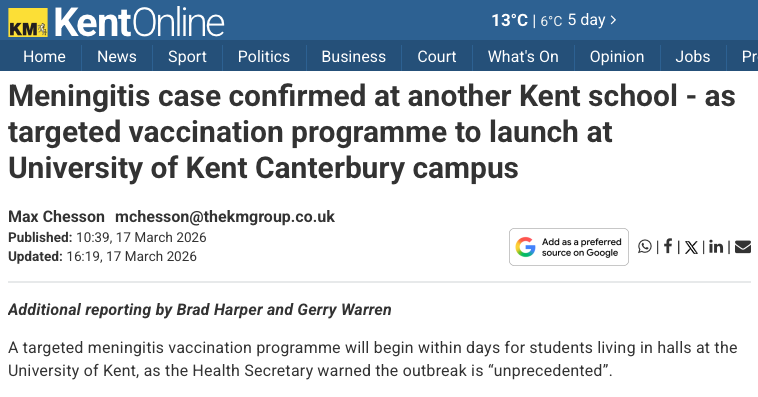
At least 15 cases of meningitis have been confirmed at the time of writing – with the University of Kent known to be affected, along with at least four schools.
Students from the Bailiwick at universities in the English county are urged to follow UK Health Security Agency advice.
The UKHSA has been running a targeted vaccination programme at halls of residence in Canterbury.
Students who have already come back to the Bailiwick for their Easter holidays should contact Public Health in Guernsey for advice.

Education, Sport, and Culture told Express it knows of “fewer than ten students” at university in Kent, but there may be more who are not receiving States funding or who are not registered with the States.
Some of the students who attend university in Kent may now be home for Easter, or on their way back soon.
Associate Director of Public Health, Alex Hawkins-Drew said students who are at risk of being affected by the meningitis outbreak should have already been contacted by the UKHSA.
Students should follow that advice closely, she encouraged.
“Public Health Services in Guernsey is aware of the recent reports of meningitis cases affecting young people in the Canterbury area,” Ms Hawkins-Drew said. “The situation is being managed by the UK Health Security Agency (UKHSA).
“They are starting a small, targeted vaccination programme with resident at Canterbury Campus Halls of Residence at the University of Kent in the coming days and are identifying close contacts of confirmed cases and arranging precautionary antibiotics, where appropriate.
“Anyone assessed as being at increased risk will be contacted directly by UKHSA or their University and provided with specific advice.”
Bailiwick students who have already returned home for Easter, or who are worried they may be affected by the meningitis outbreak in Kent, can contact Public Health in Guernsey for advice, Ms Hawkins-Drew said.
“Any students from Guernsey who have been contacted to say they are eligible for vaccination but have already returned home early for the Easter break should get in touch with our Public Health team at publichealth@gov.gg.
“Students from Guernsey who are studying in Canterbury, including those who are planning to return home for the Easter break, should follow the guidance issued by UKHSA and their University.”
Ms Hawkins-Drew stressed that the meningitis outbreak is so far contained to Kent, saying “there is no guidance recommending wider immunisation of students” at present.
She also stressed that while older teenagers won’t have immunised against Meningitis B as a child, they will have received the relevant vaccines as an adolescent.

Ms Hawkins-Drew said anyone who is concerned can check their vaccination status.
“Vaccination against Meningitis B was introduced to the childhood programme in 2015, so those aged over 10 will not have received it as part of their routine schedule,” she explained.
“Vaccination outside of the routine schedule is not recommended by UKHSA, however it is available privately through GP practices. Anyone wishing to pursue this option should contact their GP surgery for further information.
“Students currently at University should have received the MenACWY vaccine as an adolescent,” she added.
“This vaccine offers protection against other strains of meningococcal disease and we would like to remind young people to check their vaccination status.”
In Guernsey, the MenACWY vaccine is available free of charge up to the age of 25, said Ms Hawkins-Drew.
“This is particularly relevant for those born before 2015 who may not have received the vaccine as part of the routine school programme. Anyone unsure of their vaccination history should contact their GP practice for advice. For further information on the vaccine, go to: Childhood Vaccinations – States of Guernsey.”
Meningitis B
The meningitis outbreak in Kent has been confirmed to be Meningitis B.
It is “a severe, rapidly progressing bacterial infection caused by Neisseria meningitidis serogroup B, often leading to meningitis or septicemia”, according to the NHS.
The bacteria can be spread through close contact such as coughing, sneezing, kissing, or sharing drinks and utensils.
“Students can reduce their risk by avoiding the sharing of drinks, bottles, cigarettes, vapes or eating utensils, covering coughs and sneezes, disposing of tissues promptly, and maintaining good hand hygiene, particularly after coughing or sneezing,” said Ms Hawkins-Drew.
“We encourage all students and young adults to remain alert to the symptoms of meningitis. Early symptoms can resemble flu or a hangover and may develop suddenly.”
Symptoms
Symptoms of meningitis can include:
- a high temperature
- vomiting
- headache
- a rash that does not fade when a glass is rolled over it (though a rash may not always appear)
- stiff neck
- a dislike of bright lights
- drowsiness or unresponsiveness
- seizures (fits)
“These symptoms can appear in any order, and not everyone will experience all of them,” warned Ms Hawkins-Drew.
“Anyone who is concerned about possible meningitis symptoms should seek urgent medical advice. It is important to know how to spot the symptoms of meningitis and septicaemia as early detection and treatment can save lives.
“Public Health Services will continue to monitor developments closely through our established links with UK health protection partners.”
