


Public Health has defended a survey that school pupils have been asked to fill in, which includes some questions around sexual activity.
The ‘Young People’s Wellbeing Survey’ was shared with children in years 6, 8, 10, and 12 this week with different questions for the different age groups.
Some parents and carers have taken umbrage with the nature of some of the questions, including those aimed at teenagers, asking about their sexual activity.
Director of Public Health, Dr Nicola Brink told Express that the questions have been designed to help education and health officials see “an accurate picture of the current health and wellbeing of our island’s young people”.
The questions were shared with parents before being handed out in lessons, and Dr Brink said the pupils can opt-out of doing the survey.

The ‘Young People’s Wellbeing Survey’ is an updated version of the previous ‘Young People’s Survey’ which had been carried out every three years in schools since the 1990s.
The last ‘Young People’s Survey’ was carried out in 2022, with Public Health taking over responsibility for it and rebranding it as a ‘wellbeing survey’ with a “health-topic focus”.
The survey will still be used to help frame Guernsey’s curriculum while also supporting the development of health and care services for young people.
Dr Brink said the questions have been developed to reflect those aims.
“Surveys of this nature are designed to help Education and Health & Social Care put together an accurate picture of the current health and wellbeing of our island’s young people,” she explained.
“Sexual health is an important part of that, and it is important we have a high-level understanding of whether young people are practicing safe sex if they are engaging in sexual activity. This information can inform sexual education curriculums and help us ensure our health and care support for young people is appropriate.”
Where parents and carers have concerns about the nature of the questions being asked, Dr Brink clarified that there are different surveys for younger and older pupils.
“The survey content is age-specific so younger children do not see all of the questions that older children see (specifically, the Sexual Activity Questions are only posed to those in Years 10 and 12),” she said.
“Parents have had the questions shared with them in advance and Data Protection colleagues have advised and guided us to ensure opt-out arrangements that are in place, so, any young person can opt out of filling the survey in, or choose not to answer certain questions if they would prefer not to.”
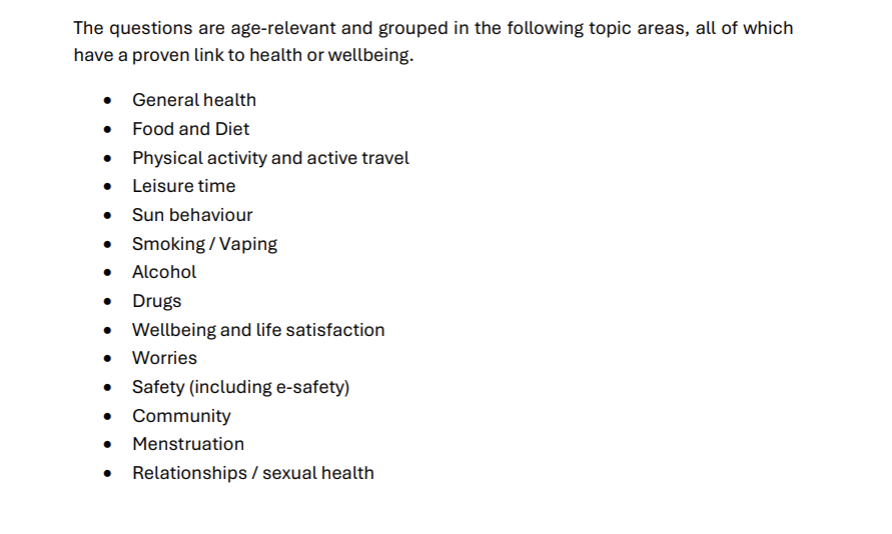
The letter sent to parents and carers before the questionnaires were shared with pupils explained what the surveys would ask and what the data would be used for.
It also gave parents and carers the option to opt out on behalf of their child before the surveys were shared in the classrooms. Pupils can also opt out of answering questions while doing the survey.
Dr Brink said “it is also important to note” that the survey topics are wide-ranging and cover many topics to provide a broad overview of health and wellbeing, and that the survey content has been benchmarked against questions asked elsewhere to ensure it is age-appropriate.
Where the older pupils in year 10 and 12 are being asked about their sexual activity they do not get asked the follow on questions if they state they have not been sexually active yet.
The information collated from those who have been sexually active “allows us to accurately gauge health needs (e.g. for pregnancy prevention or STI prevention),” said Dr Brink.
The letter sent to parents, with links to the survey questions, can be read HERE.
