


As Guernsey celebrates World Book Day and the National Year of Reading, Express decided to see exactly how a book goes from a glimmer in a writer’s imagination to your bedside table.
And who better to help us take a peek ‘behind the dust jacket’ than Steve Foote, from the local publisher Blue Ormer, and author and independent bookshop founder Kelvin Whelan?

Mr Foote was already a “passionate reader” when he founded Guernsey-based publisher Blue Ormer 12 years ago, following a career in management consulting.
The idea came out of a chance conversation with British historian Edward Chaney, who had been writing a series of articles based on his friendship with Guernsey writer Gerald Basil Edwards, author of 20th Century classic ‘The Book of Ebenezer Le Page’.
“I said, ‘Why don’t you write a book?'” Mr Foote explained, “He said, ‘Well, I would, but who will publish it?’ So, I said, ‘Well, if you write it, I’ll publish it.'”
That book, ‘Genius Friend‘, became the first in Blue Ormer’s catalogue and launched Mr Foote’s publishing career.
Gateway drug
Since then, the company has published more than 75 books on topics from Guernsey’s Occupation in World War Two to Britain’s leading Queen Camilla lookalike.
However, high-quality books on the bailiwick’s folklore have become one of the publisher’s mainstays.

Mr Foote said: “I think one of the things I’ve realised is that folklore seems to be what I call a gateway drug for young people to get into local history, because that captures the imagination in a way straightforward history doesn’t.”
So how does he select the titles and what goes into publishing them?
“I don’t like saying no to a good idea,” he said, “But the biggest challenge I’ve got these days is there’s more good stuff out there than I can handle.”
Mr Foote said he always tried to “imagine who the audience for a particular book is”, before deciding whether to go ahead.
Local talent
Blue Ormer sells 80% of its books locally, with many being from in-person sales in bookshops, markets and Seafront Sunday – something Mr Foote attributes to their quality.
“You don’t really appreciate one of our books until you pick it up, it’s an attractive object as well as interesting content.”
Mr Foote said he works with local designers, illustrators, proofreaders and – where possible – printers to ensure the books look and feel just right.
“Unfortunately, none of the printers on the island can do hardback books,” he said, “If you want to come up with a nice coffee table book I have to get something printed off island and then shipped over.”

Having to print books off the island gives Mr Foote additional logistical challenges, because of everything from poor weather to dealing with multiple suppliers.
“It’s a pain, because you’ve got to build in extra time to get something printed off island and then shipped over,” he added, especially when there was a fixed deadline like the Guernsey Literary Festival.
‘Try not to lose money’
While it could be “really stressful”, Mr Foote’s previous experience as a project manager was a “transferrable skill” that definitely came in handy.
He said his objective was “not to lose money”, adding that he wanted to “generate enough money from the sales this year to fund books I want to publish next year”.
“It doesn’t feel like work,” Mr Foote finished, “I’m not saying it’s easy, but it’s something which I do for the passion more than the profit.”

Like Mr Foote, the book industry isn’t Kelvin Whelan’s first career.
He launched independent bookshop Writer’s Block in 2022, after a 20-year career in finance.
Mr Whelan said he had “always wanted to be an author“, but hadn’t considered entering the book trade until he realised he wanted a change as he had “started to feel less and less like myself”.
His shop, in the Arcade in St Peter Port, is in the perfect location as it’s “close to places where people go looking for books”, with several second-hand and antiquarian bookshops nearby, as well as the Guilles-Allés Library.
‘Works of art’
While there were plenty of transferable skills from his previous career, one thing the finance industry hadn’t given him was experience curating a collection of books.
Mr Whelan said he thought of the shop – which is situated in a former high-end jewellers – as a constantly-changing “gallery”, with more of the covers facing out than a typical bookshop.
He said: “People say ‘Don’t judge a book by its cover’, but that’s a misnomer – everybody judges a book by its cover.
“If you’re browsing a shelf, the first thing you see is the cover, and that’s the first thing that’s going to attract you.”
He said the cover needed to “reflect what’s inside the book” and be “kind of eye catching, to stand out from the others”.
“I think some of them are works of art.”
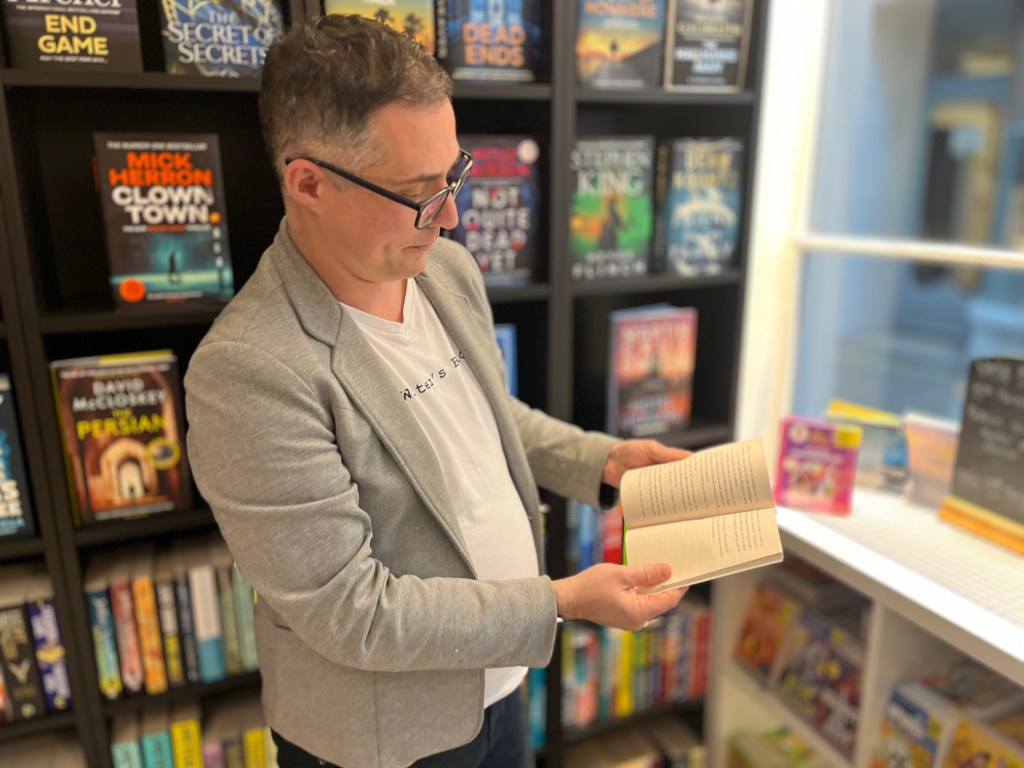
Mr Whelan said he felt there had been a gap in the market for a specialist, independent bookshop, as there hadn’t been one since “Buttons at the top of Smith Street”.
However, he was careful to spot the gaps in the market left by other retailers that sold books as part of their offering, such as stationers Lexicon and TG Jones.
He told Express: “I wanted to focus a bit more on non-fiction, as it’s a weak spot of the other shops.”
Esoteric
“I’m a big history lover and I was getting a bit frustrated – their history sections just weren’t good enough.”
Mr Whelan said he wanted to “focus on some really good upmarket non-fiction – a bit more elevated”.
And that “elevated” feel is something that’s continued to this day, whether it’s cookery books that focus on “different cuisines from different places” or “esoteric” choices in the classic fiction section.
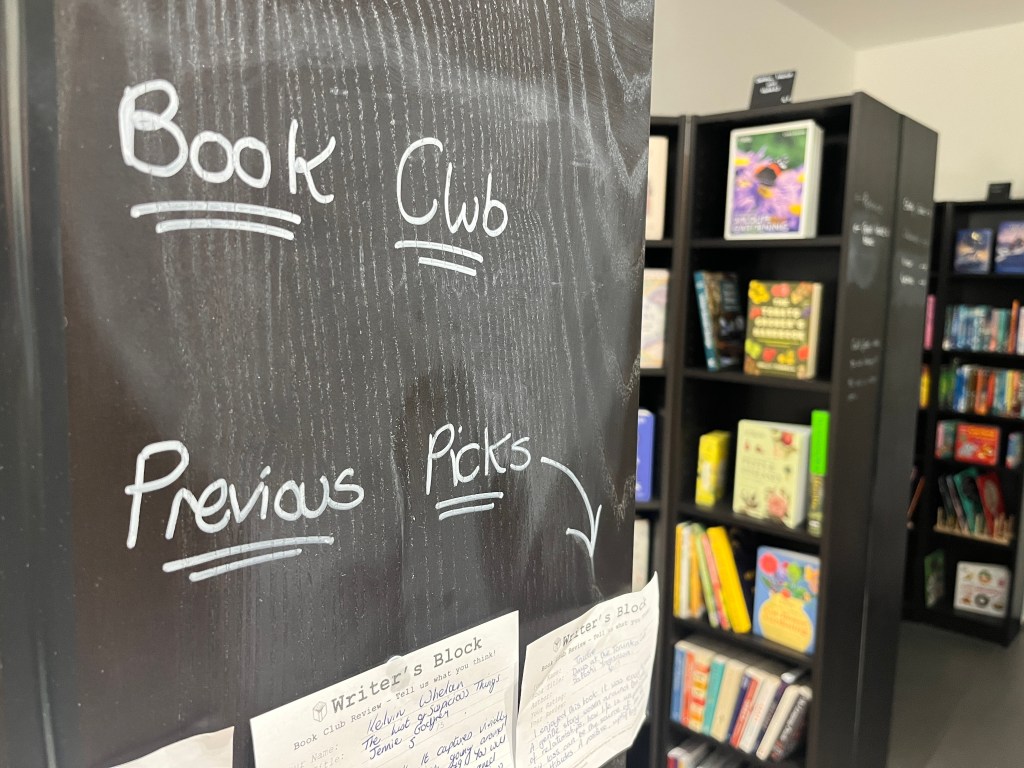
Writer’s Block carries around 3,000 books at any one time, but rarely multiple copies of the same title.
As well as the usual small business owner tasks of bookkeeping and paying bills, Mr Whelan spends hours every week researching books and trends, but said ultimately there was no “secret sauce” to choosing.
His supplier has a “fantastic” website, which gives Mr Whelan “a really good indication of what other booksellers are buying what’s being reviewed well, what’s got buzz, what’s got trends”.
“But, one of the things I like to try and do in my own reading is to read different authors,” he said.
Buzz
“I read widely, talk to people about books that they’re liking, and just getting a feel and being very intuitive with it, rather than relying solely on hard data.”
Mr Whelan said he likes “just to get a real feel for what people are talking about, what people are thinking about, what the buzz is around the book”.
“Because sometimes that’s more valuable than just going on sales data.”
Lifelong readers
Mr Whelan said one of the most rewarding aspects of his job was helping people who came in for advice after not having read for “10 to 15 years”, but “don’t know where to start”.
“Then they come back to you and say, ‘Oh, I loved that book, I surprised myself… what else have you got?'”
“Now they’ve become hopefully lifelong readers.”
So, does Mr Whelan regret turning his back on his finance career? Not one bit.
“One of the good tests is when you wake up in the morning, even if you’re feeling crappy, whether you still want to get up and come into work – and I always do.”
“I love it here – I love what I do.”
