
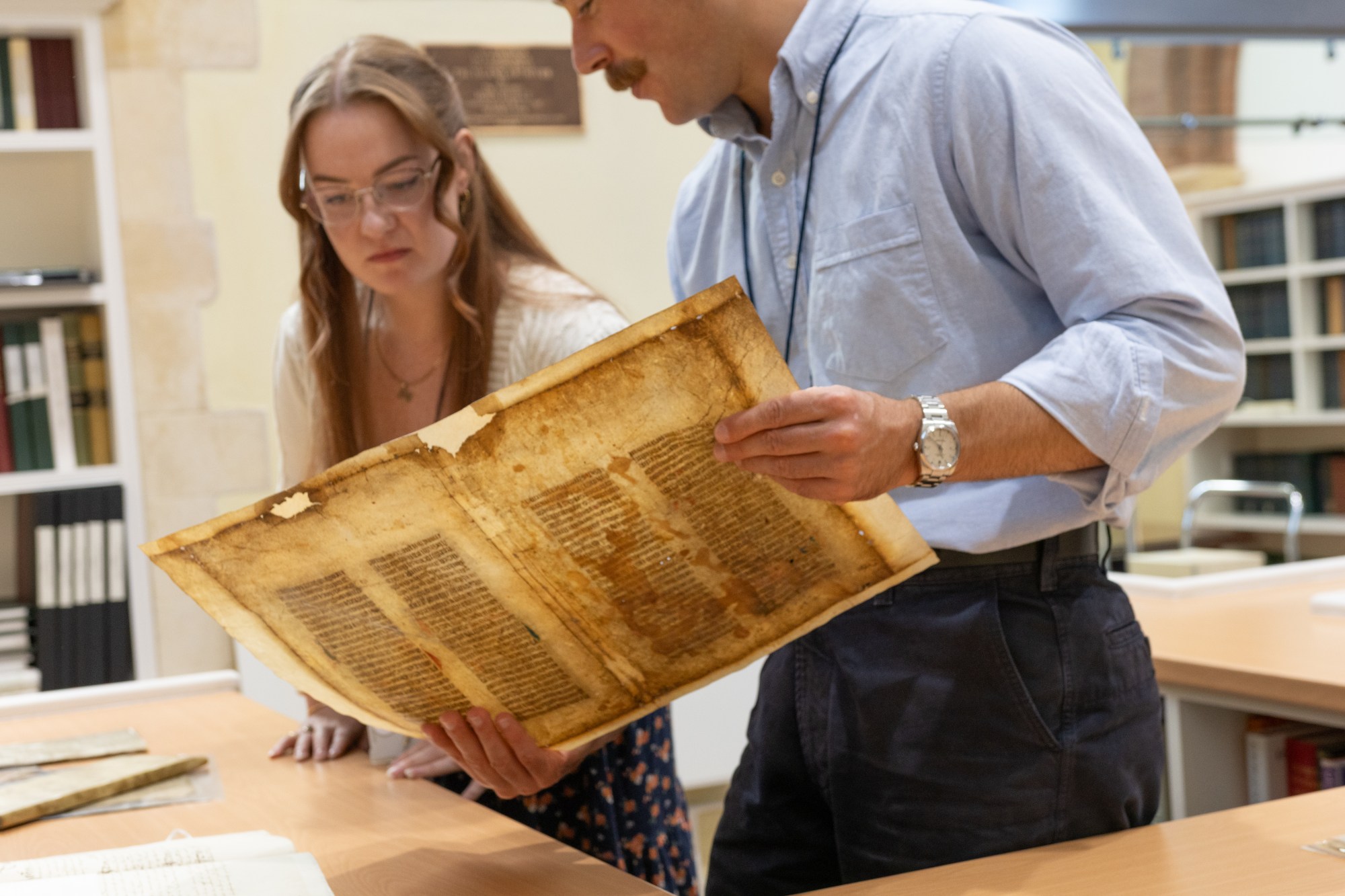

A series of medieval manuscripts that spent centuries disguised as notebook covers have revealed a hidden side of Guernsey’s past.
Archivists have uncovered 17 rare fragments of medieval texts that were recycled as bindings for administrative records, preserving evidence of a literary culture previously thought lost to history.
Vikki Hart, Island Archivist, said: “We are delighted that these remarkable fragments have been identified and are generating interest among researchers both on and off the island.
The remarkable find has also provided the first clear evidence of a medieval literary culture in the Bailiwick, showing that books were being read, copied and circulated in Guernsey centuries ago.
Some of the fragments were already known to archivists, but others have only recently been uncovered from the collections of Island Archives and records held in His Majesty’s Greffier’s strongroom.
Ms Hart said the discovery highlighted the “vital role of archives and libraries in enabling new research”.

She added that the fragments were “striking early examples of recycling”.
“What was once a practical act of reusing old parchment has, centuries later, preserved pieces of the island’s history that would otherwise have been lost.”
Literary black hole?
Until now, there had been little evidence of libraries, reading or collections of books in medieval Guernsey.
Taken together, however, the fragments suggest the island had an active literary culture and that many islanders were reading in French.
The discovery began when Archival Assistant Callum Tostevin-Hall was researching a 16th century copy of Edward III’s 1331 ‘Extente of Guernsey’.
He noticed a reference to a vellum cover containing Latin text which had previously been removed from a notebook.
“I checked this cover and was astonished to find that it was clearly a reused bifolium from a medieval manuscript,” he said.
“Taken together the fragments give an unprecedented glimpse into Guernsey’s medieval past.”

Most of the fragments are copies of texts that survive elsewhere in England and France.
One contains a version of ‘L’Estoire de Griseldis’, a poem written by Philippe de Mézières around 1395.
While versions of the work exist across Europe, the Guernsey example survives in only one other known manuscript.
Researchers say the fragment offers a rare insight into how literary works were copied and passed between readers across generations.
Unprecedented glimpse
The project involved collaboration between Island Archives and manuscript experts from across the UK.
Dr David Rundle, from the University of Kent’s Centre for Medieval and Early Modern Studies, and Oxford University book historian Professor Tamara Atkin helped identify and research the fragments.
“Ask most people, including scholars of medieval and early modern literature, what they know about the literary culture of premodern Guernsey, and the answer that you’ll invariably get back is ‘not much’,” Professor Atkin said.
“These discoveries by the team at Island Archives transform what we can now say about Guernsey’s medieval manuscript culture.
“They offer definitive evidence of Guernsey’s medieval literary and textual culture and reveal that books of several kinds, scholastic, liturgical and literary, were available on the island.”
Island Archives will host an academic study day on 10 September, featuring researchers from the UK and France, hands-on study sessions and a public talk examining the discoveries in more detail.
