

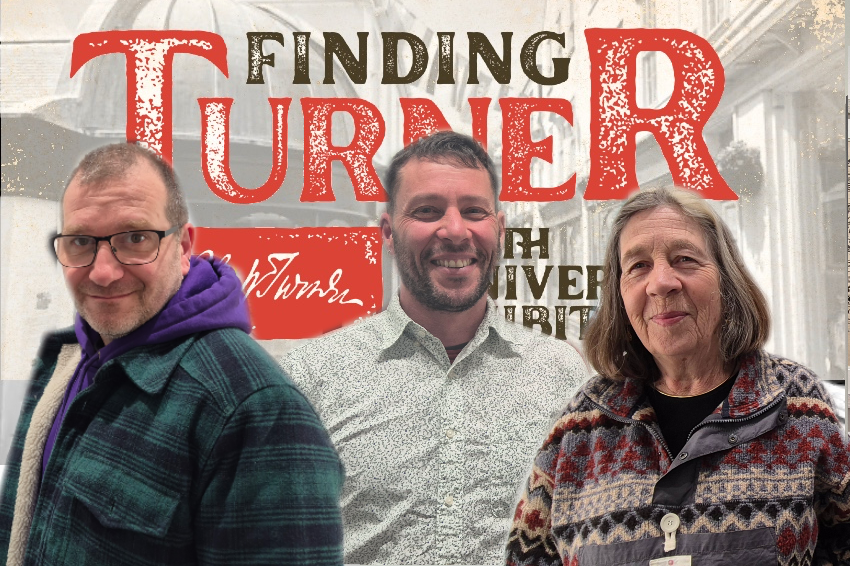
Art for Guernsey’s latest exhibition opened earlier this week with a packed private showing, before the doors opened to the public on ‘Finding Turner’.
The works adorning the walls come from four artists who spent time studying and recreating Guernsey’s landscapes, seascapes, and architecture. They also spent their time taking in the ‘Turner Trail’, following in J.M.W. Turner’s footsteps.
The result of these residencies is a wide and varied collection of works by Merlyn Chesterman, Damon Kowarsky, Charlie Mcfarley, and Gideon Summerfield all inspired by Turner’s art and the influence of his visit to the Bailiwick of Guernsey around 1832, during which he extensively sketched the Bailiwick.
The links between the Islands and the artist were discovered five years ago, when one of the 19th century artist’s sketchbooks was discovered to contain drawings of places in Guernsey.
Art for Guernsey’s Jock Pettitt said: “This second instalment of our Finding Turner journey promises to be something quite special, bringing together four distinct international artists to respond to the inspiration that Turner created in his ‘Guernsey’ sketchbook during his visit to the islands in circa 1832.”
David Ummels, the founder of Art for Guernsey, said: “Turner came to the island in or around 1832 and spent approximately six months in Guernsey, intensively sketching – he produced more than 100 sketches, all now in the custody of Tate Britain. Like for the Renoir journey, we adopted a four-year plan to engage in an amazing adventure to celebrate the heritage that the most famous of all British painters left on the island.
“This year our main event will be the curation of the body of work that four international artists have spent a year producing, inspired by Turner and the locations that he visited, side by side with the school murals.”
The artists
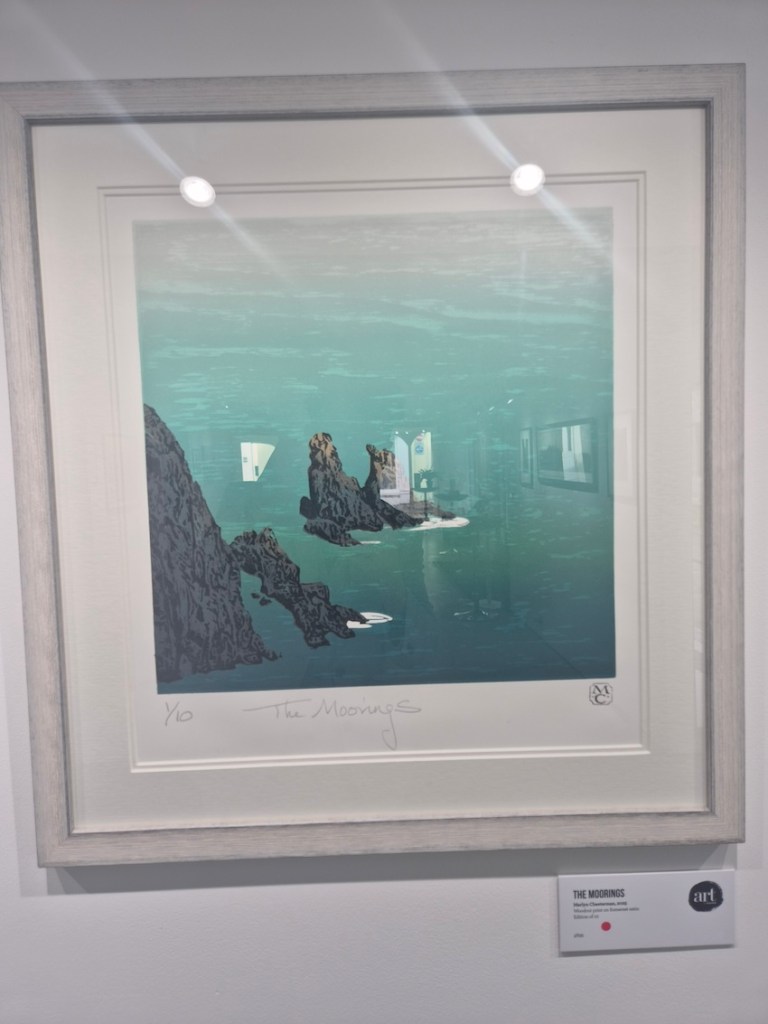
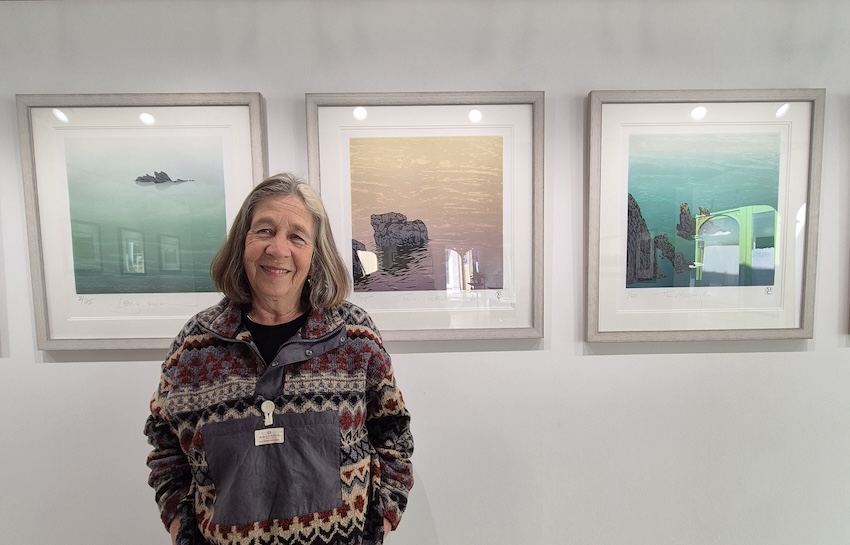
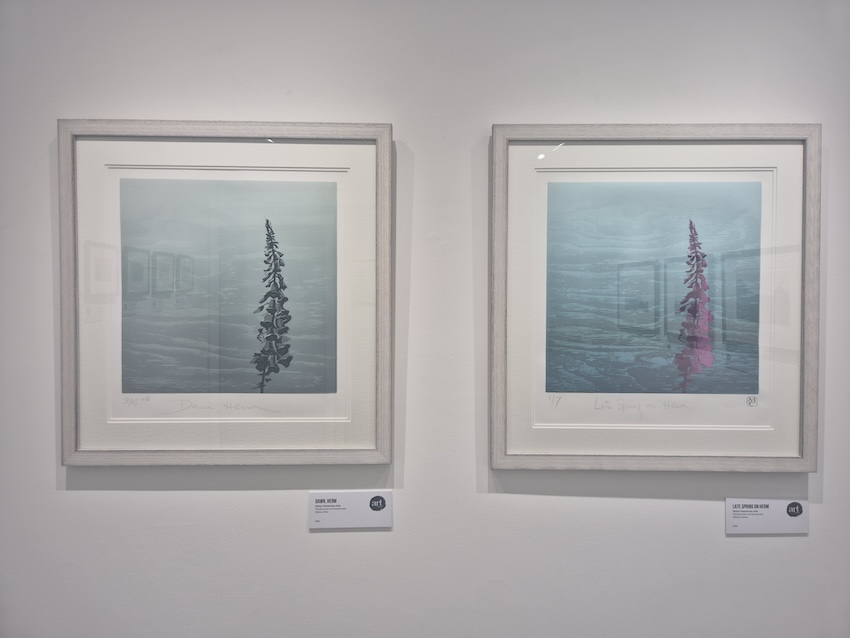
Merlyn Chesterman is a British printmaker who specialises in woodcuts. She’s a Fellow of the Royal Society of Painter-Printmakers as of 2014, and is currently on the Council.
“I’m a wood block print maker. I trained in Fine Art many years ago, and I was a painter until I did my first wood cut, and I’ve never done a painting since. So I think, 2000, the year 2000 I started wood block prints, and never looked back, actually.
“It’s an indirect medium, so there’s always an element of surprise, but there’s also many different parts to the process. So as with a painter, you have an idea, and you might do some sketching with a wood cut. You then get to sit down. You know, some people do their knitting or their, you know, tapestry or whatever, you get to sit down and you lose yourself in carving, and I find that really therapeutic and wonderful. Then you come to print it, and never know entirely what you’re going to get. So there’s always that element of surprise, and then, of course, I do multi blocks, I’ll put other blocks under blocks, discard blocks, I can change the color, I can work on it as I would with a painting, until I’m happy.”
A lot of Ms Chesterman’s work has a distinct contrast between the blacked out or gradient portions, to smooth transitions of vivid colour, and they all have some connection to nature.
“I’ve always lived by the sea, I’ve really always lived in the country, and I’ve never been interested in history, you know? I’m interested in wildlife and the natural world. So of course, coming here was perfect, because there’s so much natural beauty.
“I had not been until last May, when I came for my 10 day residency, I live in North Devon, which is not that far away, a short flight from Exeter. So immediately I was struck by, first of all, that you’re ahead of England, you know, being closer to France, so everything was more lush and more colorful, and there were more flowers, and the sea was bluer, and there were more sparkles.
“I just thought, I’m the luckiest person in the world to be here, you know? Thank God, places like this still exist. Then there’s a group we went to Sark as well. So I’ve seen a lot, and it’s incredibly beautiful, moving to me.”

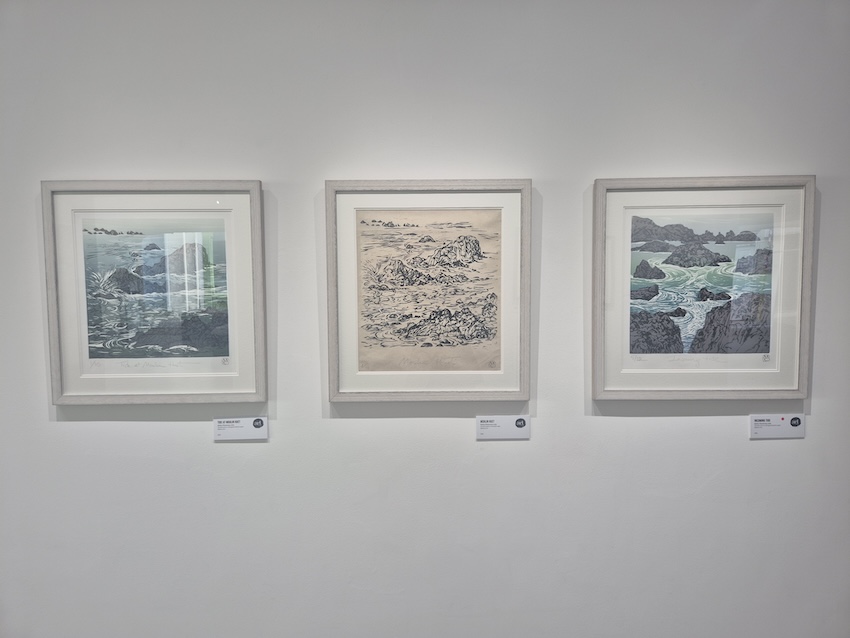
Damon Kowarsky, is an Australian artist known for intricate etchings and drawings that blend architecture and the landscape. His work explores urban and rural spaces and human connections to the built environment, this made Guernsey the perfect inspiration during his three week residency last June.
“Guernsey, it’s really distinctive. I mean, it’s the climate, the wind, the ocean, the rocks, the crazy cliffs, and then also the way the architecture is built out of local materials. So you’ve got that blue, gray granite everywhere, and slate roofs, or in some places, thatched roofs. So there’s very much a a link between the land, the agriculture, the small fields and the wall, the walled areas, and then the little lanes, and then the architecture.”
He had two distinct sets of work which are being displayed by Art for Guernsey, his speciality is one that goes back centuries, and involves etching into copper plates;
“There’s drawings which are with pencil and watercolor on paper, and then there are also the etchings, which are made with copper plates. Essentially, you scratch a piece of copper, and where the scratches are holds ink, and the ink transfers off onto paper. So it’s a process that’s been around since the 15th century. It was pioneered by the German artist Albrecht Dürer, Rembrandt did a lot of etching, as did Goya, Picasso, and many artists in the 20th century. So while it’s an old technique, it’s one that continues to be used throughout the world.”
This type artistic medium requires a detailed plan from wherever inspiration strikes, and taking those plans back to the studio to later create his masterpieces, it’s something he found very reminiscent of the 19th Century artist himself, whilst taking on the Turner Trail;
“For me, the inspiration of Turner was the sketchbook that he made in Guernsey. I was very lucky to be able to go to the Tate last year and look at the actual sketchbook, which is tiny. It’s, I think, 12 by 19 centimeters, so you can just fit it in one hand. It’s very clear that he had it in one hand and stood drawing as he was out in the fields. So it was very much that idea of taking Turner’s process, which is, he had a sketchbook, he traveled, and then he went back to his studio. I mean, Turner was better known as a painter, I don’t tend to paint, but it was using that idea of the sketchbook and that was the way into his work.”


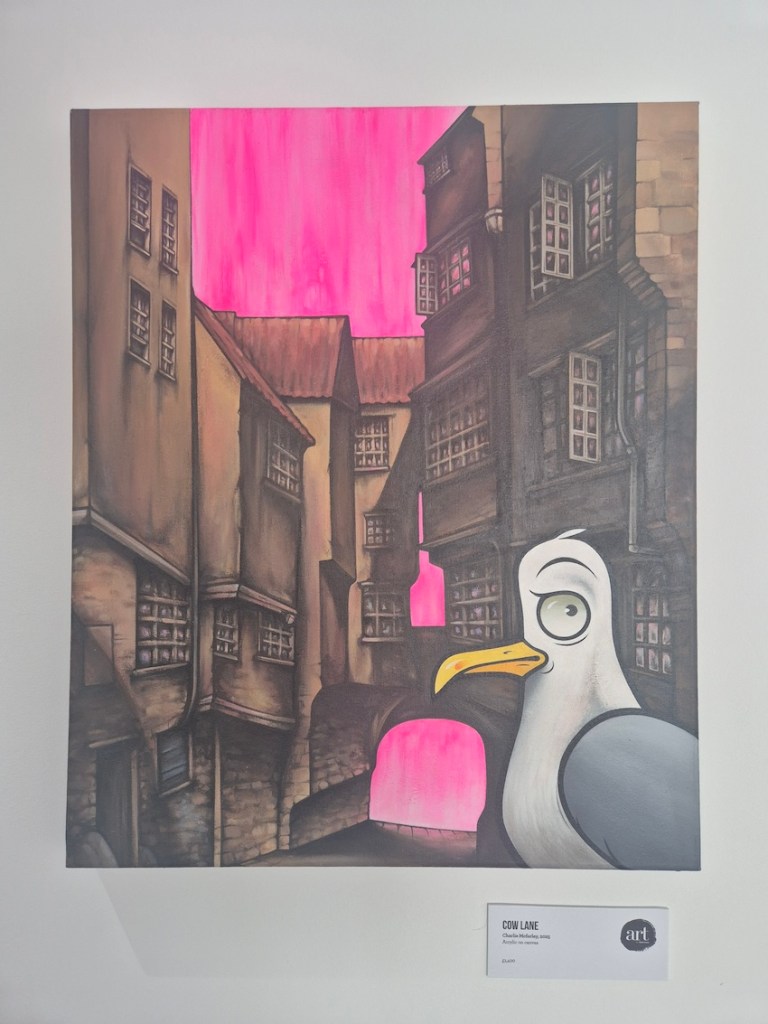
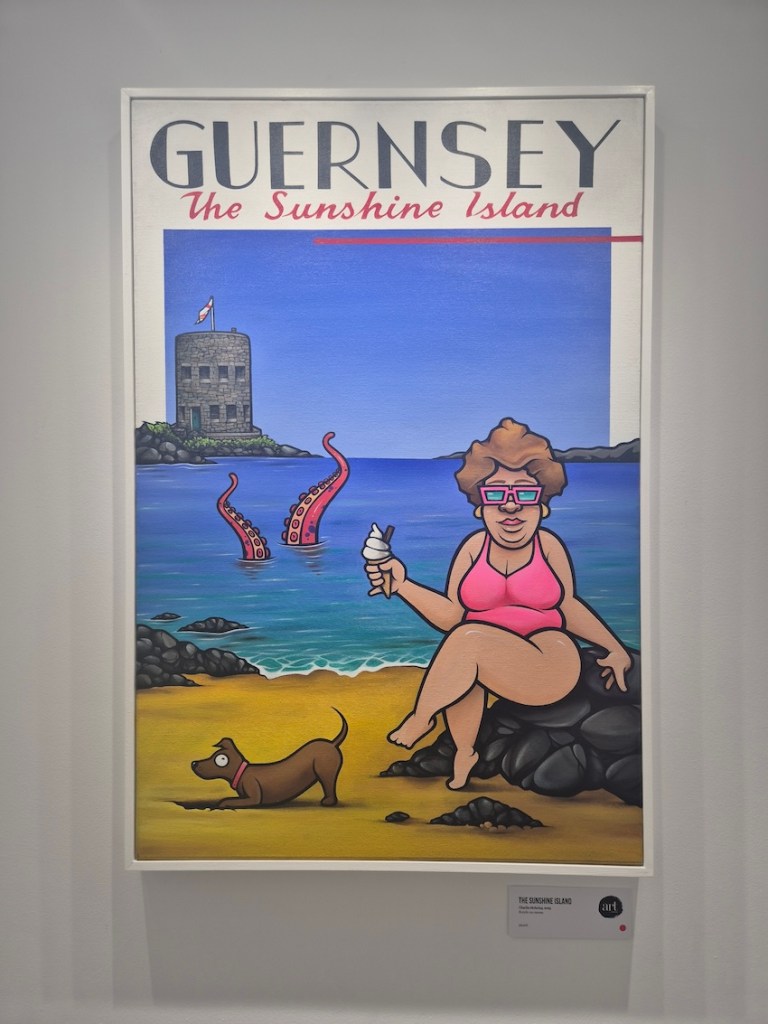
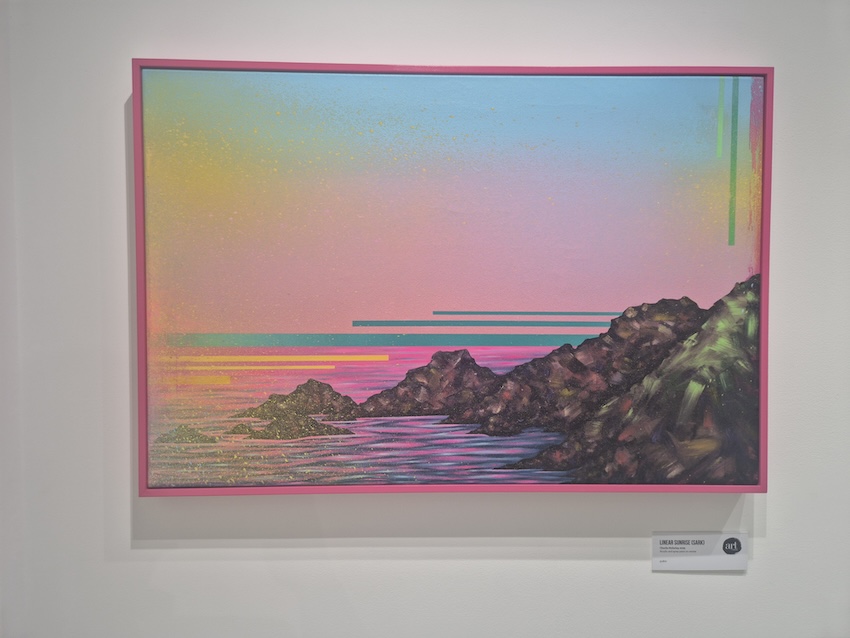
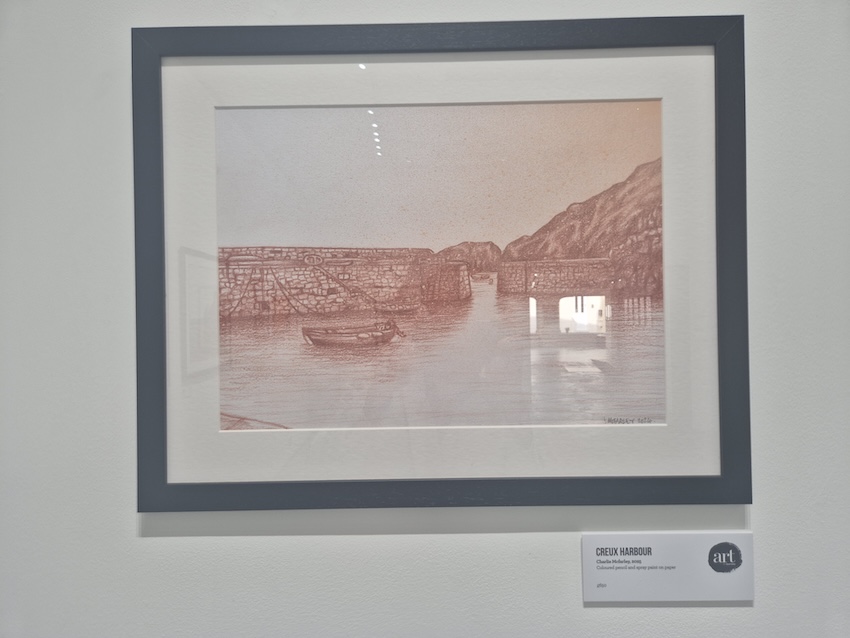
Charlie Mcfarley grew up in 1980s London, which provided a perfect place to develop his passion for graffiti, which blossomed into a deeper involvement with the music and street cultures that defined the era, influencing his work and creative evolution.
“I like to use spray paint on a large scale, I like to paint walls out in public spaces. That’s what I do. I like to keep it clean. There’s a thing with graffiti where people judge how clean your line work is, because it’s notoriously very difficult to get a clean line using the spray can. So if you’re doing it for 25 plus years, that becomes really important with painting walls.”
His residency didn’t see him creating 15ft murals or sizeable seagulls, instead it focussed on other mediums away from street art.
“It’s a painting of the stained glass window at Town church, and it’s very graphic. The stained glass window just spoke to me straight away, because it looks like something I would paint with a spray can on the wall. I managed to get the kind of colors looking like they’re luminescent, and the blends with what they’ve had on the glass, where they’re sort of using stuff to stain the glass, I can get with paint. That’s kind of what I go for with my painting.”
“They’ve got some gold. It’s actually paint which people use to gild frames and sort of apply it with your finger. So they’ve got a bit of gold in there, just to give it the religious edge.”
His residency also saw him find an attraction to Guernsey’s Church Square, and the architecture that surrounds it. An influence which seems to be staying with him, even after his time in Guernsey;
“I kept finding myself on the bench by the Albion pub right there. That was my sort of spot when I was getting tired and I was walking back from somewhere, I’d sit on that bench, and it was a good place to sketch from, yeah, and the town church kind of was like a big spaceship in the middle of town. And I thought it deserved a drawing, which I spent ages on, because it’s made in Biro. So, yeah, lots of little lines making and lots of dark.”
“I think with all of the work I produced for this show, this picture in particular, sort of amalgamated my two styles. I suddenly became happy with using a sketchy style, and it’s not as neat as I usually go, and it’s got spray paint overlaid on top of it, which is a very messy process. You can ruin your picture in one spray, but I’m happy with the results of this one, and it’s sort of something I’m going to follow up in the future and produce more work which looks like this.”


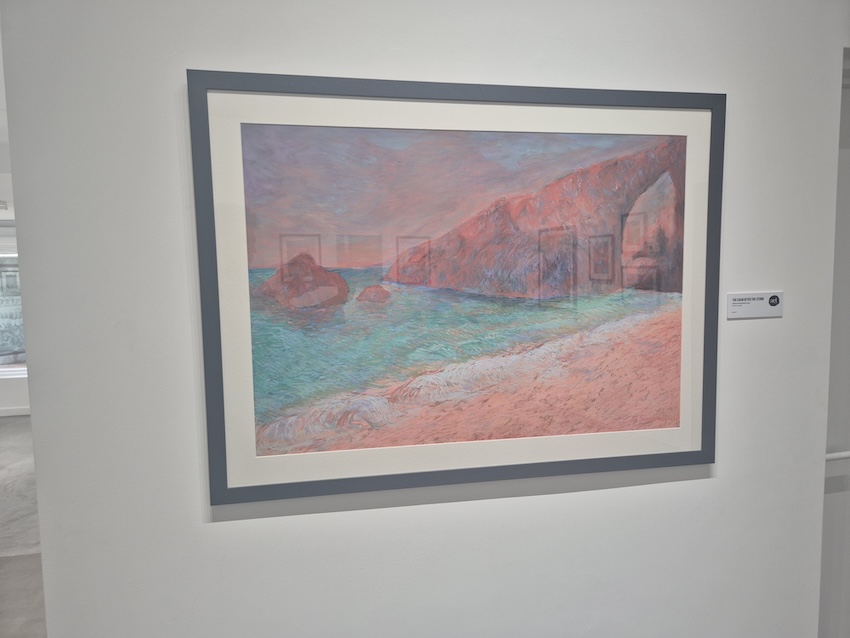
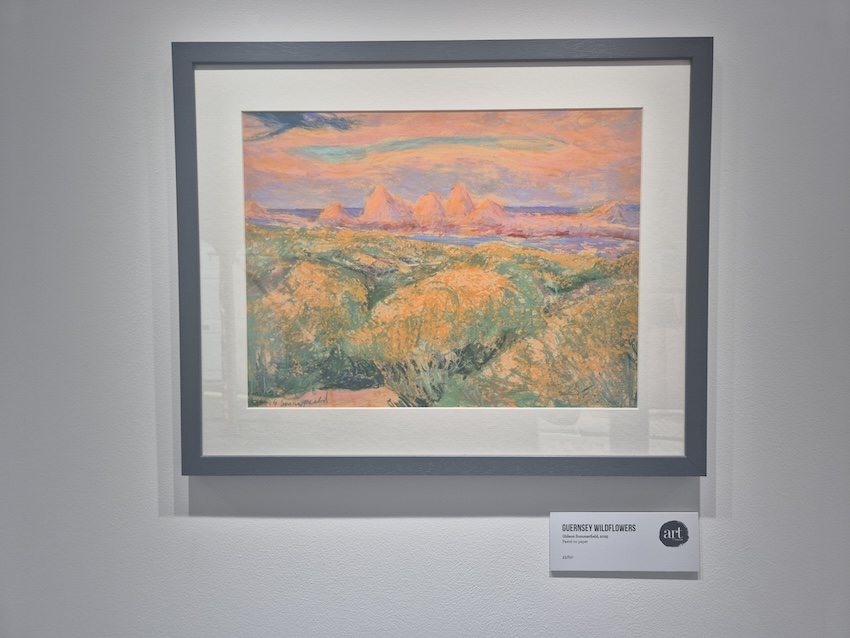
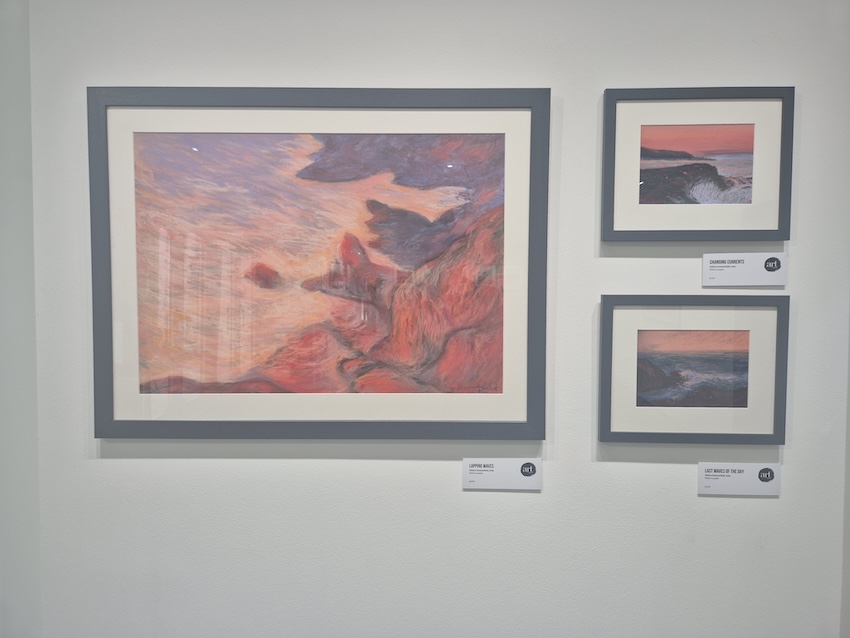
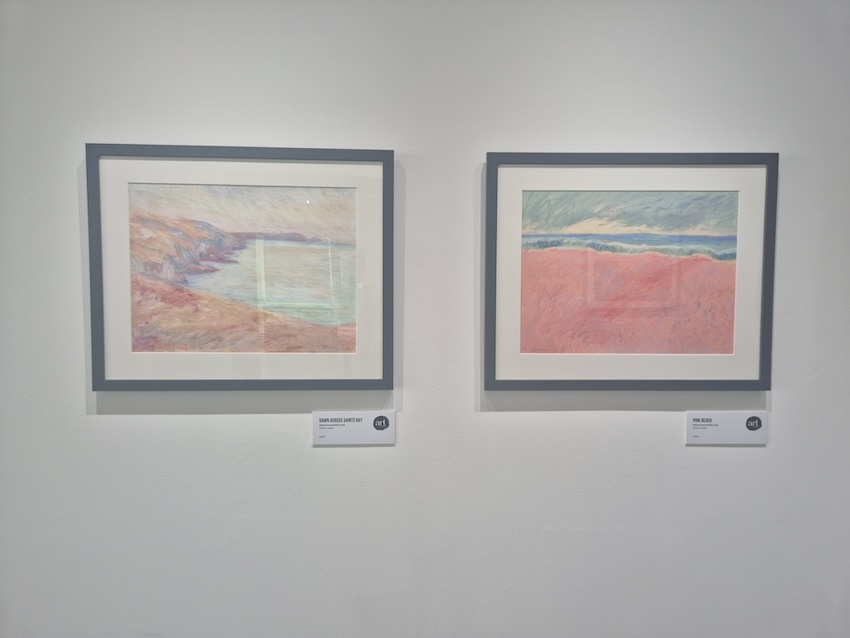
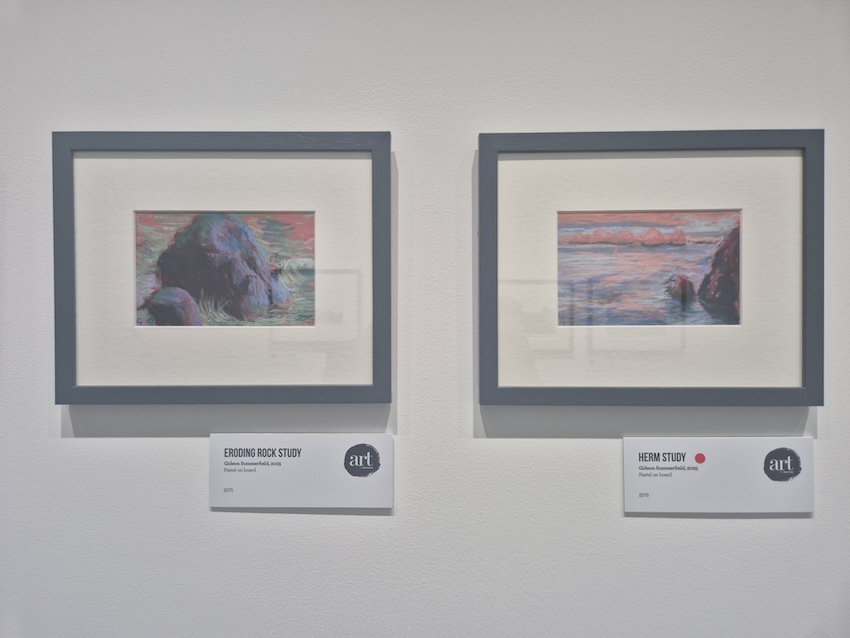
Bath-based artist Gideon Summerfield has a passion for capturing human stories, and despite being a UK based and born artist, he has a link to the island through his family, and stories passed down about the island.
“I was lucky enough to spend two weeks here, and it’s a very special place for me because my father and my grandmother both spent time here all throughout their lives. This was the first experience that I have had in the place which meant a lot for them and and to respond to it in a very sort of pure and natural sense of seeing something so majestic for the first time and recording it through art and through colour, and focusing on things which perhaps Turner did as well. Predominantly the light, time of day, drama, atmosphere, everything! I have felt very inspired by Turner and also the landscape.”
“I can certainly see why he visited and why he recorded things that he did and drew out the things which captured him the most, which he wanted to elevate further into the drama and the atmosphere. Because, you know, even throughout the days I was here, there was beautiful sunshine, there were storms, rain, you name it. So to be able to then record that was a fantastic experience.”
Mr Summerfield was personally chosen by HM King Charles III to capture the Royal Coronation in May 2023, and he subsequently produced a part of the Royal Collection;
“It was an enormous pleasure to be personally commissioned by Majesty, the King, to paint his coronation. A couple of years ago now. I ended up doing a two meter by three meter painting for him, which captures the real essence of a coronation, from the carriages, the horses to the crowd, to the soldiers, you name it.
“So to be able to be literally 10 meters away from where it was happening was the most…what an experience it was! I think I’m still sort of digesting it now, even a couple years on!
“There’s things to come, future exhibitions, big shows, perhaps in New York and in Europe as well as in London. I’m working with a series of portraits as well, related to World War Two veterans, and continuing my portraits of Holocaust survivors. Who knows, there are a few other secret projects and residencies up and coming, but early days, I think, to say right now that actually.”

You can find out more about exhibition and the work that Art for Guernsey undertakes on their website HERE.
