

The politician in charge of the States’ finances has described the 1% annual savings target as “silly” and said nobody in Policy & Resources (P&R) supported it – despite months of the public and deputies being told the opposite.
Deputy Charles Parkinson, P&R’s Treasury Lead, made the extraordinary assertion in a BBC radio interview on Monday, suggesting the committee had been forced to prepare Option A, the cheaper budget based on 1% savings, against its will.
He said: “Option A was not our budget; it was the budget we were told to produce [by the States], but we didn’t like it.”
He later doubled down on the claim, insisting to Express “P&R’s budget was Option B”, despite months of P&R using the 1% efficiency savings as a central pillar of its GST sales pitch.

‘Baked in savings’
Deputy Lindsay de Sausmarez, Chief Minister, told Express in June that the savings were “baked in” to the tax reform package.
They included £6.66m a year until 2029, and then £20m a year after that.
She said P&R felt “very strongly” that the savings “should be about genuine efficiencies, not expenditure reductions which are going to impact frontline services”.
We’re spending £10m less than we otherwise would have been.
Deputy Lindsay de Sausmarez, P&R President
Deputy Parkinson himself co-signed the tax policy letter, which committed P&R to delivering “1% per annum in efficiencies in public sector expenditure”.
Yet he told us this week: “None of the members of P&R thought the 1% per annum approach was the way to go about making the savings.”

What did Deputy Parkinson actually say?
Asked on the radio whether he stood by the dual budget approach, he said: “Well, we had to do it because we were under instructions from the States to produce a budget which showed 1% cuts.
“So Option A was not our budget; it was the budget we were told to produce, but we didn’t like it.
“Option B was far more sensible […] hopefully the States have learned their lesson and won’t be telling us to do something silly.”
On the record: How P&R built its tax case on 1% savings
Deputy Parkinson’s assertion that nobody in P&R supported the 1% annual savings approach sits uneasily alongside the committee’s own policy documents, public statements and contributions to States debates.
The following record shows how prominently the savings featured in P&R’s tax reform case, and how the committee’s position evolved.
1. In the official tax reform policy letter (June 2026)
In June, all five members of P&R, including Deputy Parkinson, agreed to the Tax Reform 2026 Policy Letter.
The letter opened with a stark warning about Guernsey’s finances, telling islanders that the General Revenue Reserve was on course to run dry by 2031 unless action was taken.
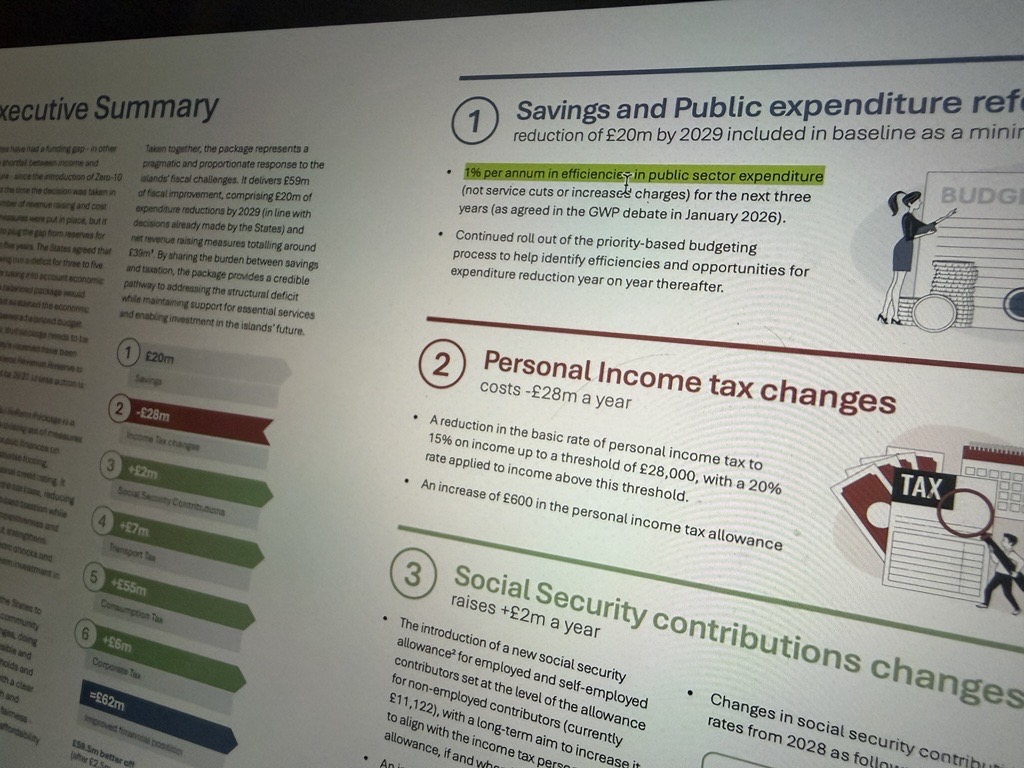
P&R presented its £59m tax reform package as a way to address the structural deficit, combining increased taxation with £20m in expenditure reductions.
It described the £20m savings by 2029 as a central pillar of the £59m package:
“It delivers £59m of fiscal improvement, comprising £20m of expenditure reductions by 2029 (in line with decisions already made by the States) and net revenue raising measures totalling around £39m. By sharing the burden between savings and taxation, the package provides a credible pathway to addressing the structural deficit…”
Section 1.4 explicitly committed P&R to annual efficiency savings:
“Savings and public expenditure reform (reduction of £20m by 2029 included in baseline as a minimum): 1% per annum in efficiencies in public sector expenditure (not service cuts or increased charges) for the next three years (as agreed in the GWP debate in January 2026).”
P&R also made clear that controlling spending was essential to securing public acceptance of higher taxes. Section 5.2 stated:
“For the community to accept that it needs to pay more, the States must also demonstrate that they are doing everything possible to manage expenditure, reduce waste and inefficiency and reduce or remove non-essential services.”
It went on to describe the 1% real-terms annual reduction as a States commitment, equivalent to £20m in annual expenditure reductions by 2029.
The savings were also built directly into the financial modelling used to support the tax reform proposals and demonstrate how the structural deficit would be addressed. In Appendix 10, Assumption 15 stated:
“The agreed 1% savings target is reflected (£6.8m in 2027, increasing to £13.5m in 2028 and £20.1m from 2029).”
2. To the public and media (summer and autumn 2026)
In a June interview with Express, Deputy de Sausmarez said the £20m savings had already been factored into the tax reform package:
“So this is actually something the States has already agreed to, so we’ve factored it into the baseline. We are anticipating – we are baking in – about £20 million of savings from 2029.”
She added:
“We’re spending £20 million less than we otherwise would have been… It’s £20 million delivered over three years, for a start, and then annually recurring.”
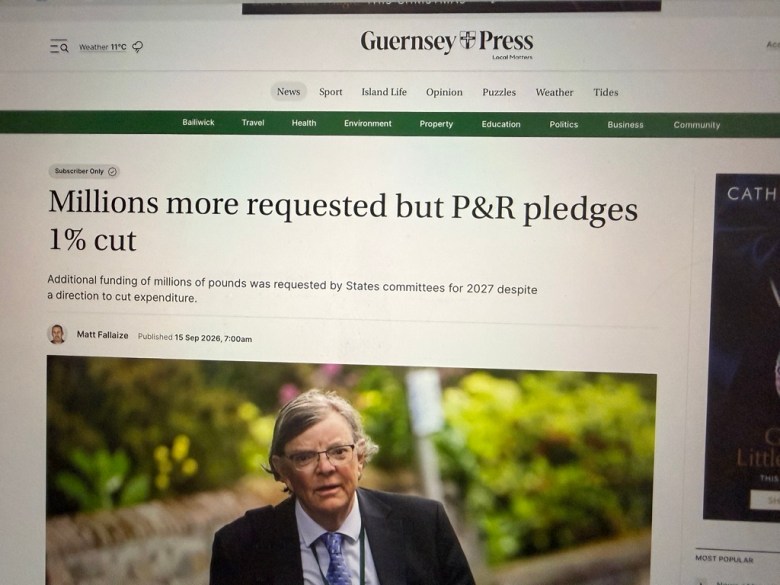
On 15 September, as committee spending bids began to emerge, the Guernsey Press published a report by former deputy Matt Falaize headlined ‘Millions more requested but P&R pledges 1% cut’.
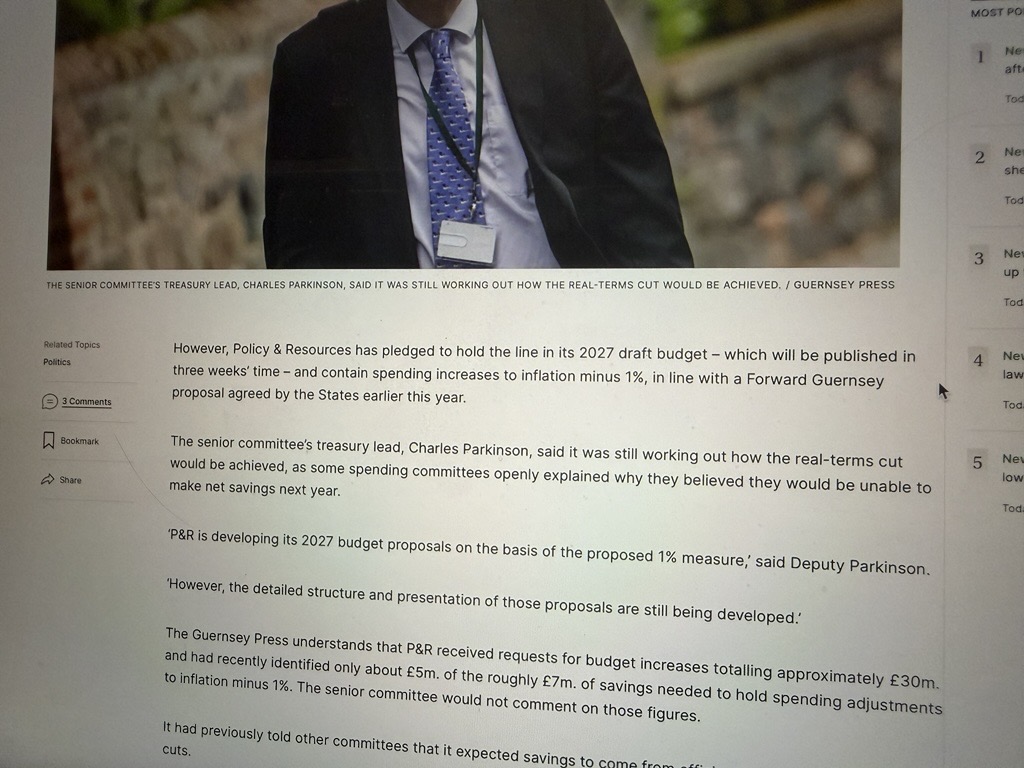
Deputy Parkinson was quoted as saying the committee was still working out how the real-terms cut would be achieved.
Deputy Andrew Niles also made the case publicly, arguing in an opinion piece that Guernsey could not rely on economic growth or one-off windfalls to fix its long-term finances.
He set out a three-pillar approach based on controlling public expenditure, securing contributions from corporates and windfalls, and introducing consumption taxes.

That placed Deputy Niles firmly among the public advocates of the wider package, which presented tax increases and spending restraint as complementary parts of the same financial plan.
3. In Scrutiny and the States chamber (July and October 2026)
During the July Tax Reform debate, Deputy de Sausmarez assured the Assembly that efficiency savings were non-negotiable:
“Government efficiency… is non-negotiable. It has to happen and it is happening… and this Assembly has committed to finding recurring savings over the next few years.”
Deputy Niles also defended the financial architecture of the package during scrutiny, arguing that GST was necessary to create a sustainable tax base and address the island’s structural deficit.
Appearing alongside Deputies de Sausmarez and Parkinson, he told the Scrutiny Management Committee:
“The central premise is that our tax system at the moment is far too predicated on income. For us to have a sustainable ongoing tax base, we need to be more broadly based in our tax… undoubtedly introducing a Goods and Services Tax […] enables us to move forward in a far more sustainable way than we have at the moment.”
He also addressed the implications for the States’ reserves, saying: “I am not suggesting at all that the purpose of this package is to replenish the reserves because it is clearly not going to do that, but it addresses the issue with the reserves of them decreasing.”
During the July debate, Deputy Niles voted against amendments seeking to block or remove GST from the package, including proposals to block its introduction and drop associated tax reforms.
When the debate resumed in October, Deputy de Sausmarez defended P&R’s financial projections by confirming that the anticipated £47m funding gap assumed the 1% reduction would be supported:
“We are still anticipating a funding gap in the region of about £47 million for next year, and that is assuming that the Assembly supports the 1% reduction.”
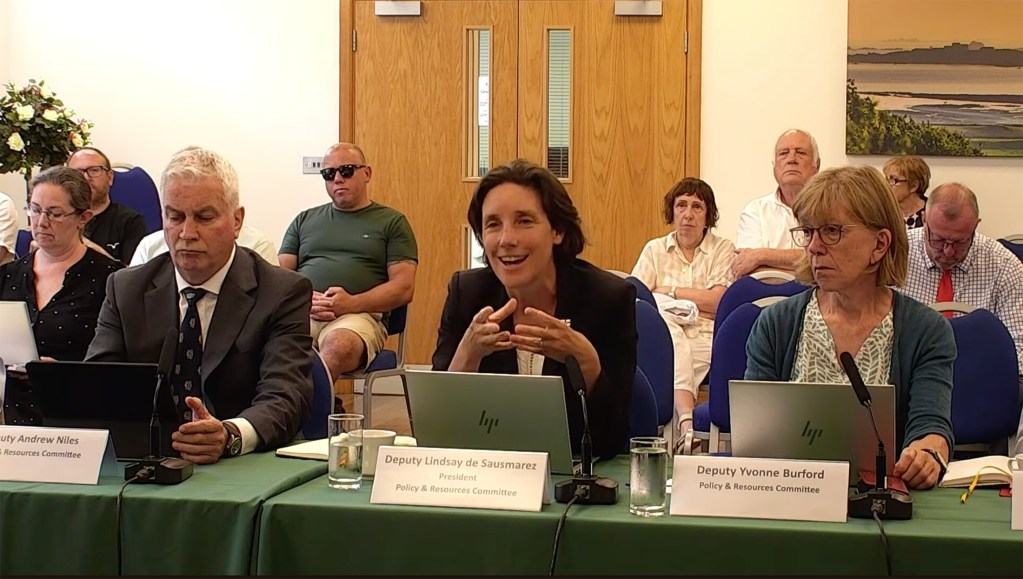
Deputy Yvonne Burford also presented P&R as determined to find efficiencies, telling the Assembly during the October tax debate: “My manifesto commitment was that making efficiencies and savings in our public sector should be a continual process… P&R is ruthless in its efforts to cut unnecessary process and glue from government systems.”
Deputy Steve Falla also linked the case for tax reform to better financial discipline.
During the October debate, he described the package as offering “a better future”, built on a firmer foundation of “better governance, better cloth-cutting, stronger accountability”.
However, Deputy Parkinson had already expressed his personal opposition to the mechanism. On 1 October, he told the Assembly:
“I opposed the 1% cut amendment because I did not think it could be delivered… If you really want to make cost reductions in the cost of Government, you have to reduce the scope of what Government does.”
That raises a question about how his opposition was reconciled with P&R’s published policy and the financial assumptions being presented by the committee.
The distinction is important: while Deputy Parkinson had publicly opposed the 1% mechanism, other members of P&R continued to defend the wider tax reform package and its financial rationale.
4. The reversal in the 2027 budget (November 2026)
When the 2027 budget arrived, P&R backed Option B, which allowed committees an additional £15.7m in expenditure compared with Option A, which was based on the 1% real-terms reduction.
Opening the debate on 3 November, Deputy Parkinson made his preference clear:
“One option would result in a real terms reduction of 1% in spending. The other would increase public spending by 1.3% in real terms… I’m going to vote for Option B.”
Closing the debate on 6 November, he confirmed that all his P&R colleagues would join him:
“Members will know that I support Option B… I don’t think [Option A] would be the right thing to do because I don’t think that would allow us to get to the efficiencies we need to make in an orderly structured way. So, personally, I say I’m going to vote for Option B. My colleagues in P&R will also vote for Option B…”
The committee also recommended changing the States’ existing savings mandate, Resolution 10, to allow the £20m target to be achieved after 2029 if necessary.
The revised wording means the savings must be made either by 2029, “or as soon as possible thereafter”.
Deputy Burford subsequently described Option B as “our normal budget process”, adding that it was the approach the States would have taken “in the absence of the 1% resolution”.

Deputy Falla also urged members who wanted additional Health and Social Care funding not to amend Option A to accommodate it, but to back Option B instead.
“Rather than tinkering with Option A so it emulates Option B,” he said, “if members agree that the HSC committee should be given this funding, they should vote for Proposition 17, aka Option B.”
During the same debate, Deputy de Sausmarez urged members seeking to protect services under Option A to back Option B instead:
“The reason we don’t support this amendment is because it erodes and undermines the very principle of proposition of Option A… which is of course a 1% reduction… If members are minded to support that to invest more in our maintenance then the straightforward answer is to support Proposition 17 [Option B] and for that reason I ask members not to support this particular amendment.”
Ultimately, all five members of P&R voted for Option B and the higher spending limit.
What did we ask – and was it answered?
We put four questions to Deputy Parkinson about P&R’s decision to approve Option B in the 2027 budget, its £20m savings commitment and the financial modelling underpinning tax reform.
Here’s what he said – and what he didn’t.
Note: Click on the summary of the question to see the full question we asked.
Why did you say Option A was not P&R’s budget?
We asked why Deputy Parkinson had described Option A as imposed on P&R by the States, despite having co-signed the Tax Reform Policy Letter incorporating the 1% savings target and P&R subsequently describing Option A as its “core budget proposal”.
We also asked whether he accepted that his comments in the radio were misleading.
FULL QUESTION:
On 8 June 2026, you co-signed the Tax Reform 2026 Policy Letter, which explicitly incorporated the 1% savings target as Pillar 1 of P&R’s strategy.
It stated:
“It delivers £59m of fiscal improvement, comprising £20m of expenditure reductions by 2029 (in line with decisions already made by the States) and net revenue raising measures totalling around £39m. By sharing the burden between savings and taxation, the package provides a credible pathway to addressing the structural deficit.”
Under the section on savings and public expenditure reform, P&R also committed to:
“1% per annum in efficiencies in public sector expenditure (not service cuts or increased charges) for the next three years (as agreed in the GWP debate in January 2026).”
The 2027 Budget Report itself is even more explicit. Paragraph 6.7 describes Option A as P&R’s “core budget proposal”, stating:
“Accordingly, the Policy & Resources Committee has prepared its core budget proposal (Option A) on the basis of the extant Resolution, including delivery of the 1% savings target.”
You were also reported in the Guernsey Press on 15 September, in your capacity as Treasury Lead, as saying P&R was still working out how the real-terms 1% cut would be achieved.
Given that you co-signed the policy letter incorporating the savings, and P&R subsequently described Option A as its own core budget proposal, why did you tell BBC Radio Guernsey that it “was not our budget” and suggest it was simply something imposed on P&R by the States?
Do you accept that this characterisation was misleading, given what P&R’s own published documents actually say?
He said: “Option A was prepared in response to the Humphries/Rylatt amendment, which I voted against. P&R’s budget was Option B.”
🟠 Partly answered: Deputy Parkinson said Option A was prepared in response to the Humphries/Rylatt amendment, which he opposed, while claiming Option B was “P&R’s budget”.
However, he did not explain why P&R’s own Budget Report described Option A as its “core budget proposal”, or address whether his comments to the BBC were misleading.
Why were we told the £20m savings were supposedly “baked in”?
We asked whether P&R was presenting £20m of savings as already factored into its financial projections while its Treasury Lead considered the 1% annual savings mechanism undeliverable.
We also asked how any disagreement within P&R was handled, and whether the Assembly and public should have been told about his concerns before those savings were used to support the financial case for tax reform.
FULL QUESTION:
Ahead of the Tax Reform debate, your P&R President, Deputy Lindsay de Sausmarez, was asked about the savings by Bailiwick Express. She told us:
“So this is actually something the States has already agreed to, so we’ve factored it into the baseline. We are anticipating – we are baking in – about £20 million of savings from 2029 […] We’re spending £20 million less than we otherwise would have been.”
During the October debate, she also confirmed that P&R’s projected £47m funding gap assumed the 1% savings target would be supported.
Yet on 1 October, you told the Assembly:
“I opposed the 1% cut amendment because I did not think it could be delivered […] If you really want to make cost reductions in the cost of Government, you have to reduce the scope of what Government does.”
Given that you were P&R’s Treasury Lead, was the committee presenting £20m in savings to the public as already “baked in” to support its case for tax reform, while you considered the mechanism for delivering those savings undeliverable?
How was that disagreement handled within P&R? And do you think the Assembly and public should have been made aware of it before those savings were used to support the financial case for tax reform?
He said: “We still intend to deliver £20m of savings from baseline budgets by 2029, but in an orderly, structured way, not by ‘salami slicing’ 1% per annum.”
❌ Not answered: Deputy Parkinson said some words in response to our question, but none of them appeared to answer any of them.
He did not address whether he believed the 1% annual savings approach was undeliverable while P&R was presenting the £20m savings as already factored into its financial projections.
He also did not explain how any disagreement within P&R was handled, or whether the Assembly and public should have been made aware of it.
What has changed?
We asked whether P&R’s decision to soften the 2029 deadline reflected an acknowledgement that the original £20m savings commitment was unrealistic.
We also asked whether P&R still stood by the commitment made in its Tax Reform Policy Letter, or whether its position had changed.
FULL QUESTION:
P&R has now recommended softening the 2029 deadline for delivering the savings, changing Resolution 10 of Billet d’État No II, 2026, to include the qualification:
“by 2029 (or as soon as possible thereafter, recognising that savings need to be sustainable and deliverable without undermining agreed service outcomes)”.
Does this reflect a recognition that the original £20m commitment was unrealistic?
More broadly, given your comments this morning, does P&R still stand by the £20m savings commitment it made in the Tax Reform Policy Letter, or has that position now changed?
He said: “As noted above, we still intend to achieve the £20m reduction in baseline budgets by 2029, or, if not, shortly thereafter.
“None of the members of P&R thought the 1% per annum approach was the way to go about making the savings.”
🟠 Partly answered: Deputy Parkinson said P&R still intends to deliver £20m in savings, but through an “orderly, structured” approach rather than 1% annual cuts. He also said none of P&R’s members supported the 1% approach.
However, he did not explain what the alternative approach involves, or when the savings will be delivered if the 2029 deadline is missed.
Does the financial modelling still stand up?
We asked why the 1% savings target was included in the financial modelling underpinning P&R’s tax reform proposals if Deputy Parkinson considered the approach “silly”.
We also asked whether the projected funding gap and wider financial case for tax reform remained valid if the £20m savings on which they relied could not be delivered as originally envisaged.
FULL QUESTION:
This morning, you described the 1% savings target as something the States should not have been telling P&R to do, and suggested it was “something silly”.
If you considered the target silly, why was it included in the financial modelling underpinning P&R’s tax reform proposals in the first place?
P&R’s projected funding gap relied on those savings being delivered. Does your position now mean that the modelling, and the financial case for tax reform built around it, is no longer valid? If not, how can P&R be confident that the figures still stand up?
He said: “The financial modelling still stands up. We intend to get to the £20m savings target in a more sensible way.”
🟠 Partly answered: Deputy Parkinson insisted the financial modelling remains valid, saying P&R intends to achieve the £20m savings target in a “more sensible way”.
However, he did not explain how the modelling remains valid if the original mechanism and potentially the timeframe for delivering those savings have changed.
