

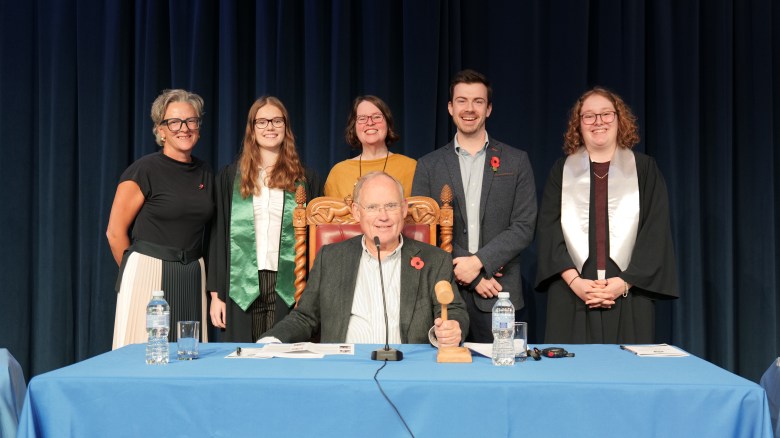
Young people have told the States of Guernsey that artificial intelligence (AI) should not be its number one priority, arguing that the island has more pressing challenges to address.
The message came from students at The Ladies’ College’s fifth annual Big Debate, where Lower Sixth student Amelia joined Deputy Sally Rochester in opposing the motion that AI should be the States’ top priority.
They faced Upper Sixth student Charley and PwC Director Callum McCutcheon, who argued that AI could help tackle economic and social pressures, improve public services and prepare the island for the future.
The audience ultimately backed the opposition, with 44 voting against the motion and 38 in favour. That was a narrower margin than the initial vote, when 54 were against and 31 supported it.
The debate was chaired by Sir Richard Collas, retired Bailiff of Guernsey and former Governor of the college, and formed part of the AI Sprint event series.
Risks
Amelia raised concerns about the financial and ethical risks of introducing AI into government decision-making, including potential bias, errors and costly implementation failures.
She argued that existing laws, including data protection legislation, were sufficient for the time being and that specialist AI legislation should not take priority over the States’ other responsibilities.
Adding new legislation [for AI] risks complexity, duplication and cost.
Amelia, Lower Sixth student, The Ladies’ College
“Currently, the States of Guernsey interpret existing laws, such as the data protection laws, to govern AI use on the island. These have worked adequately thus far,” she said.
“With the limited resources of the States of Guernsey, specialised AI legislation should not be prioritised over the States’ other responsibilities to the community, as adding new legislation risks complexity, duplication and cost.”

Outcomes over tools
Deputy Rochester argued that government should prioritise outcomes rather than tools, and enable technological innovation rather than lead it.
She said Guernsey had more immediate challenges, including housing, public finances and demographic change.
Artificial intelligence is undeniably powerful, but… a tool should never become more important than the outcome that it delivers.
Deputy Sally Rochester
“Artificial intelligence is undeniably powerful, but it does remain a tool, and a tool should never become more important than the outcome that it delivers,” she said.
She recognised AI’s potential to improve public services, but argued that the States should create the conditions for responsible adoption, working alongside businesses and the wider community without diverting attention from existing priorities.
Size can be strength
On the proposition side, Mr McCutcheon argued that prioritising AI was not about identifying Guernsey’s biggest challenge, but finding an effective first step towards tackling wider economic and social pressures.
He said AI could support economic growth, improve public services and prepare future generations for a changing workplace, particularly in a small island with limited resources and a shortage of specialist skills.
When we’re slow, our size is our weakness, but when we’re quick, it is our greatest strength.
Callum McCutcheon, PwC director
“Small places like Guernsey don’t get to wait and see,” he said. “When we’re slow, our size is our weakness, but when we’re quick, it is our greatest strength.”
Charley argued that AI could make government departments more efficient, citing planning applications and tax returns as examples where it could reduce administrative backlogs.
She also said the States had a responsibility to protect young people through education, legislation and greater awareness of the risks.
“Burying our heads in the sand and hoping for the best does not mitigate these risks but instead makes our community more vulnerable,” she said.
Burying our heads in the sand… makes our community more vulnerable
Charley, Upper Sixth student, The Ladies’ College
“Love it or loathe it, AI is ever evolving, and with the proper implementation, has the potential to streamline government services to increase efficiency.”
Principal Daniele Harford-Fox praised the students for holding their own alongside the experienced speakers, and for their ability to research, articulate arguments and respond to challenges.
She said the debate was particularly important at a time when people were “replacing their written voice with the generic tone of AI”.
She added: “It was amazing to see Amelia and Charley hold their own on the night alongside experienced voices, demonstrating their ability to research and articulate complex arguments, but also to listen, challenge and respond thoughtfully.”
The college said the views expressed during the debate were adopted for discussion and should not be taken to represent the speakers’ personal opinions.
