

A senior Guernsey politician has suggested that Jersey should learn lessons about its income tax and social security structure following a contentious debate in the neighbouring Bailiwick over the introduction of GST.
Deputy Mark Helyar, President of Guernsey’s Trading and Supervisory Board and former treasury lead for the Policy and Resources Committee, said that mitigations included as part of the move to bring in GST were conspicuous by their absence in Jersey.
What’s happened in Guernsey?
After years of political division and several mass protests, plans for GST were brought back onto the political agenda following the election in summer 2025.
Although a decision was delayed in mid-July this year because parliamentary time ran out, Guernsey’s GST debate resumed last week, and after six days’ of debate the tax was passed on 2 October after a vote of 22-17, with one abstention.
The 3% tax will be introduced in 2029, with politicians also voting to increase the rate to 4% two years later and to 5% in 2033.
There was significant opposition to the move, including a 9,000-signature petition and public demonstrations, with some businesses barring the politicians who voted in favour, with an appeal to islanders to refrain from launching personal attacks.
What mitigations accompanied Guernsey’s GST decision?
Personal income tax allowance will be raised by £600, the basic rate of personal income tax will be cut to 15% on income up to £28,000 a year, and a new personal allowance – including a zero rate for the first 11,000 in earnings – will be applied to social security.
Those in employment earning £40,000 would be left better off by about £1,200 a year, whereas paying GST of £1,200 a year would require spending £40,000.
It has been estimated that the package, which also includes new motoring taxes, more revenue from company taxes and £20m of annual public spending reductions, will improve government finances by about £55m per year.
Flashbacks to Jersey’s “noughties” experience
In May 2005 the States Assembly agreed in principle to introduce a broad-based fiscal strategy featuring a 3% GST as part of a massive black hole in public finances caused by the restructuring of corporate tax laws.
The legal framework for the new tax was approved in April 2007 and GST was formally introduced in May 2008.
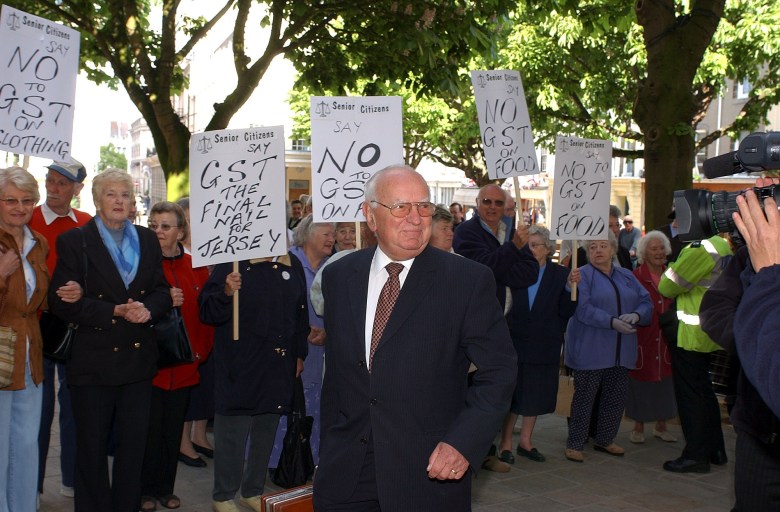
Several large-scale protest rallies were staged during the period, with further contention when the rate of GST in Jersey was increased to 5% in June 2011.
There were limited exceptions: accommodation, exports, financial services, medical services, charities and school fees (should the school be a registered charity) were exempt.
Other elements of Jersey’s income tax and social security framework were unchanged, although a new system of Income Support was introduced in January 2008.
Lessons for Jersey from recent debate “next-door”
Speaking after the crucial vote last week, Deputy Helyar said: “One of the things which was not mentioned was that I think Jersey is now going to have to move and amend its own approach to GST, because there are not any mitigations in place in Jersey.”

“I know from discussions with senior politicians in Jersey when we first formulated these ideas that they felt they were likely to gain quite a lot of momentum in Jersey because GST is a regressive tax in its standalone form.”
